
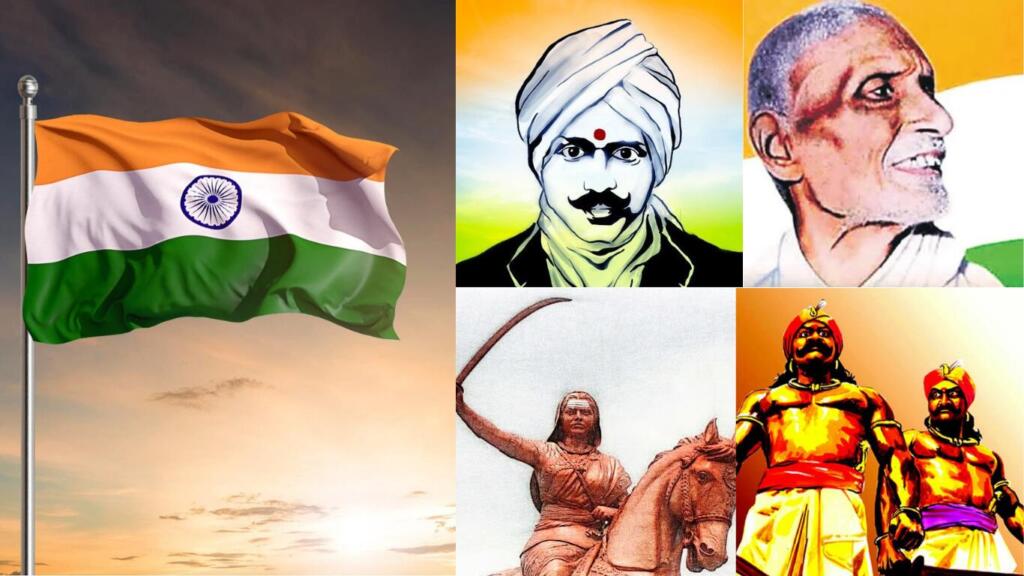
India’s independence was won through the sacrifices of countless men and women, many of whom remain unknown to the wider public. While national figures like Mahatma Gandhi, Jawaharlal Nehru, and Bhagat Singh dominate history books, the regional leaders who fought relentlessly in their own territories deserve equal respect.
In South India, several valiant individuals challenged British rule, sacrificing their comfort, careers, and lives for the nation’s freedom. Their contributions were vital to the larger movement and should be remembered with pride.
The Visionaries and Political Leaders
Pingali Venkayya
Best remembered as the designer of the Indian National Flag, Pingali Venkayya was a devoted follower of Mahatma Gandhi. An expert in geology and agriculture, and an educationist, Venkayya first created the flag for the Indian National Congress, which was later adapted as the national flag. His design became a powerful symbol of India’s unity and identity during the struggle for independence.
Tanguturi Prakasam
Popularly known as “Andhra Kesari” (The Lion of Andhra), Tanguturi Prakasam was a fearless politician and freedom fighter. Initially a successful lawyer, he gave up his practice to join the freedom movement. Prakasam is remembered for standing unarmed before British rifles during the 1928 Simon Commission protests in Madras. He later became the first Chief Minister of the Madras Presidency and of Andhra Pradesh, continuing his fight for people’s rights even after independence.
The Warriors Who Defied the British
Veerapandiya Kattabomman
Decades before the 1857 revolt, Veerapandiya Kattabomman, a Palayakarrar (Polygar) chieftain from Panchalankurichi, Tamil Nadu, resisted British demands for tribute. In 1799, after waging a spirited war against the British East India Company, he was captured and hanged. His bravery inspired later generations of freedom fighters in Tamil Nadu.
Puli Thevar
One of the earliest leaders to oppose British rule in South India, Puli Thevar resisted the Nawab of Arcot, who was backed by the British. From his base in Nelkatumseval, he fought a series of confrontations against British forces in the 1750s and 1760s, marking the start of organized resistance in the region.
Sangolli Rayanna
Born on 15 August 1798 in Karnataka, Sangolli Rayanna served as the army chief of the Kingdom of Kittur. Loyal to Rani Chennamma, he waged a guerrilla war against the British even after her capture. Betrayed and arrested, Rayanna was hanged from a banyan tree in 1831, becoming a symbol of Karnataka’s resistance.
Rulers Who Took Up Arms
The Maruthu Pandiyar Brothers
Periya Maruthu and Chinna Maruthu, rulers of Sivagangai in Tamil Nadu, were among the first to openly declare independence from British rule. On June 10, 1801, from the Tiruchirappalli Thiruvanaikoil Temple, they issued a proclamation urging all Indians to unite against the British—56 years before the Sepoy Mutiny of 1857. Their call was one of the earliest pan-Indian appeals for liberation.
Kittur Chennamma
In the 1820s, long before the Rani of Jhansi’s famous rebellion, Kittur Chennamma, queen of Kittur in Karnataka, led an armed uprising against the British over the doctrine of lapse. Despite fighting valiantly, she was captured and imprisoned, where she remained until her death. She is remembered as one of India’s first female warriors against colonial rule.
Voices of Freedom
Subramania Bharati
Known as “Mahakavi Bharathi,” Subramania Bharati was not just a poet but a revolutionary thinker. His fiery Tamil verses ignited nationalist passion, while his writings in journalism and prose challenged British authority and social inequalities. His works promoted women’s emancipation, unity, and self-reliance. Years of British harassment and imprisonment weakened his health, leading to his untimely death in 1920, but his words continue to inspire.
Remembering South India’s Bravehearts
The freedom struggle was not a monolithic movement centered in one region it was a nationwide effort with countless battles fought in villages, towns, and princely states across India. South India’s heroes, from flag designers to warrior-kings, from poets to guerrilla fighters, played a crucial role in resisting British domination. Their stories remind us that independence was the result of collective courage, not just the actions of a few well-known leaders. Honoring these unsung warriors is essential to keeping alive the full spirit of India’s fight for freedom.