
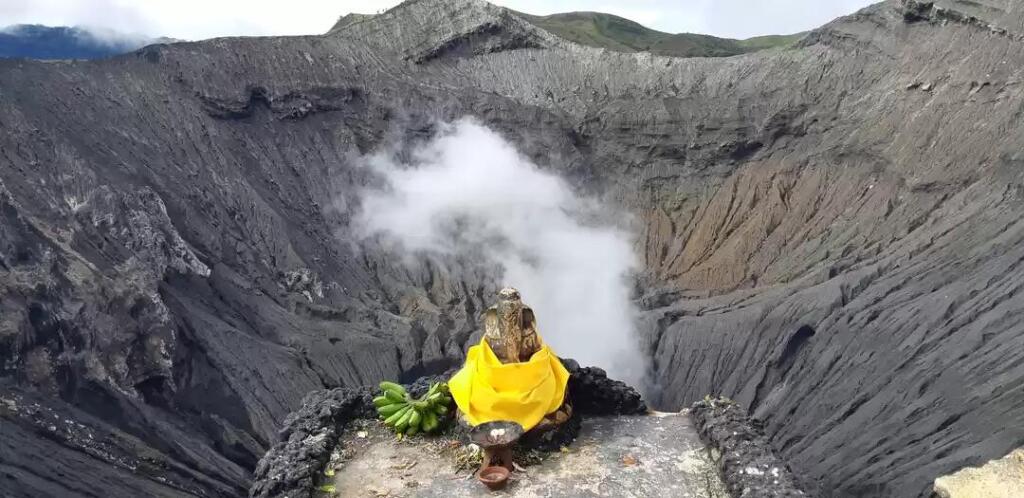
High on the rim of Mount Bromo, one of Indonesia’s most active volcanoes, stands a sacred idol of Lord Ganesha. Perched close to the mouth of the crater, this 700-year-old statue has been worshipped for centuries by the local Tengger tribe, who believe that the deity protects them from volcanic fury. Even today, offerings of goats, fruits, and flowers are made to Lord Ganesha in the belief that without his blessings, the volcano’s wrath could devastate their lives.
The question arises: How did a Hindu deity find his way to one of the world’s largest Muslim-majority nation, and why has his worship endured in Indonesia for centuries? The answer lies in a fascinating story of cultural exchange, ancient kingdoms, and the resilient blending of Hindu traditions with local beliefs.
The Spread of Hinduism to Indonesia: A Cultural Confluence
The roots of Ganesha’s presence in Indonesia trace back to the early centuries of the Common Era, when maritime trade between India and Southeast Asia flourished. By the 1st–5th centuries CE, Indian merchants, scholars, and priests had established strong cultural and commercial ties with Indonesian islands. Alongside goods like spices and textiles, they brought with them philosophical ideas, religious rituals, and Sanskrit texts.
-
Early Indianized kingdoms like Kutai, Tarumanagara, and later Srivijaya absorbed Hindu and Buddhist traditions.
-
The worship of major Hindu gods like Shiva, Vishnu, and Brahma soon became deeply integrated into Indonesian society.
In this wave of cultural exchange, Lord Ganesha, the remover of obstacles and god of wisdom, quickly gained popularity. His dual identity as both a Hindu and tantric deity made him adaptable to the diverse spiritual traditions flourishing in Southeast Asia.
Ganesha’s Rise During the Majapahit and Singhasari Empires
The true flourishing of Ganesha worship came during the Singhasari (1222–1292 CE) and Majapahit (1293–1527 CE) empires in Java. These kingdoms were remarkable for blending Hinduism and Buddhism into a syncretic belief system. Kings and scholars of this era revered Ganesha not only as a divine guide but also as a protector of political power and cultural wisdom.
-
The association of Ganesha with Shiva, who was central to Javanese Hinduism, reinforced his importance.
-
Kings invoked Ganesha’s blessings before battles, governance decisions, and religious ceremonies.
Unique tantric practices in Java also shaped Ganesha’s iconography. In certain 14th–15th-century depictions, Ganesha appears crowned with skulls, dancing among burial grounds, or seated on skull thrones. These artistic innovations reflect his integration into the tantric Shaivism that thrived in Java under King Kertanagara, who even performed secretive rituals like the Ganachakra.
Thus, Ganesha evolved from the Indian remover of obstacles into a uniquely Indonesian guardian deity, balancing wisdom, power, and spiritual mysticism.
Ganesha in Indonesian Temples and Art
The presence of Ganesha across Indonesian temples provides strong evidence of his wide worship. Unlike in medieval India, where Ganesha was often depicted in sculptural niches as a minor deity, in Indonesia he sometimes occupied central shrines.
-
Prambanan Temple (9th century): The largest Hindu temple complex in Java, dedicated to the Trimurti (Brahma, Vishnu, Shiva), includes a shrine to Ganesha within the Shiva temple.
-
Candi Panataran (Majapahit period): Features statues of Ganesha that highlight his role as the god of learning and prosperity.
-
Mount Bromo: The 700-year-old Ganesha statue placed at the volcano’s edge remains a rare and remarkable fusion of religion and nature, symbolizing divine guardianship over natural forces.
Indonesian depictions of Ganesha also carry local adaptations. He is sometimes shown in elaborate sarongs, adorned with Javanese jewelry, and seated in relaxed postures. This blending of Indian iconography with Javanese artistry reflects how Hindu traditions were indigenized within local culture.
Ganesha’s Role in Indonesian Society: Knowledge, Trade, and Protection
Beyond temple walls, Ganesha held a vital place in daily life during Indonesia’s Hindu-Buddhist era.
-
Patron of Learning and Statecraft
-
Inscriptions from the Tarumanagara Kingdom mention Ganesha in connection with learning, governance, and wisdom.
-
Royal courts invoked him as a divine guide to ensure justice and prosperity.
-
-
Protector of Traders and Sailors
-
As a seafaring nation, Indonesia relied heavily on maritime trade routes. Merchants and sailors sought Ganesha’s blessings for safe voyages and profitable exchanges.
-
Offerings to Ganesha were customary before embarking on long journeys across the seas.
-
-
Guardian Against Natural Forces
-
On Mount Bromo, the Tengger tribe has long worshipped Ganesha as the guardian against volcanic eruptions. Ritual sacrifices and offerings to his statue at the crater remain part of annual ceremonies, underscoring his role as a divine protector of communities.
-
Through these functions, Ganesha became deeply embedded in Indonesian spirituality not just as a Hindu god, but as a cultural protector tied to the land and its people.
Decline and Resurgence of Ganesha Worship in Modern Indonesia
With the arrival and spread of Islam from the 13th century onward, Hinduism and Buddhism gradually receded across much of the archipelago. By the 16th century, Islam dominated most islands, though Hindu traditions endured in Bali, where they remain vibrant even today.
-
In Bali: Ganesha continues to be worshipped in temples and homes, invoked for wisdom, prosperity, and protection. Rituals in his honor are common across the island’s Hindu population.
-
In National Life: Ganesha has transcended religious boundaries to become a symbol of knowledge and learning. Notably, Gadjah Mada University one of Indonesia’s most prestigious institutions uses Ganesha as its emblem, reflecting his association with wisdom.
In contemporary Indonesia, Ganesha’s image also appears in art, crafts, and modern design, blending traditional motifs with contemporary creativity. His enduring presence is visible not only in religion but also in cultural identity and tourism. Sites like Mount Bromo, Prambanan, and Bali’s temples attract global visitors, showcasing Indonesia’s Hindu-Buddhist heritage.
Ganesha as Indonesia’s Timeless Guardian
The story of Ganesha in Indonesia is a remarkable testament to cultural fusion, resilience, and continuity. From Indian traders introducing him in the early centuries CE, to his elevation during the Majapahit empire, to his unique role as a protector atop Mount Bromo, Ganesha’s journey reflects the adaptability of faith across geographies and centuries.
Despite Indonesia’s transformation into a Muslim-majority nation, Ganesha endures as both a religious deity and a cultural icon. His statue at Mount Bromo stands not only as a guardian against volcanic fury but also as a reminder of Indonesia’s layered history a history shaped by trade, religion, and the blending of civilizations.
A Bridge Between Past and Present
Today, Ganesha in Indonesia symbolizes more than wisdom or protection. He represents a living bridge between India and Southeast Asia, between ancient kingdoms and modern nations, and between faith and culture. His enduring presence reminds us of humanity’s universal quest for knowledge, resilience, and the strength to overcome obstacles.