
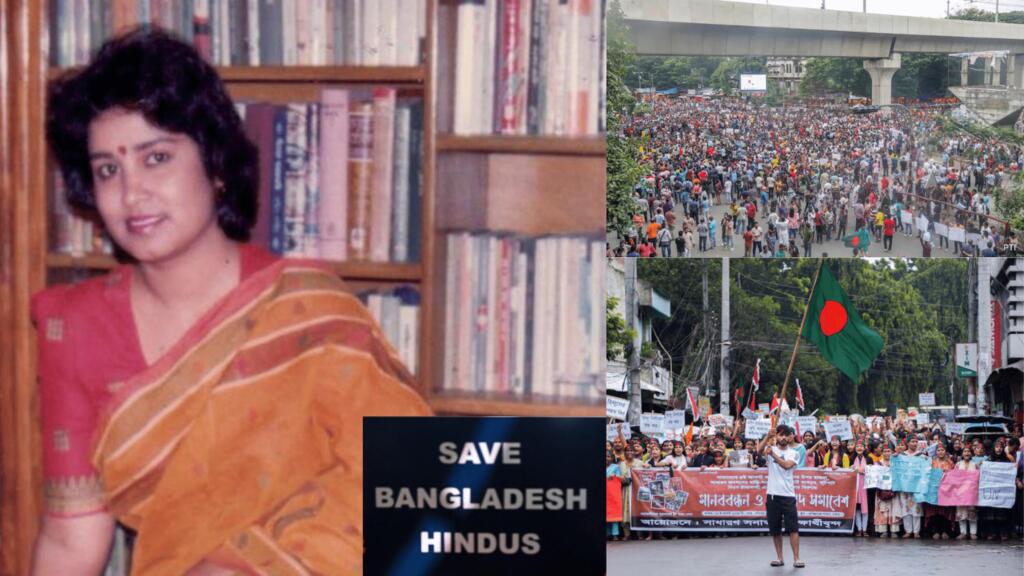
Exiled author Taslima Nasreen has taken to X (formerly Twitter) to expose the persecution of Hindus in Bangladesh, warning that the original Hindu inhabitants are now a minority in their own land. She decried the destruction of homes, looting of temples, forced arrests of Hindu leaders, and sexual violence against Hindu women under the Islamist‑leaning interim government of Muhammad Yunus. With over 2,400 hate incidents reported since August 2024—including rapes, killings, and arson—Nasreen called on international society to awaken and demanded secular, equal citizenship for all. Her plea paints a grim picture: a shrinking Hindu community driven into exile, craving justice.
Nasreen began by recalling that before the arrival of Islam, Hindus were the indigenous population of what is now Bangladesh. Over centuries, many lower-caste Hindus converted, and today Hindus make up just 8% of the population. Those remaining face persecution: forced displacement, threats, and violence simply for practicing their faith. Since the Partition of India, thousands have fled their ancestral homes for India or elsewhere, often penniless and traumatised.
One‑Sided Violence: Not Riots, But Targeted Persecution
Nasreen emphasised the distinction between two‑sided communal riots and systematic targeting of Hindus. She condemned the recurring one‑way violence that leaves temples burned, homes looted, and Hindu women raped. According to the Bangladesh Hindu Buddhist Christian Unity Council, between August 2024 and June 2025, there were 2,442 incidents of communal violence—including killings, sexual assaults, property destruction, and vandalism—with perpetrators often enjoying impunity.
Temple Attacks, Arrests, and Impunity
Nasreen highlighted over 470 temples destroyed and hundreds more looted or desecrated in recent decades. Since August 2024 alone, 152 attacks on Hindu temples have been reported along with 23 Hindu deaths in the parliamentary record from India’s Ministry of External Affairs. Hindu leader Chinmoy Krishna Das remains jailed on sedition charges, while mobs freely target Hindu homes and shops.
Nasreen accused the interim regime under Nobel laureate Muhammad Yunus of failing to protect minorities, and even being complicit in their suppression. She alleged that extremist groups like Jamaat‑e‑Islami and Hefazat‑e‑Islam effectively control the country, fueling anti‑Hindu violence and banning groups like ISKCON with calls for slaughter. Meanwhile, secular and liberal voices in India remain silent—criticising foreign atrocities while ignoring those committed right next door.
Nasreen’s Personal Plea and Literary Legacy
Reflecting on her own roots—as the descendant of Hindu converts with the surname Sarkar—Nasreen expressed deep sorrow over the loss of her homeland as a safe space for Hindus. She invoked her novels Lajja and Fera, which exposed violence, displacement, and the longing for home among persecuted Hindus. Though these works resonated with many, they remain largely unadapted—even in liberal Bengal—underscoring the reluctance to confront Hindu suffering.
Historical data reveals a steady decline of Hindu population in Bangladesh—from about 22% in 1951 to less than 9% by 2011. Major outbreaks, such as the 2021 Durga Puja violence that damaged over 50 temples and injured hundreds, especially among Hindus, illustrate the repeated targeting of the community in times of social tension.
Dreaming of Justice and Return
Nasreen ends her powerful thread with a vision: a Bangladesh where Hindus, atheists, and freethinkers live safely under secular democracy. She calls for repeal of the Enemy Property Act, equality through a uniform civil code, and global awareness of Hindu suffering. While the world looks away, she urges secular India and international institutions to counter hypocrisy—not to only voice solidarity with distant Gaza, but to stand for Hindus next door. Nasreen’s dream is simple yet transformative: that every Hindu persecuted in Bangladesh may return home, and that respect and justice replace fear and expulsion.