
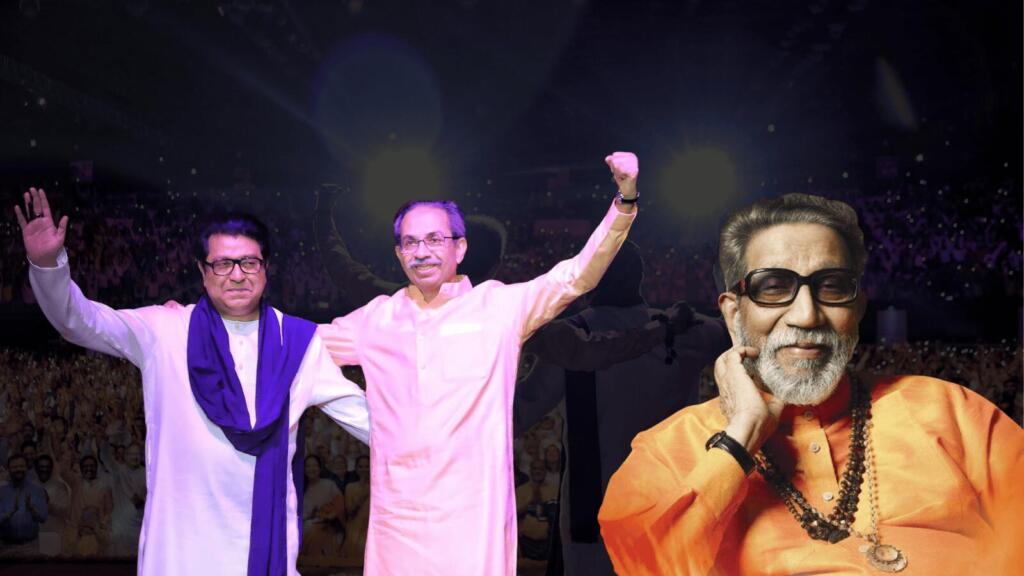
Mumbai’s political scene is witnessing a noteworthy development as the Thackeray cousins, Uddhav and Raj, have temporarily set aside their deep-rooted differences to form an alliance aimed at retaining control of the Brihanmumbai Municipal Corporation (BMC). This move reflects the high stakes involved in the upcoming civic elections and underscores their desperate bid to hold onto political relevance.
Raj and Uddhav were once seen as two sides of the same political coin. Their fathers, Bal and Shrikant Thackeray, were brothers, and their mothers were also sisters. Raj was a visible and vocal presence during Shiv Sena events in the 1990s, while Uddhav managed party affairs from the background.
In 2003, Bal Thackeray appointed Uddhav as the working president of Shiv Sena, a move that left Raj and his supporters feeling sidelined. Raj’s frustrations culminated in his resignation in 2005. “All I asked for was respect. All I got was insult,” he said.
Three months later, Raj founded the Maharashtra Navnirman Sena (MNS), positioning it as an aggressive pro-Marathi alternative to the Shiv Sena. Uddhav remained with Shiv Sena, eventually taking over the reins fully after Bal Thackeray’s death.
The BMC Budget: A Crucial Source of Political Clout and Financial Power
The BMC isn’t just any municipal body, it is India’s wealthiest civic organization, managing a yearly budget of nearly ₹60,000 crore. This massive pool of funds governs Mumbai’s infrastructure, healthcare, education, sanitation, and welfare initiatives.
For the Thackeray family, controlling the BMC means more than administrative authority; it translates into enormous political influence. The budget determines the allocation of contracts, development projects, job opportunities, and welfare schemes, directly impacting voters and consolidating grassroots support.
Losing the BMC would mean forfeiting access to this immense financial resource and the political leverage that comes with it — a serious blow to the Thackerays’ hold on Maharashtra politics.
Timing of the Upcoming BMC Elections
The BMC elections are expected to take place in late October or early November 2025, following the completion of the ward delimitation process. The Maharashtra government has set a deadline of October 6, 2025, for finalizing ward boundaries based on the 2011 census. This schedule indicates that the elections will likely be held soon after the Diwali festival.
Given Mumbai’s prominence as India’s financial capital and the BMC’s extensive administrative reach, these elections carry enormous significance. For the Thackerays, this represents a critical crossroads: retaining control over the BMC is vital not only as a political symbol but also to maintain access to Mumbai’s administrative and financial resources. The elections will test their ability to rally Marathi voters under a united front and counter increasing challenges from rival parties like the BJP.
Why the Thackeray Cousins Have Reconciled
With the BMC polls approaching, the Thackeray cousins have temporarily put aside their longstanding rivalry. This alliance is a tactical move to unite the Marathi vote bank, which remains their core support base despite previous divisions.
Their renewed emphasis on Marathi linguistic pride and cultural identity is a deliberate strategy aimed at rekindling the passion of their fractured voter base. The use of language-centric rhetoric and the amplification of cultural anxieties serve to galvanize Marathi voters by presenting their community’s interests as under threat, thereby sidelining political competitors.
Nevertheless, this partnership remains fragile and likely temporary. Given their history of competition and mistrust, this truce is pragmatic rather than a true reconciliation, motivated solely by the shared goal of retaining the BMC’s vast resources.
Recent Language Row: A Political Strategy
In recent months, Maharashtra has been engulfed in a renewed language controversy, with heated debates around the promotion of Marathi in public life and education. Both Raj Thackeray and Uddhav Thackeray have played prominent roles in amplifying this issue. Raj, known for his aggressive stance on Marathi identity, has used this language row to reinforce his hardline image, while Uddhav has also leaned into Marathi pride to consolidate his traditional voter base. This surge in language-based politics appears less driven by cultural concerns and more by electoral calculations, aimed at uniting Marathi voters ahead of the crucial BMC elections. By fueling linguistic identity politics, the cousins hope to divert public focus from governance challenges and secure their hold over Mumbai’s municipal power.
The BMC: The Final Bastion of the Thackeray Legacy
The BMC stands as the last major political foothold for the Thackeray family. Beyond its administrative role, the corporation represents a vital source of power and influence in Maharashtra’s political landscape. By joining forces and leveraging identity politics to win the upcoming civic polls, the Thackeray cousins aim to maintain control over the BMC’s massive budget and the patronage it enables.
Losing this stronghold would mark a significant setback, potentially signaling the decline of the Thackeray political dynasty in Maharashtra.