
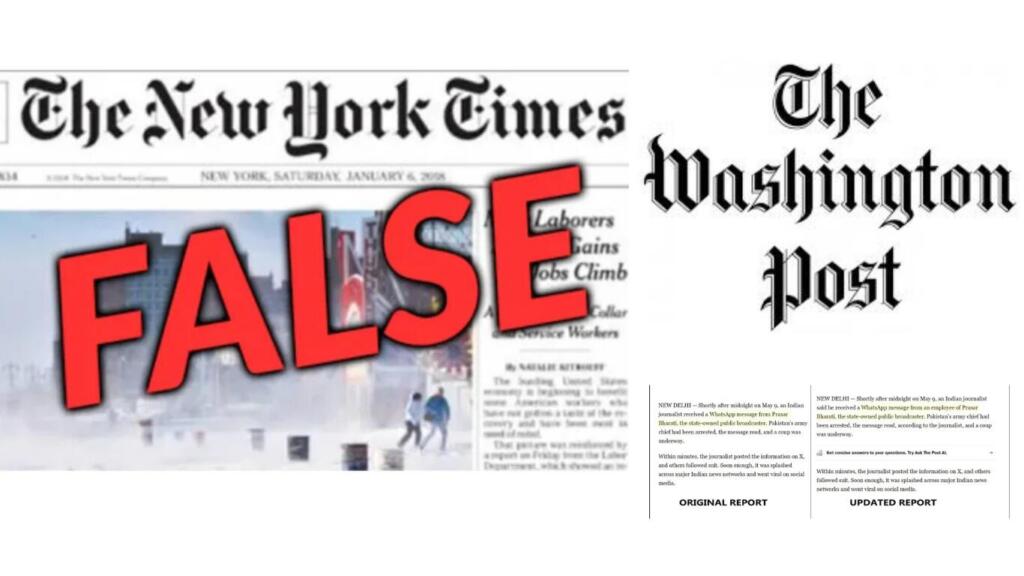
In recent weeks, the curtain has been pulled back on the shocking double standards of the Western press. The Washington Post and The New York Times outlets that position themselves as guardians of truth and defenders of press freedom have been caught disseminating misleading, unverified, and outright false narratives about India and global conflicts. While they habitually question the credibility of Indian journalism, they themselves have slipped into the very habits they condemn: mistranslation, misattribution, and misrepresentation.
In their obsessive bid to frame India as a purveyor of misinformation and nationalism, these legacy media houses have crossed ethical lines. Whether it’s mistranslating local phrases to suit their agenda or pushing a misleading visual narrative from Gaza without verifying facts, these incidents are not isolated. They form a pattern—a concerted attempt to delegitimise India on the world stage while hiding behind half-baked corrections and vague editor’s notes.
Western Media’s Blunders: Operation Sindoor and WaPo’s Quiet Retraction
During the tense standoff between India and Pakistan in Operation Sindoor, The Washington Post (WaPo) published a sensational report claiming that misinformation had overtaken Indian newsrooms. Authored by Karishma Mehrotra, the article tried to portray Indian television as a hyper-nationalist echo chamber. However, it soon emerged that WaPo itself had relied on false claims and unverifiable sources.
Central to WaPo’s article was an anecdote involving a WhatsApp message allegedly from Prasar Bharati claiming a coup in Pakistan. The report used this to blame Indian journalists for spreading hysteria. But as it turns out, the message wasn’t official—it came from an unnamed individual with no proof of affiliation. Even worse, WaPo admitted this only in a quiet post-publication correction.
WaPo also falsely claimed that TV9 Bharatvarsh had aired reports about Pakistan’s Prime Minister surrendering. This accusation was later deleted silently from the article without explanation. Such baseless claims, if made by Indian media, would have triggered widespread condemnation. But when Western outlets err, they bury the truth in footnotes.
Lost in Translation: Western Media’s Cultural Ignorance
WaPo’s report further mistranslated common Hindi expressions. A phrase like “Karachi mein tabahi”—typically used to denote chaos—was inaccurately translated to mean “complete destruction.” This is either a case of lazy reporting or willful distortion. Using tools like Google Translate without context, WaPo demonstrated its ignorance of local languages and idioms.
These are not harmless errors. They distort perceptions globally, especially when reported by platforms with vast international reach. Instead of investing in culturally literate journalism, Western outlets seem content with parachute reporting—entering a region during conflict, extracting headlines, and leaving behind half-truths.
The Gaza Incident: NYT’s Starvation Story Falls Apart
The New York Times also recently found itself under fire for publishing a misleading narrative about Gaza. It used images of a severely underweight Palestinian child, Muhammad Zakariya Ayyoub al-Matouq, to portray starvation allegedly caused by Israeli military actions. But there was a glaring problem—Muhammad suffers from a rare congenital disorder.
The NYT eventually issued a ‘clarification’, not an apology, and quietly updated the story. This update was not posted on the publication’s main handle, but rather through a side channel, suggesting an intent to avoid public attention. Worse, they congratulated themselves for their supposed bravery in reporting from Gaza, instead of acknowledging the misleading nature of their initial narrative.
Media outlets including CNN, BBC, The Guardian, and even the Vatican’s official newspaper followed suit, using the boy’s image to fuel anti-Israel sentiment. None of them acknowledged that his condition was medical—not the result of famine. Conveniently, they omitted photos of the boy’s healthy sibling who appeared in the same frame. The truth, in this case, was clearly inconvenient.
Weaponising Journalism Against India
It’s becoming increasingly clear that the Western media has a playbook: amplify selective outrage, demonise India’s internal affairs, and when caught, issue vague “clarifications.” The eagerness to label Indian media as propaganda while their own lapses go unaddressed is both hypocritical and malicious.
From Kashmir to border operations, Indian narratives are constantly undermined by Western reporters who often lack local context. Terms like “hypernationalism,” “authoritarianism,” and “Hindu majoritarianism” are carelessly used to frame India as unstable or aggressive. This is narrative warfare, not journalism.
Despite having limited access, little knowledge of regional languages, and often relying on local stringers or Western-funded NGOs, these publications feel entitled to pass judgment on India’s democratic institutions and media landscape. The result is a dangerously distorted global perception of the country.
India Must Call Out the Bias
These back-to-back episodes highlight a deeper rot in how Western media covers India and global conflicts. Their agenda-driven coverage has gone from flawed to reckless. With vast global platforms, they shape narratives that ripple through diplomatic corridors, policymaking, and public opinion.
India can no longer afford to stay silent. Media watchdogs, public institutions, and informed citizens must begin calling out this bias. Holding the Western press accountable is not about nationalism—it’s about journalistic fairness. If global media wishes to critique India, they must also commit to accuracy, cultural sensitivity, and transparency in their own reporting.
Until then, their so-called exposés are nothing more than propaganda cloaked in the language of journalism. And India, with its vibrant and noisy media democracy, deserves far better than this colonial-style scrutiny from a press that fails its own test of credibility.