
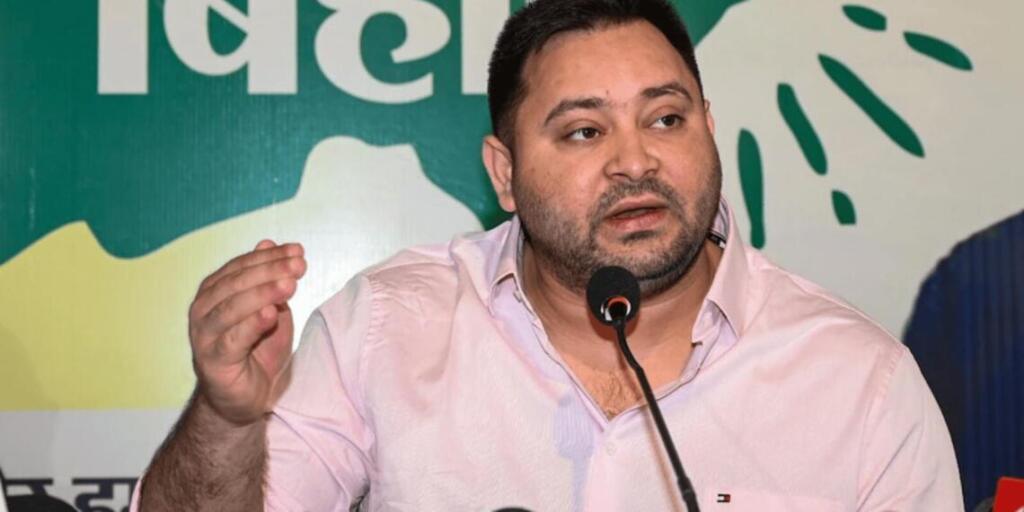
In Bihar’s volatile political landscape, yet another disturbing episode has shaken the state’s conscience. A 32-year-old man, Ajay Yadav, was brutally lynched during a Muharram Tazia procession in Motihari. Armed mobs attacked Hindu locals with lathis, rods, and swords, leading to Ajay’s death and injuring several others. While the incident has outraged the public and social media, what stands out is the eerie silence of Tejashwi Yadav, leader of the Rashtriya Janata Dal (RJD), a party that once claimed to be the guardian of the Muslim- Yadav (MY) social fabric. At a time when political leaders are expected to condemn such violence unequivocally, Tejashwi’s quietude speaks volumes.
Shahabuddin’s Shadow: Glorification of a Convicted Criminal
Just hours before Ajay’s murder, Tejashwi Yadav invoked the name of Mohammad Shahabuddin, a convicted gangster and former RJD strongman, on the party’s Foundation Day. From a public platform, he chanted, “Shahabuddin ji zindabad,” effectively glorifying a man whose criminal record has contributed to the fear and lawlessness in Bihar for decades. This act was not a slip of the tongue but a calculated political gesture. Shahabuddin had become a symbol of RJD’s lawless reign in the past, and now Tejashwi seems to be walking the same path.
The disturbing irony lies in the contrast: while a notorious criminal is being hailed, the death of an innocent Yadav youth goes unacknowledged. This is not just political hypocrisy; it is a dangerous signal that criminal glorification and selective silence are part of a larger vote-bank strategy.
The ‘MY’ Equation: A Bridge or a Weapon?
RJD’s political strategy for decades has revolved around the so-called ‘MY’ (Muslim-Yadav) equation, carefully crafted by Lalu Prasad Yadav and now inherited by his son. While originally presented as a means of forging social unity among backward and minority communities, this formula has increasingly become a tool for polarisation and appeasement.
The murder of Ajay Yadav has exposed the cracks in this narrative. The very community that formed the bedrock of RJD’s vote bank is now questioning its leaders. On social media, Yadav youth have asked why Tejashwi Yadav is quick to defend one community but refuses to speak out when someone from his own social group is slaughtered. Is this silence due to the fact that the attackers allegedly belong to the minority group, and any condemnation might affect RJD’s vote arithmetic?
Appeasement and Its Bloody Cost
This is not the first time communal tensions have escalated during Muharram in Bihar. Reports of stone pelting, armed processions, and provocation have surfaced year after year.
Tejashwi Yadav’s past remarks further illustrate this trend. From calling the Waqf Amendment Bill anti-Muslim and demanding it be “thrown in the dustbin,” to voicing support for Sharia law, the leader has consistently pandered to hardliners for electoral gain. But with Ajay Yadav’s death, the cost of this appeasement has now come home to roost. The Yadavs are no longer just passive supporters; they are now victims, sacrificed at the altar of political ambition.
RJD’s Track Record: Complicity and Silence
Bihar’s history is riddled with examples of the RJD looking the other way when it comes to fundamentalism. From sheltering controversial figures like Shahabuddin to turning a blind eye to rising communal tensions, the party has often found itself on the wrong side of public interest. The recent rally where Tejashwi made pro-Sharia statements and opposed the Centre’s anti-terror initiatives reflects the party’s unwillingness to take a firm stand against radicalism.
This pattern is dangerous. When mainstream political parties refrain from condemning religious extremism, they create fertile ground for more violence. Ajay Yadav’s murder is not just an isolated act; it is a symptom of the deeper malaise where political expediency trumps justice and community safety.
Time to Rethink Bihar’s Political Compass
Ajay Yadav’s brutal murder has turned the spotlight on a critical question: When your own lose their lives, and your silence is deafening, what moral authority do you hold as a leader? Tejashwi Yadav’s reluctance to speak out against the communal violence in Motihari, while glorifying a convicted criminal like Shahabuddin, has revealed a disturbing duality in Bihar politics.
Bihar doesn’t need leaders who glorify crime or remain silent when innocent lives are lost. It needs leadership that values justice over vote banks, law over appeasement, and unity over division. The tragic killing of Ajay Yadav is not just a communal incident; it is a warning bell. If the political class, especially those claiming to represent the MY equation, fail to act now, they risk losing the very base they are trying to protect.
The Yadav community and wider civil society must demand accountability not just from the government but from those who aspire to lead it. Because when politics becomes complicit in silence, democracy suffers, and the people pay the price.