
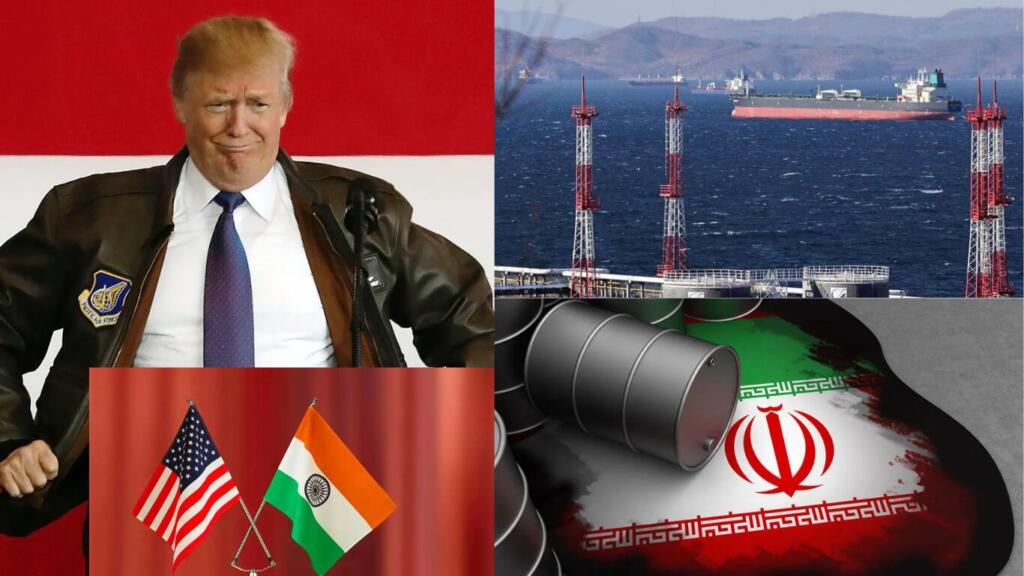
In a development that has sent ripples across India’s industrial and diplomatic circles, the United States has imposed sanctions on six Indian companies for allegedly engaging in significant transactions involving Iranian petroleum and petrochemical products. The move is part of a broader U.S. crackdown on entities across the globe accused of bypassing its sanctions regime on Iran. While the Trump administration positions this as a part of its larger Middle East policy strategy, the decision is likely to raise concerns in New Delhi, especially as it comes close on the heels of other economic pressure points, including trade-related actions and tariffs.
Washington Targets Indian Firms in Global Iran Crackdown
On Wednesday, the U.S. Department of State announced sweeping sanctions on 20 companies and entities across several countries, citing violations of Executive Order 13846—an order that reimposed extensive economic restrictions on Iran following the U.S. withdrawal from the 2015 nuclear agreement. Among the blacklisted entities are six Indian firms, including Kanchan Polymers, Alchemical Solutions Pvt. Ltd., Ramniklal S. Gosalia and Company, Jupiter Dye Chem Pvt. Ltd., Global Industrial Chemicals Ltd., and Persistent Petrochem Pvt. Ltd.
These firms were accused of knowingly participating in the trade, purchase, or marketing of Iranian petroleum or petrochemical products. In addition to companies, the U.S. has also designated 10 vessels as “blocked property,” effectively preventing them from operating in any U.S.-linked financial or logistics ecosystem. The penalties underscore Washington’s aggressive stance on choking Iran’s oil revenues, which it claims are used to fund terrorism and regional destabilization.
US Defends Action as Anti-Terror Strategy
Defending the move, the U.S. State Department issued a strongly worded statement: “The Iranian regime continues to fuel conflict in the Middle East to fund its destabilizing activities. Today, the United States is taking action to stem the flow of revenue that the regime uses to support terrorism abroad, as well as to oppress its own people.” The sanctions are designed to freeze any U.S.-based assets of the designated firms and restrict their access to global financial systems where U.S. compliance laws are enforced.
This decision comes at a time when the Trump administration is seeking to reinforce its Middle East policy, particularly in the wake of recent tensions involving Iran-backed militant groups and the broader instability in the Gulf region. The inclusion of Indian companies signals that Washington is now unwilling to overlook even indirect or intermediary-level violations of its Iran policy.
Broader Impact and Geopolitical Implications for India
The sanctions come amid an increasingly complex phase in India-U.S. relations. Just days earlier, the U.S. had announced a 25% tariff on certain Indian exports, prompting concerns about a potential trade rift. The targeting of Indian companies, especially those involved in chemicals and petroleum trading, could strain the economic engagement further.
India, for its part, had significantly reduced oil imports from Iran after 2019 when U.S. sanctions were previously ramped up. However, trade links—especially through intermediaries or alternate shipping routes—had continued in muted forms. Many of the Indian firms now sanctioned have not released public statements, though they may seek delisting through the U.S. Treasury’s Office of Foreign Assets Control (OFAC), which provides an appeal mechanism for designated entities.
Interestingly, some of the sanctioned firms are linked with overseas companies as well. For instance, Cora Lines Inc., a company sanctioned in this round, is a subsidiary of Teodor Shipping L.L.C. based in the UAE, which is reportedly controlled by an Indian national. This indicates that Washington is not merely going after direct violators but also those enabling transactions through multi-layered international routes.
U.S. Expands Sanctions to Multinational Network of Brokers and Shippers
The U.S. action isn’t limited to India. Entities from Turkey, China, Indonesia, and the UAE have also been sanctioned, suggesting a coordinated sweep against a multinational network believed to be facilitating Iranian oil sales. Many of these foreign firms have operational or ownership ties to Indian nationals or companies, thereby expanding the scope of India’s indirect involvement.
According to the U.S. State Department, the sanctions aim to disrupt every link in the supply chain—from brokers and shippers to marketing agents and financial facilitators. This broader strategy raises questions for Indian businesses involved in global chemical and petrochemical trade, many of whom may have previously navigated grey areas in the enforcement of international sanctions.