
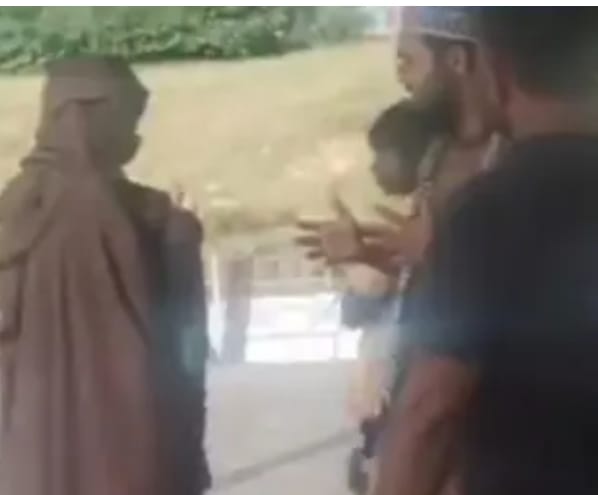
In a chilling case of radical vigilantism masked as moral guardianship, the Uttar Pradesh Police have unearthed a disturbing network called the ‘Haidari Gang’ or ‘Haidari Dal’, allegedly responsible for orchestrating a systematic campaign of harassment, intimidation, and public shaming of Muslim women found in the company of Hindu men in public spaces.
The group’s members filmed confrontational encounters with women and circulated the videos online through Instagram and WhatsApp. In reality, authorities say, the network operated more like a digital-extremist cult, rooted in religious radicalization, misogyny, and communal polarization.
Eid Incident Sparks Outrage and Unveils Wider Conspiracy
The crackdown began after an incident on June 7, 2025, during Eid al-Adha (Bakrid) celebrations at Gandhi Park in Bareilly. A group of Muslim girls celebrating the festival were confronted, interrogated, and harassed by four men claiming to be protecting Islamic values. The incident was recorded and uploaded to Instagram, complete with incendiary captions like ‘Resist saffron jihad’ and ‘Hijab is our honor.’
The viral video drew massive public outrage, prompting an investigation by the Bareilly Police, which soon revealed that this was not an isolated incident. It led to the discovery of an organized network operating across several districts and social media platforms.
How the Haidari Gang Operated: Vigilantism Disguised as Protection
The modus operandi of the Haidari Dal was systematic and calculated. Members operated in teams that actively scouted parks, shopping malls, cafes, and other public spaces across Bareilly and nearby towns. Their objective: to identify Muslim girls with Hindu boys, confront them publicly, and record the interaction.
These confrontations, often aggressive and invasive, were filmed without consent and distributed via a network of at least 68 Instagram accounts and over a dozen WhatsApp groups.
The group claimed to be ‘protecting Muslim women from Hindu boys trying to lure them away from Islam’, a justification that authorities have labeled as a thin veil over communal and misogynistic aggression.
Digital Ecosystem and Funding Trail
According to investigators, the Haidari Gang was well-organized, functioning through:
A network of closed WhatsApp groups for coordination and planning
Multiple Instagram handles with names like @haidari_dal_bareilly, used to post hate-filled content
QR-code-based donation drives, collecting funds from sympathizers under the guise of protecting religious honor
Police have frozen two bank accounts used for receiving money through QR codes. These accounts were promoted in closed groups, allegedly by a local cleric (imam) who is now under the scanner for radicalizing youth and encouraging donations. The imam’s messages reportedly included phrases like ‘Donate ₹200 to save our Muslim sisters.’
Arrests Made and Charges Filed
So far, six individuals, all in their early 20s, have been arrested: Shahbaz alias Sufiyan, said to be the handler of the main Instagram page which had over 4,000 followers, along with Sameer, Raza, Riyazuddin, Jaish, Shanu, and Nabi Hasan.
Of these, Sufiyan has been identified as the primary digital propagandist, responsible for uploading and captioning the videos. Nabi Hasan, arrested in Shahjahanpur, was found in possession of obscene videos involving a minor, resulting in charges under the POCSO Act in addition to cybercrime and communal incitement.
According to SP City Manush Pareek, ‘This is not about religion; it is about power, and control disguised as faith. The group preyed on women’s privacy and dignity while inciting communal hatred.’
Radicalization and Religious Extremism
Further investigations revealed that the group was being actively promoted by a local cleric, who shared QR codes in WhatsApp groups urging followers to financially support the Haidari Dal. CO Ashutosh Shivam confirmed that statements from the arrested individuals pointed toward ideological backing and digital mobilization by religious influencers.
Authorities are now pursuing the cleric and investigating whether similar efforts exist in neighboring states like Rajasthan and Madhya Pradesh, where accounts such as @haidari_dal_rajasthan remain active, continuing to post provocative videos.
Public Surveillance and Policing of Interfaith Interactions
The Gandhi Park incident has led to increased surveillance of public spaces in Bareilly. Security guards have been instructed to verify Aadhaar cards and restrict access to interfaith couples. According to a guard named Rohit stationed at the park: ‘Now, if we suspect a Hindu-Muslim pair, we ask for ID and don’t allow them in. Police patrol daily.’ While this is meant to deter vigilantism, critics argue that it borders on institutional intrusion into personal liberty.
Condemnation and Social Fallout
The incident has sparked intense debate across political and religious circles. Mufti Shahabuddin Razvi Barelvi, president of the All India Muslim Jamaat, said: ‘This is a direct assault on women’s freedom and communal harmony. Radicalization is spreading from both ends. If civil society doesn’t intervene, the damage to the social fabric could be irreversible.’
What’s Next?
Despite the arrests, the Haidari Gang’s digital ecosystem is far from dismantled. Several linked accounts are still active, sharing hate-filled videos under the guise of community policing.
SP Pareek warned that the group’s influence is expanding: ‘This is not just a law-and-order issue, it’s a battle for the safety of women and the future of religious harmony. More arrests will follow. We are monitoring the network’s expansion into other states and its links to extremist funding.’
The case serves as a stark reminder of how digital platforms can be weaponized to spread hate, and how religious extremism can manifest in forms that directly threaten women’s safety, personal liberty, and communal peace.