
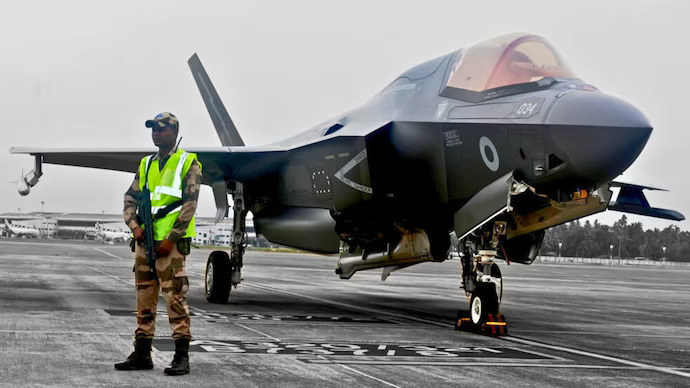
After remaining grounded for over a month due to a technical malfunction, a British Royal Navy F-35B Lightning II stealth fighter jet has finally taken off from Thiruvananthapuram International Airport. The jet had made an unscheduled landing at the airport in June following a mid-flight emergency, prompting a prolonged stay that drew considerable public and media attention.
The stealth fighter, valued at over $100 million, was part of the air wing deployed aboard the HMS Prince of Wales aircraft carrier. On June 14, while returning from a mission over the Arabian Sea, the aircraft encountered dual complications, unfavorable weather conditions and critically low fuel. The pilot initiated an emergency landing and diverted to the nearest available airstrip, which happened to be in Kerala.
After a successful landing, ground checks revealed a hydraulic system failure, a serious issue that rendered the jet inoperable. The problem was particularly concerning because it affected critical systems like landing gear, brakes, and steering.
UK Repair Team and Logistical Hurdles
Initially, a small maintenance crew from the carrier attempted to fix the issue onsite but made little progress. Given the highly classified nature of the F-35’s technology, the UK was cautious about moving the aircraft or exposing it to extensive third-party oversight. As a result, the jet remained parked in an isolated bay at the airport for weeks, under tight security and CISF supervision.
Eventually, the UK dispatched a specialized 25-member technical team, who arrived in Kerala aboard a Royal Air Force transport aircraft on July 6. They brought advanced equipment and components to carry out the repairs. With the help of Indian authorities, the jet was then shifted to a hangar to avoid further weather-related damage and allow for more secure maintenance.
Aviation Drama Meets Viral Fame
The grounded F-35 became an unexpected attraction and sparked a wave of online buzz. Social media platforms were flooded with memes, jokes, and even mock tourism posters imagining the jet “vacationing” in Kerala. The incident offered a rare blend of high-stakes military aviation and light-hearted internet humor.
Kerala’s tourism department also took advantage of the publicity, with witty posts that jokingly suggested the fighter jet had become a long-term visitor enjoying the monsoon.
Repairs Completed, Jet Cleared for Takeoff
By the third week of July, the jet’s hydraulic systems were fully repaired, and it successfully completed all pre-departure safety checks. It is now cleared to fly back, either independently or accompanied by a support aircraft. During its extended stay, the UK is reported to have incurred around ₹8 lakh (approximately $9,600) in parking and ground handling charges.
A second RAF transport plane is expected to arrive shortly to retrieve the repair team and equipment, bringing the month-long episode to a close.
Broader Implications
Though operational in nature, the incident underscored the depth of India-UK defense cooperation. Indian Air Force coordination, airport authorities’ support, and diplomatic handling ensured that the jet’s security and confidentiality were maintained throughout.
The F-35B, known for its stealth capabilities, short takeoff and vertical landing (STOVL) design, and next-gen avionics, is one of the most advanced fighter jets in the world. Its presence on Indian soil—even temporarily—sparked interest among aviation experts, defense watchers, and the public alike.
After more than 30 days on Indian ground, the British F-35B fighter jet has finally departed Thiruvananthapuram, concluding an unusual chapter in international military aviation. What began as an emergency landing turned into a logistical and diplomatic exercise, handled smoothly by both nations—and not without a few viral moments along the way.