
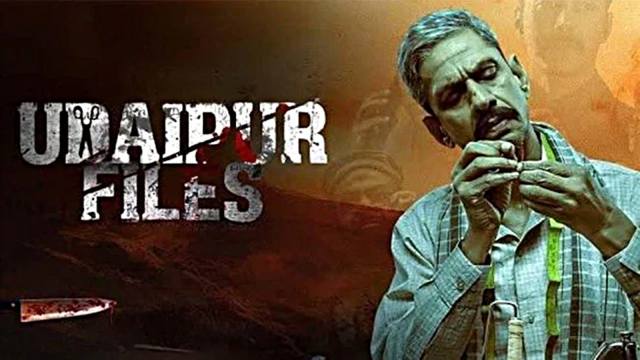
In a significant development, the Supreme Court on Friday declined to extend the stay on the release of the film Udaipur Files: Kanhaiya Lal Tailor Murder, allowing the path to be cleared for its public screening. The Court advised those opposing the film to seek recourse from the Delhi High Court if they wish to pursue their objections further.
A bench of Justices Surya Kant and Joymalya Bagchi, hearing the case, directed senior advocates Kapil Sibal and Menaka Guruswamy to move the Delhi High Court for any challenge to the expert committee’s decision. The committee, formed by the Information and Broadcasting Ministry following the Delhi HC’s earlier order, had already reviewed the film and recommended its release with minor changes, including a disclaimer.
The Court made it clear: “We have not touched the merits…We will pass an order asking the high court to take it up on Monday…Whatever arguments you have to make, go to high court.” When counsel sought a stay in the meantime, Justice Kant firmly responded, “Meanwhile, nothing.”
As the legal battle rages over the film, Kanhaiya Lal’s son, Yash Sahu, has raised a pointed and painful question “Why is there so much urgency in court decisions about film releases, but not when it comes to justice for my father’s brutal murder?”
This sentiment echoes the frustration of many who believe the judiciary must show equal swiftness in delivering justice for victims of hate and terrorism.
The Brutal Murder That Demands National Reflection
The 2022 murder of Kanhaiya Lal, a humble tailor from Udaipur, was not just a criminal act—it was an act of terror meant to instill fear across communities. Kanhaiya Lal was hacked to death in broad daylight for merely expressing support on Facebook for then-BJP spokesperson Nupur Sharma. His murderers not only filmed the beheading but released the video to spread fear and glorify their radical ideology.
Despite clear video evidence and widespread public outrage, justice has moved at a snail’s pace. No final verdict has been delivered. Meanwhile, attempts to narrate the story through cinema—an art form that often holds a mirror to society—have been met with repeated legal resistance.
Why must the truth be stifled? Why are those speaking up for justice being silenced? These are the questions Udaipur Files dares to ask, and this is exactly why its release matters.
Jamiat’s Pattern: Legal Aid for the Accused, Silence for the Victims
Much of the opposition to the film comes from the Jamiat Ulema-e-Hind, whose president Maulana Arshad Madani filed the petition opposing the release. Appearing for him was senior advocate Kapil Sibal, while Menaka Guruswamy appeared for Mohammad Javed, one of the accused in Kanhaiya Lal’s murder.
Jamiat’s legal cell has a long history of defending individuals accused in high-profile terror cases. Since 2007, they have extended support to over 700 accused, including suspects from the 26/11 Mumbai attacks, 2006 Malegaon blasts, Ahmedabad serial blasts, and even ISIS and Al-Qaeda operatives.
While everyone deserves legal representation, many question the selective activism of such organisations—where the accused get top-tier legal backing while victims like Kanhaiya Lal are reduced to statistics and forgotten names.
Filmmaker Amit Jani, who produced Udaipur Files, stated that even after senior advocate Kapil Sibal previewed the film, he opposed it “just because he was paid to.” Jani confirmed his resolve to fight till the end and hinted at a possible return to the Supreme Court to protect the film’s release and, with it, the truth.
VHP and Nationalist Voices Call Out Hypocrisy
The Vishwa Hindu Parishad (VHP) has been outspoken in its support for Udaipur Files, condemning efforts to block the film. VHP spokesperson Amitosh Parik said:
“Just like The Kashmir Files and The Kerala Story, Udaipur Files reveals the ugly face of religious extremism. Why does Jamiat want it banned? Is the truth hurting them?”
He added that cinema is society’s mirror, and banning it under the garb of “secular harmony” is a betrayal of justice. If extremists can freely spread fear and violence in the name of faith, why can’t filmmakers expose them? Why must the victims be forgotten while the accused get state-of-the-art legal support?
The public sentiment, especially in nationalist circles, reflects this logic. Udaipur Files is not just a film it’s a demand for accountability.
A Fight for Truth, Not Just a Film
The Supreme Court’s refusal to halt Udaipur Files is a small victory for truth, but it also highlights a deeper irony in the Indian legal system. The wheels of justice often turn slowly for victims, but censorship battles are settled in a flash.
Kanhaiya Lal’s son, Yash Sahu, is right to question the priorities. The courts must show the same urgency in delivering verdicts on heinous crimes as they do in regulating films. The Udaipur Files is not just a piece of cinema—it is a voice for the voiceless, a narrative the mainstream refuses to tell.
At a time when radical ideologies threaten peace and harmony, suppressing truth-based storytelling only empowers the extremists. The release of Udaipur Files is not merely a legal matter—it is a moral one. The nation must decide: Do we stand with the truth or cower before terror?