











On the very day when Defence Minister Rajnath Singh addressed Parliament during the Operation Sindoor debate, Indian security forces delivered a decisive blow to Pakistan-sponsored terrorism. Three Lashkar-e-Taiba terrorists Suleiman Shah (a former Pakistani soldier and mastermind of the Pahalgam massacre), Abu Hamza, and Yasir were gunned down in a high-profile encounter in Kashmir, dubbed Operation Mahadev.
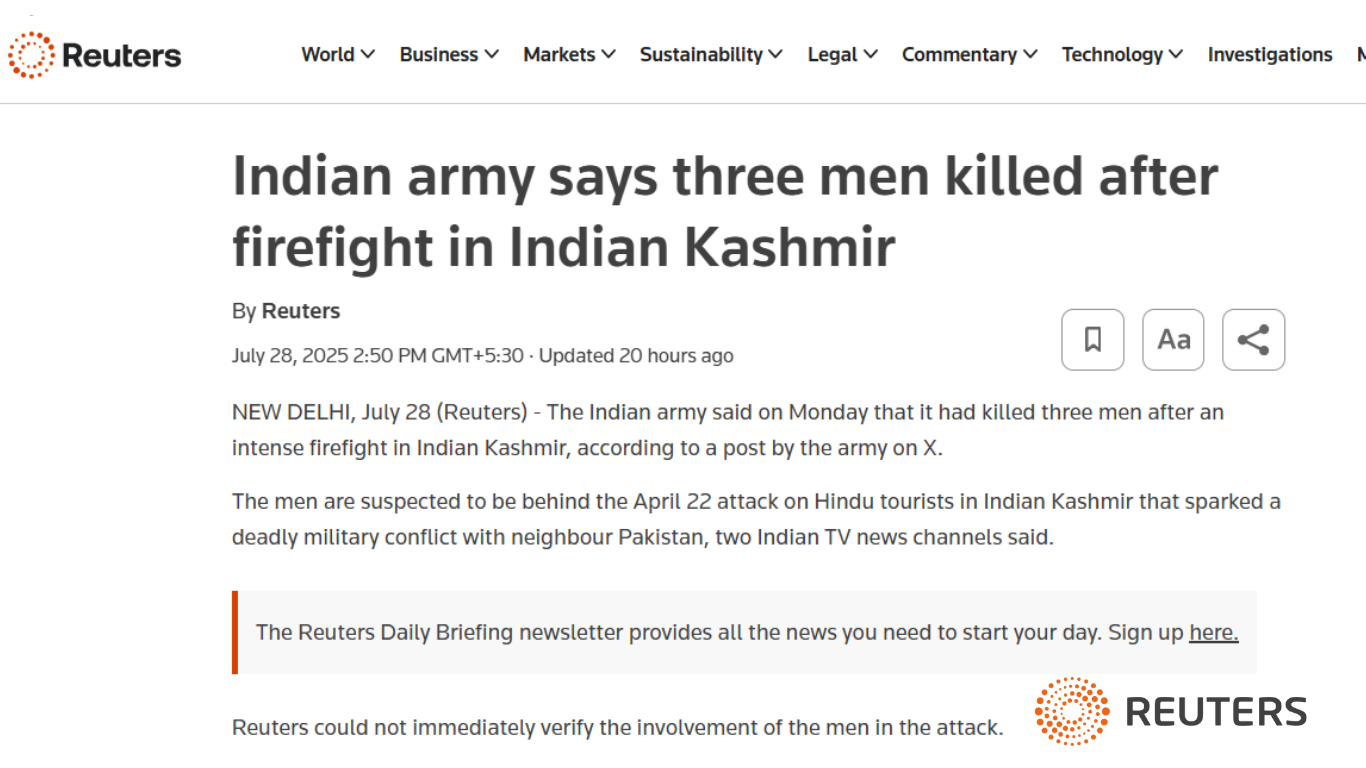
Yet, in a stunning display of editorial insensitivity, Reuters referred to these hardened terrorists as simply “three men” in its global news report. Even more concerning is the byline: Tanvi Mehta, Sakshi Dayal, and Editor YP Rajesh all Indian nationals working for a foreign media house that repeatedly underplays threats to India’s national security.
When Indian Reporters Forget the Nation
Instead of celebrating the bravery of Indian soldiers or acknowledging the magnitude of the counterterrorism success, Reuters sanitized the headline, reducing terrorists to anonymous “men.” One would expect Indian journalists to push back against such editorial malpractice. Instead, they complied.
When contacted by TFI, YP Rajesh, Reuters South Asia Breaking News Hub Chief, refused to comment on the article he edited. While Reuters journalists get clarifications and seek answers from Indian officials and Politicians Rajesh said “I cannot talk about that. Reuters won’t allow its journalists to talk to the media. You’ll have to get in touch with our office”.
That alone raises serious questions: Are Indian employees of foreign publications forced or willingly set aside national interest to maintain foreign editorial narratives?
Reuters Has a Pattern: A Legacy of Bias
This isn’t a one-off case. Over the years, Reuters has cultivated a disturbing pattern of downplaying terrorism in India, misrepresenting facts, and outright echoing narratives from adversarial nations like Pakistan and China. Here are a few notable instances:
- May 7, 2025: Reuters falsely claimed three Indian fighter jets crashed in J&K, quoting Pakistani military sources.
- May 9, 2025: A recycled lie said Chinese jets downed Indian aircraft—authored by Pakistani journalists Idrees Ali and Saeed Shah.
- Dec 2023: Reuters published an Ayodhya piece starting with “Dara Hua Musalman,” stoking imaginary fear among Muslims before Ram Mandir’s inauguration.
- Delhi Riots (2020): Reuters and similar outlets blamed Hindus while ignoring the brutal murder of IB officer Ankit Sharma and other Hindu victims.
The trend is clear: when Pakistan is attacked, the perpetrators are “terrorists”. When India defends itself, the enemies become “men” and soldiers are seen as aggressors.
National Sentiment Sacrificed at the Altar of Foreign Narratives
The silence of Indian reporters at foreign outlets like Reuters is not just disappointing it is dangerous. When Indian voices fail to stand up for the country’s sovereignty and security, it empowers biased narratives. It also reveals how easily journalistic ethics can be compromised when working under editorial policies that prioritize international agendas over national truths.
Social media backlash has been swift and fierce. Public figures like Major Surendra Poonia and handles like @pranavmahajan have called out Reuters for its disgraceful whitewashing of Pakistani terrorism. “They are not ‘men,’ they are terrorists. And you know that Reuters. Shame on Tanvi Mehta, Sakshi Dayal, and YP Rajesh,” one user wrote.
Another tweet stated: “Hello @Reuters, Indian Army said ‘They gunned down 3 terrorists in Kashmir.’ Now you can pen down a heartfelt obituary for your ‘3 men’!”
Time to Call Out Double Standards
Foreign media outlets like Reuters are not new to distorting India’s image but when Indian journalists participate in that distortion, it becomes a matter of national concern.
Operation Mahadev was not just a military operation; it was a statement that India will not tolerate terrorism. The least Indian journalists could do is acknowledge that without playing word games that insult the nation’s security forces.
If you can’t call a terrorist a terrorist, perhaps journalism isn’t your calling. And if Indian employees of foreign media won’t stand for the truth, the nation should at least know where they stand. The truth is simple: national interest must come before editorial loyalty to foreign boards.