
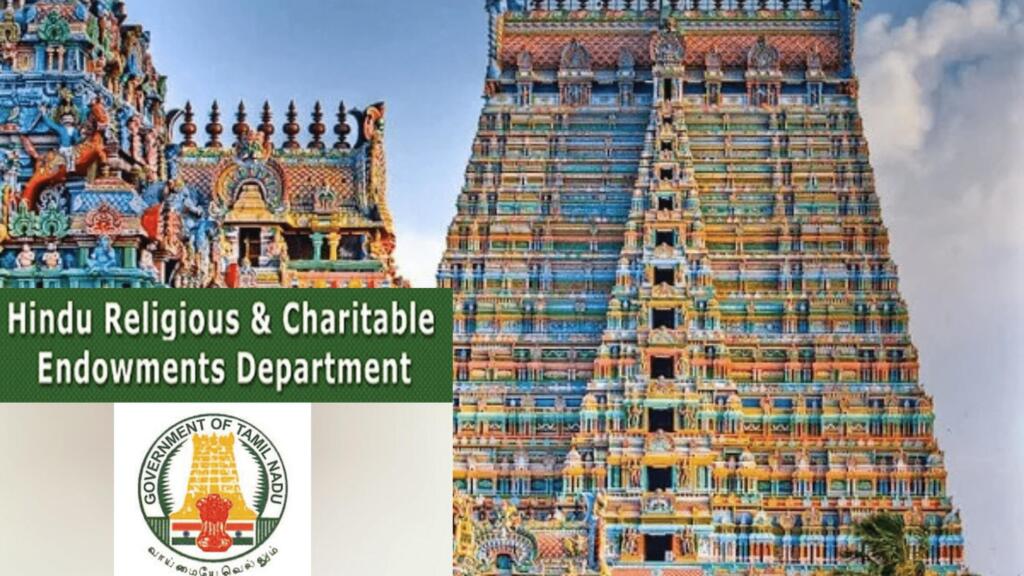
India prides itself on being a secular nation where religion and state are meant to function independently. Yet, one of the glaring contradictions lies in how Hindu temples are governed under the Hindu Religious and Charitable Endowments (HR&CE) Department particularly in Tamil Nadu. This institution, created under a string of colonial-era and post-independence laws, exercises immense control over temple administration, property, and finances, but not without raising serious concerns. Why is such control necessary? Is the HR&CE Department protecting religious sanctity or infringing upon it?
This article explores the history, controversies, and growing calls for dismantling the HR&CE department, especially under the DMK-led Tamil Nadu government.
A Colonial Legacy with Extended Reach
The seeds of government interference in temple administration were sown during British rule. In 1863, the British passed the Religious Endowments Act, granting the state limited control over temples, under the pretext of regulating finances. However, this intrusion grew deeper over time.
By 1925, the Madras Hindu Religious Endowments Act was passed, followed by the 1926 revision to fix legal issues. These acts laid the groundwork for the modern HR&CE structure. After Independence, the Madras Hindu Religious and Charitable Endowments Act, 1951 was enacted and later replaced by the Tamil Nadu Hindu Religious and Charitable Endowments Act, 1959, which established the HR&CE Department officially.
This Act gave the Tamil Nadu government full authority to supervise, manage, and even take over temples and endowments. Curiously, this control applies only to Hindu and Jain temples, not to places of worship belonging to other religions. This double standard remains a sore point among the Hindu community.
As per the HR&CE website, 45,994 temples are currently under its control an overwhelming majority of them centuries old and deeply revered.
A History of Legal Battles and Public Resistance
Over the decades, many devotees, temple trustees, and religious leaders have challenged the HR&CE Department’s actions in court. Some notable landmark cases stand as a testament to the legally questionable overreach of the department:
Devaraja Shenoy vs. State of Madras (1951): The court struck down the government’s attempt to take over the Shri Venkataramana Temple in Mulkipetta.
Shri Lakshmindra Thirtha Swamiar vs. State of Madras (1951): The Supreme Court invalidated the state’s takeover of Udupi Krishna Temple and Chidambaram Sabhanayagar Temple.
Recent Case – Ayodhya Mandapam, Chennai: The High Court quashed an HR&CE order attempting to control this sacred space.
These and many other cases have raised fundamental questions about the constitutional right of Hindus to manage their own religious affairs, especially when Article 26 of the Indian Constitution clearly provides every religious denomination the freedom to do so.
Growing Distrust Among Devotees
Hindu devotees and critics alike argue that the HR&CE has abused its authority for decades. According to renowned advocate and temple activist T.R. Ramesh, “HR&CE officials carry out a lot of illegal activities in temples. Most of their orders replacing trustees or interfering in temple matters are without jurisdiction or in abuse of it.”
Several temples allege misappropriation of temple funds, encroachment of temple lands, and unauthorized appointments of staff. What angers devotees more is the belief that this interference stems not from administrative necessity, but from ideological bias. The department currently employs 1336 staff out of 2409 sanctioned posts, including IAS officers. The Commissioner (currently P.N. Sridhar IAS) oversees all operations. The HR&CE Department comes under the Minister of Hindu Religious and Charitable Endowments, which is presently held by P.K. Sekar Babu—a DMK leader who has publicly participated in Anti-Sanatana Dharma events, notably one where Deputy CM Udhayanidhi Stalin compared Sanatana Dharma to “dengue and malaria.”
Such affiliations raise deep suspicions about the intent and neutrality of the department.
The DMK Government’s Controversial Temple Reforms
The DMK, known for its Dravidian atheistic ideology, has been repeatedly accused of pushing anti-Hindu policies under the guise of reform. Some of the most controversial initiatives under the HR&CE’s watch include: All Community Priests Scheme: This policy allows individuals from all castes to become temple priests, raising alarms about the dilution of Agama shastras and traditional practices.
Gold Melting Scheme: The government began converting donated temple gold ornaments into bars, claiming it was for accounting transparency. Devotees and activists fear this may lead to untraceable misuse of sacred offerings. Both these initiatives, critics argue, were enforced without proper consultation with religious heads or temple trustees. The HR&CE has also faced severe backlash for allegedly leasing temple lands to private parties at meager rates, and in some instances, even losing track of temple treasures.
Time to Reclaim Temple Autonomy
For too long, the HR&CE has been a symbol of state control over Hindu faith, rather than a neutral guardian of religious endowments. The stark absence of such regulation for mosques or churches highlights a clear constitutional and cultural inequality. While the original purpose of the HR&CE may have been to prevent temple mismanagement, today, it has become the source of that very mismanagement.
In a truly secular country, religious institutions must have the autonomy to manage their own affairs. The HR&CE’s continued control, coupled with ideological biases, makes its existence deeply problematic. It’s time to ask: If Hindus are trusted to pray, why aren’t they trusted to govern their own temples?
Startling Moves That Demand Public Scrutiny
The DMK government became notorious for pushing temple reforms that critics call disrespectful to centuries-old traditions. The All-Community Priests Scheme and the melting of gold ornaments into bars in temples under the HR&CE’s control are just the beginning. These practices will be investigated in-depth in upcoming stories, shining a light on how temple sanctity is being reshaped by bureaucratic and political ambitions.
(This is the Part – I of a Series of articles on Tamil Nadu’s Controversial Hindu Religious and Charitable Endowments control over Hindu Temples)