
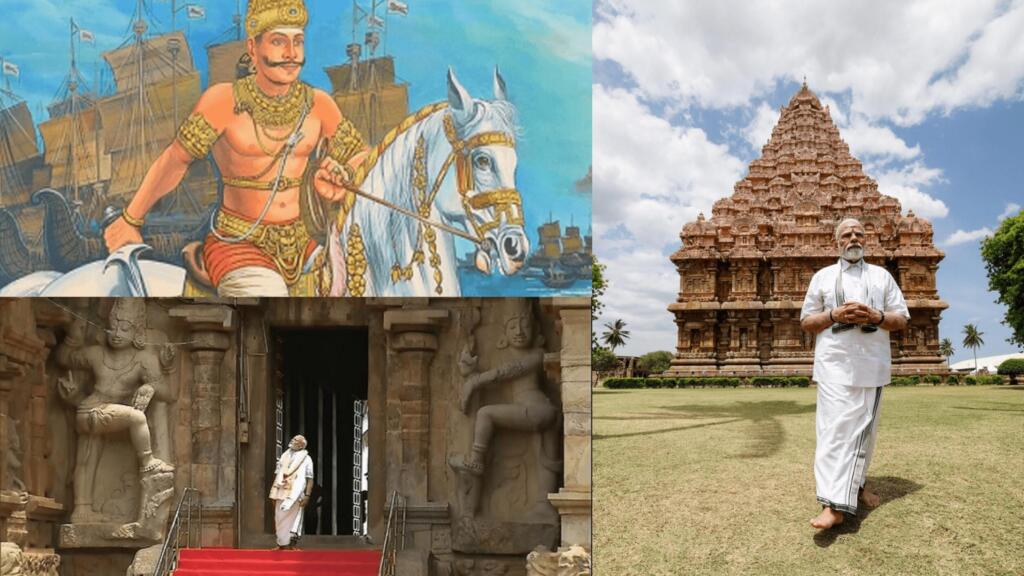
A thousand years ago, Rajendra Chola I, the mighty Hindu emperor of Tamil Nadu, brought Ganga water to the south after a triumphant military expedition to the Gangetic plains. At Gangaikonda Cholapuram the imperial capital he founded and the sacred temple he built he performed abhishekam with Ganga jal to honour Lord Shiva. In a historic civilisational echo, Prime Minister Narendra Modi has now become the first Indian Prime Minister to honour this act by performing abhishekam with Ganga water at the same temple, marking the 1000th anniversary of this spiritual moment. His message was powerful — Tamil pride is Hindu pride.
PM Modi’s visit to Gangaikonda Cholapuram marks more than a political outreach — it is a civilisational reunion. In an age where identity politics attempts to divide Bharat, Modi has chosen to bind it with the sacred thread of shared history, dharma, and pride. By performing abhishekam with Ganga water, releasing a coin in Rajendra Chola’s name, and promising statues for the Chola kings, he reminded Tamils that their legacy is not rooted in hate, but in harmony; not in division, but in devotion.
Rajendra Chola’s act of bringing Ganga to Tamil Nadu is once again alive — not just in ritual, but in spirit. And in this act, PM Modi has reclaimed not only a historical moment but a national soul. Tamil Nadu is not at odds with Bharat. It is, and has always been, its sacred heart
A Temple Born of Triumph and Devotion
The grand Chola king Rajendra I, son of Rajaraja Chola, built Gangaikonda Cholapuram nearly 1000 years ago after a victorious expedition that extended the Chola Empire to the Gangetic plains. To commemorate his conquest and devotion, he transported pots of sacred Ganga water to Tamil Nadu and performed abhishekam at the newly built Brihadisvara Temple in his new capital — Gangaikonda Cholapuram, meaning “The city of the Chola who brought the Ganga.”
This act was not just political symbolism but a cultural declaration. It was a unifying gesture by a Hindu king who spiritually and geographically connected the north and the south of Bharat. Rajendra Chola shifted his capital from Thanjavur to this city, making it the centre of Chola power for over 250 years. The temple he constructed stood as a monument of unmatched Dravidian architecture and spiritual grandeur, enshrining a 13-foot-tall Shiva Lingam that symbolised both power and piety.
PM Modi: Reawakening the Chola Spirit After a Millennium
On July 27, 2025, Gangaikonda Cholapuram witnessed a historic moment as Prime Minister Narendra Modi performed abhishekam with Ganga jal at the ancient Chola temple reviving a spiritual legacy after 1,000 years. The occasion marked the culmination of the Aadi Thiruvathirai festival, which celebrates the birth anniversary of Rajendra Chola. By performing rituals where once the Chola emperor stood, PM Modi became the first Prime Minister to pay such direct homage to the Chola legacy.
He also released a commemorative coin in honour of Rajendra Chola and announced the installation of grand statues for both Rajaraja Chola and Rajendra Chola in Tamil Nadu. The symbolic significance was clear — this was more than a political event. It was a national recognition of Tamil Nadu’s Hindu legacy, architectural brilliance, and historical contribution to India’s spiritual and imperial history.
Contrasting Narratives: Chola Pride vs DMK’s Denial
While PM Modi celebrated Tamil Nadu’s glorious Hindu past, the DMK-led state government continues to oppose such civilisational acknowledgements. The same Ganga that Rajendra Chola worshipped is today dismissed by DMK ideologues as “North Indian.” The same temples that once formed the backbone of Tamil culture are now being erased from school textbooks under the garb of opposing the National Education Policy (NEP). The NEP seeks to bring back the history of native kings like Rajendra and Rajaraja Chola, but the DMK’s resistance stems from a deeper discomfort with anything that aligns Tamil identity with Hindu civilisation.
Instead, the ruling party promotes a distorted narrative that reduces Tamil culture to an anti-Hindu and anti-Brahmin rhetoric, far removed from the actual legacy of kings like the Cholas — who were temple builders, Vedic patrons, and proud Shaivites. While the DMK’s political discourse seeks to replace spiritual pride with social division, Modi’s visit reminded Tamils that their roots are sacred, not sectarian.
Gangaikonda Cholapuram: Monument of Hindu Grandeur
The temple of Gangaikonda Cholapuram is more than stone and sculpture. It is the embodiment of a united Bharat under a proud Tamil Hindu ruler. With a vimana rising to 55 metres, exquisite carvings, and its place among the “Great Living Chola Temples” designated by UNESCO, the temple is a living witness to a time when Tamil kings saw themselves as both spiritual devotees and imperial unifiers.
It was in this temple that Rajendra Chola declared the greatness of South India to the world, not just through military campaigns that extended into Southeast Asia, but through architecture, water engineering, and temple rituals that brought the divine Ganga to the heart of Tamil land. By offering Ganga water again, PM Modi was not merely honouring a ritual — he was reigniting a flame of cultural pride that the Chola kings lit centuries ago.
Modi’s Message: Legacy Lies in Shiva, Not Periyar
The political undertone of Modi’s visit was unmistakable. His tribute to the Chola emperors was not just about history — it was a civilisational corrective. In a state where Periyarist ideologies have long tried to disconnect Tamil identity from Hindu heritage, Modi’s message was profound: “Your legacy is not in Periyar’s rants; it is in Shiva’s grace, in Chola grandeur, and in the timeless Hindu spirit of our land.”
By recognising Rajendra Chola not merely as a Tamil king but as a unifier of Bharat, PM Modi dismantled decades of divisive narrative that sought to isolate Tamil culture from Sanatana Dharma. The announcement of statues for Rajaraja and Rajendra in Tamil Nadu is not just an honour to the past — it is a statement of the future. It sends a clear signal that Tamil Nadu is integral to India’s spiritual and historical continuity, not an outlier to be treated with political suspicion.