
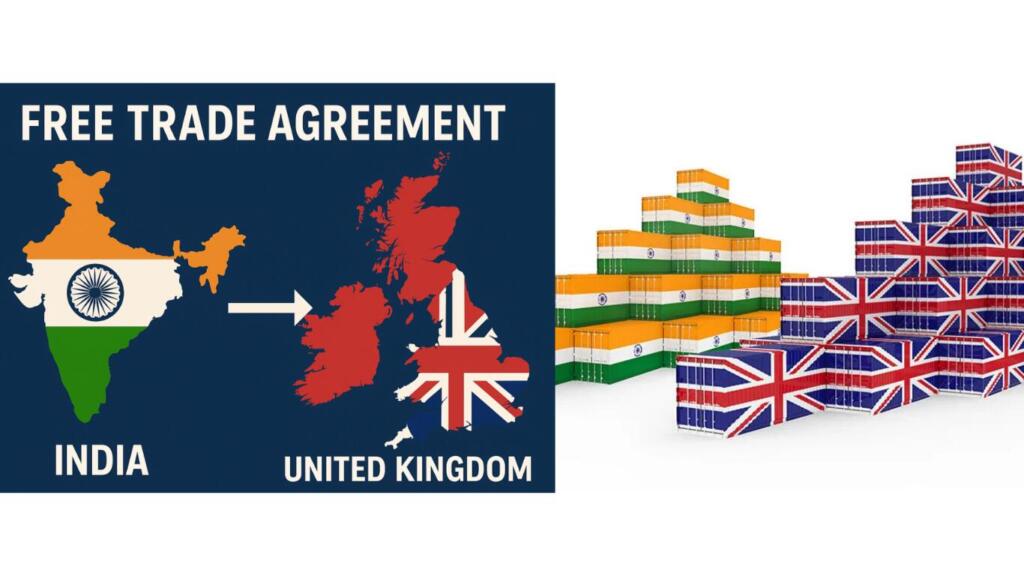
In a landmark step towards deepening bilateral economic ties, the Indian Cabinet has cleared the much-anticipated free trade agreement (FTA) with the United Kingdom. Prime Minister Narendra Modi, who is set to visit London on July 24, will formally sign the Comprehensive Economic and Trade Agreement (CETA) alongside UK authorities. This visit, Modi’s first since Keir Starmer assumed office as UK Prime Minister, marks a significant milestone in post-Brexit trade diplomacy. Accompanied by Commerce and Industry Minister Piyush Goyal, PM Modi aims to double trade volumes and open up vast new sectors to mutual benefit. Here’s a detailed look at what’s at stake.
Cabinet Clears Landmark Deal Ahead of Modi’s UK Trip
The Indian government has officially approved the Comprehensive Economic and Trade Agreement (CETA) with the United Kingdom, paving the way for its signing during PM Modi’s four-day visit to the UK and the Maldives starting Wednesday. The agreement, negotiated over multiple rounds and finalized on May 6, represents the UK’s biggest trade breakthrough since Brexit. The final draft includes detailed chapters on goods, services, innovation, government procurement, and intellectual property rights. Once signed by both commerce ministers, the deal will await ratification by the British Parliament before it can be enforced.
Boost for Indian Export Sectors and UK Imports
The FTA aims to slash tariffs on a wide range of goods and services, particularly those vital to India’s export ecosystem. Labour-intensive sectors such as textiles, leather, footwear, garments, toys, marine products, engineering goods, and organic chemicals stand to benefit immensely. The deal promises to eliminate UK duties—currently 8-12%—on 99% of Indian goods, including apparel and home textiles. In return, India will reduce tariffs on 90% of British goods, with 85% becoming fully duty-free over the next decade. This includes luxury goods like Scotch whisky and premium British automobiles, offering British exporters greater access to the Indian market.
Doubling Bilateral Trade to $120 Billion by 2030
The core ambition of the trade agreement is to double bilateral trade from its current levels to $120 billion by the year 2030. In 2023-24, India-UK trade stood at $21.34 billion, up from $20.36 billion in the previous fiscal year. India’s exports to the UK rose by 12.6% to $14.5 billion, while imports from the UK increased marginally by 2.3% to $8.6 billion. These figures indicate significant untapped potential. The deal will not only address trade imbalance but also ease norms in services and investments, which are crucial for India’s IT and pharmaceutical sectors.
Social Security Pact and Investment Treaty Still in Progress
Apart from the FTA, India and the UK have also concluded negotiations on the Double Contribution Convention Agreement, a social security arrangement that would benefit Indian professionals on temporary work assignments in the UK by avoiding dual social security payments. However, discussions on a broader bilateral investment treaty (BIT) are still underway. The BIT would provide a comprehensive framework for investor protection and dispute resolution, further strengthening investor confidence between the two countries.
India-UK Pact Signals New Era of Economic Cooperation
The India-UK FTA is more than a trade deal—it represents a strategic shift in how India engages with post-Brexit Britain. With both nations eyeing increased investment, job creation, and enhanced market access, the agreement is poised to unlock enormous economic potential. As PM Modi lands in London to formalize the pact, it sends a strong message of India’s growing economic clout and diplomatic reach. With reduced tariffs, expanded service trade, and professional mobility, the pact could redefine the India-UK economic partnership for the next decade—setting a blueprint for future FTAs with other Western powers.