














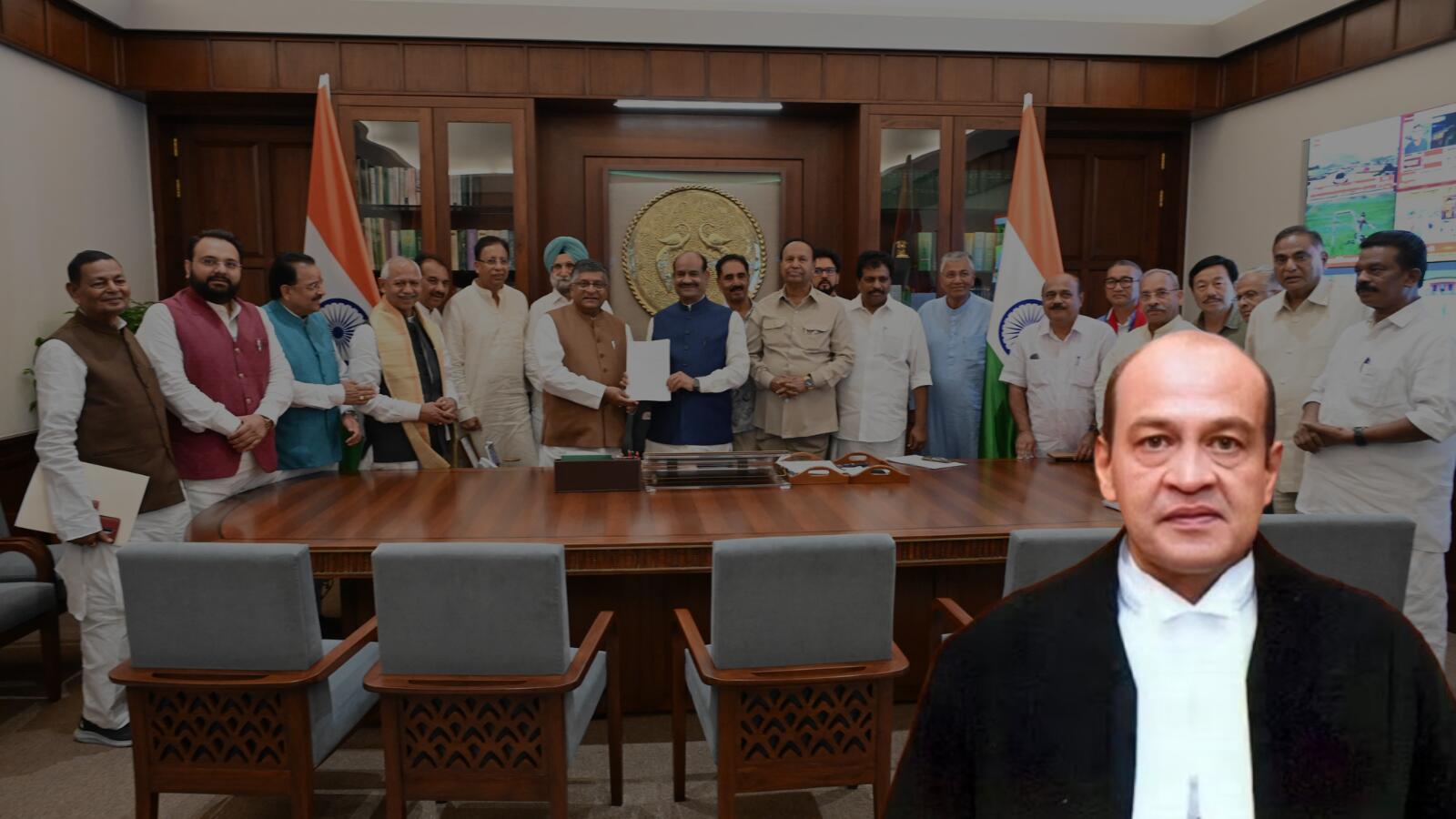
The impeachment proceedings have been initiated against former Delhi High Court judge Justice Yashwant Varma, following shocking revelations related to the recovery of burnt currency notes from his official residence. The move comes after a group of over 145 Members of Parliament, cutting across party lines, submitted a motion to Lok Sabha Speaker Om Birla, calling for his removal. In Rajya Sabha 63 MPs have submitted a similar petition for impeachment of Justice Varma.
The matter first came to light in March this year, when a fire broke out at Justice Varma’s government bungalow on Tughlaq Crescent in central Delhi. Firefighters responding to the incident found partially burnt bundles of ₹500 currency notes in an outhouse on the property. The unusual discovery prompted serious concerns and led to an internal probe ordered by the Supreme Court.
A three-member committee, appointed by then-Chief Justice of India D Y Chandrachud, conducted an extensive in-house inquiry. The panel interviewed 55 witnesses and examined photographs, CCTV footage, and other relevant evidence. In its report, the committee stated that the cash was found in a space accessible only to Justice Varma and his immediate family. It called the incident “highly suspicious” and concluded that there were sufficient grounds to begin impeachment proceedings against the judge.
Acting on the panel’s recommendation, the report was forwarded by Justice Sanjiv Khanna (who succeeded Justice Chandrachud) to President Droupadi Murmu and Prime Minister Narendra Modi. The report clearly stated that Justice Varma’s conduct warranted removal from office, as it appeared to undermine the integrity expected from a sitting judge.
In a significant political development, lawmakers from the ruling BJP, Congress, CPI(M), and several regional parties united behind the impeachment motion. Parliamentary Affairs Minister Kiren Rijiju confirmed that the required number of signatures had been collected and that all parties had shown consensus on the matter. This marks a rare moment of political unity, underscoring the seriousness of the issue.
Justice Varma, meanwhile, has approached the Supreme Court, challenging the in-house committee’s findings. In his petition, he claims that the inquiry was unconstitutional, that he was denied a fair opportunity to present his side, and that the panel overstepped its mandate. He has argued that the committee’s recommendation to impeach him is invalid as it does not follow the procedures laid out in the Constitution. He also questioned the lack of a clear explanation regarding the origin of the cash and the circumstances under which it was burned.
Legal experts suggest that the Supreme Court may have to rule on the maintainability of Justice Varma’s petition before the impeachment process proceeds further. However, with the motion already filed in Parliament and the political establishment showing rare unanimity, the matter is likely to be taken up with urgency.
As per constitutional procedure, the next step would involve the Speaker forwarding the motion to a specially formed committee, which will investigate the charges and submit a report. If the committee upholds the allegations, the motion must then be passed by a two-thirds majority in both the Lok Sabha and Rajya Sabha. Only after that can the President formally remove a judge from office.
This case has reignited conversations around judicial accountability in India. It raises critical questions about oversight within the judiciary and the mechanisms available to ensure transparency. If Parliament follows through with the impeachment, it would be one of the rare instances in India’s democratic history where a High Court judge has been removed for misconduct.
The coming weeks will be crucial as both the judiciary and legislature weigh their respective roles in handling the situation. For now, Justice Varma’s fate lies at the intersection of legal scrutiny and parliamentary action, a test for the integrity of India’s constitutional institutions.