
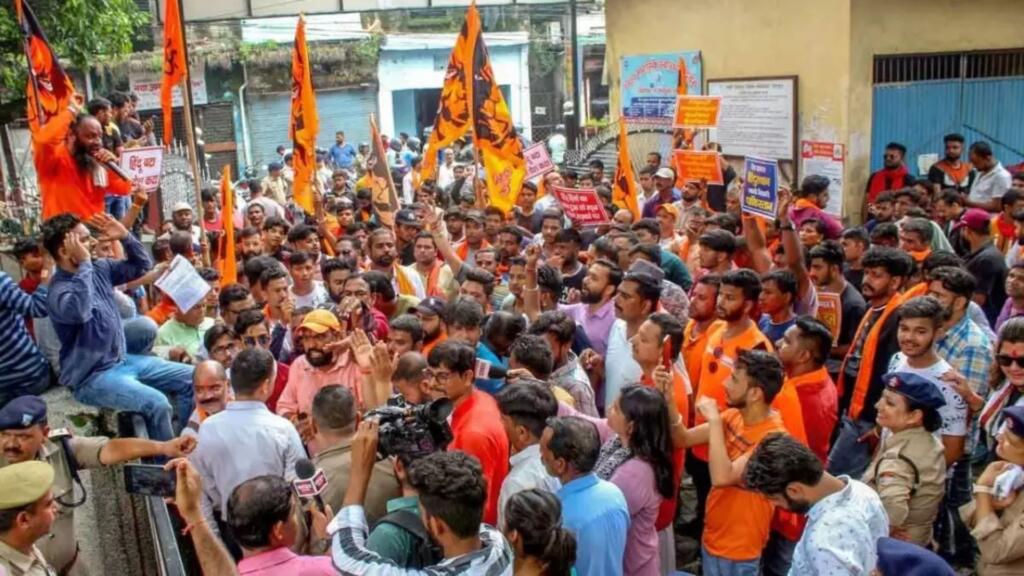
As security personnel flood into Nuh ahead of Braj Mandal Jalabhishek Yatra, a troubling pattern has re-emerged, certain regions in India require the full weight of the state just to ensure that one religious group can practice its faith peacefully. This is not an abstract legal issue. It’s a lived reality in places like Nuh, a Muslim-majority district in Haryana, where law and order seem to buckle under the pressure of communal sensitivities and Hindus cannot even conduct their religious rituals without proper police escort.
In July 2023, the district became the center of communal unrest during the Yatra. As the yatra passed through the Muslim-majority region, clashes broke out, reportedly triggered by provocative content circulating on social media platforms. The unrest quickly spread beyond Nuh, affecting nearby areas such as Gurugram, where incidents of arson and property damage were also reported.
The violence led to the deaths of at least six individuals, including two home guards and left many injured. Several vehicles were set on fire, and damage to both religious places and private property was reported. The episode highlighted the fragile communal balance in the region and raised serious concerns about law enforcement’s preparedness.
Why Does a Procession Needs Paramilitary Backup?
The mere fact that a religious procession needs a high level of security deployment in a democratic country is a red flag. Are we to believe that without this, Hindus in Nuh cannot practice their religion safely? If so, what does this say about the “secular” nature of the nation? What does it say about the enforcement, or lack thereof, of constitutional rights?
Secularism, if it is to be more than a hollow slogan, must mean equal rights and equal restrictions for all. Yet, a troubling perception has grown: that in Muslim-majority areas, the administration often tiptoes, reluctant to apply the same standards of law enforcement that would be routine elsewhere.
State’s Weakness or Strategic Silence?
This is not merely a question of community behavior, it’s a question of the state’s integrity. When certain areas become so communally charged that constitutional freedoms cannot be exercised without security cover, it implies a systemic failure. It suggests that in some places, the Constitution has to be physically “delivered” by force because it’s no longer organically respected by all sections of the population.
Should this not alarm us?
If majoritarianism is problematic in one context, it is problematic in all. If a Hindu-majority area restricted Muslim worship, it would be condemned nationwide, and also worldwide due to the prevailing ecosystem backed forces. Why then does it take armored vehicles and surveillance drones to ensure a Hindu yatra in a Muslim-majority region goes on peacefully?
Selective Secularism Is No Secularism
This selective enforcement undermines faith in institutions and fans resentment amongst the Hindus. True secularism demands that the majority in any area, be it Hindu or Muslim, must uphold the rights of the minority, without needing a battalion stationed on every street corner.
If a religious community anywhere believes that it can control public life, dictate what others can do, or disrupt legally permitted religious activities of another group, the state must act decisively and impartially, not act out of fear or political calculation.
Time for a Hard Rethink
The situation in Nuh exposes a hard truth: “secularism” in India often functions only under duress, and only when enforced by the state. This is not sustainable. The Constitution is meant to be a lived social contract, not a document that needs police reinforcements every time it is invoked.
The challenge ahead is not just communal harmony, but restoring the authority of the Constitution itself and that begins with applying the same standard, fearlessly, everywhere.