
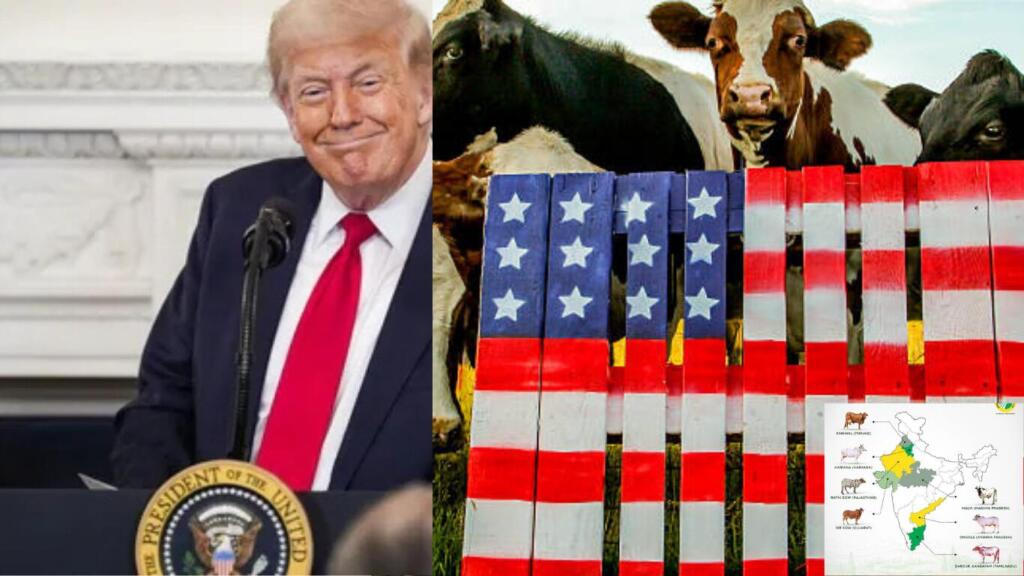
As India and the United States intensify negotiations on a landmark trade agreement, New Delhi has drawn a firm “red line”: no imports of dairy from cows fed animal by-products a non-negotiable demand rooted in deep cultural, religious, and economic concerns. The US, a top global exporter eager to tap into India’s vast dairy market, has criticized the policy as a trade barrier. However, for India home to over a billion consumers and 80 million smallholder dairy farmers any compromise would threaten livelihoods, traditions, and sacred dietary codes. In this high-stakes dialogue, milk isn’t just a commodity it’s a matter of national identity.
Cultural Sensitivities Fueling Dairy Disputes
India’s dairy embargo isn’t merely protectionism it’s preservation. The ban on “non-veg milk” dairy from cows fed animal products like meat by-products, blood, or poultry litter reflects deep-rooted religious and vegetarian principles. Millions of Indians view dairy not only as a dietary staple but also as a ritual necessity used daily in religious worship. Ajay Srivastava of the Global Trade Research Institute explains, “Imagine drinking butter from milk of a cow fed meat or blood. India may never allow that.” Such a violation would affront cultural sensibilities at a fundamental level, making this policy a red line in trade talks.
Economic Stakes: Farmers, Tariffs & Tremors
India produces 239 million tons of milk annually, contributing roughly ₹7.5–9 lakh crore to GDP and supporting over 80 million smallholder farmers. Opening the market to US imports—where dairy exports reached USD 8.22 billion last year would endanger the livelihoods of millions. High tariffs (30% on cheese, 40% on butter, 60% on milk powder) currently protect local producers. According to SBI, dairy liberalization could wipe out ₹1.03 lakh crore annually from the domestic economy. “The whole industry will suffer,” notes a Maharashtra dairy farmer. India’s stance balances economic sovereignty with farmer welfare.
Trade Pushback vs. National Priorities
Washington labels India’s milk rules “unnecessary trade barriers,” arguing certification requirements violate WTO norms. Yet India maintains the ban shrinks the risk of feeding livestock with animal by-products some of which remain legal in American cattle feed, including tallow, poultry litter, and pig blood. Such feeds are banned in India to prevent health concerns and uphold religious dietary purity. The government’s policy requires veterinary certification confirming zero animal-derived feed rejecting pragmatic US alternatives in favor of cultural preservation.
India’s Red Lines & the Path Forward
India’s surprisingly rigid stance on dairy stems not only from economics but from an identity crisis: safeguarding vegetarian traditions from global trade pressures. The government asserts that allowing unrestricted dairy imports would disconnect consumers from sacred practices and destabilize rural livelihoods. As talks move forward, New Delhi stands firm that milk purity must not be compromised—even if it risks scuttling a broader India-US trade pact. The message is unequivocal: the cow, along with its diet, is sacrosanct.
When Milk Becomes a Matter of Principle
India’s battle over dairy imports exemplifies a negotiation where trade metrics collide with cultural identity. While the United States sees growth and profit, India sees tradition, farmers’ welfare, and spiritual heritage. Any deal allowing milk from cows fed animal by-products or undermining the certification process crosses a line that India refuses to budge on.
As talks forge ahead, India is drawing its red line in pure butter, not red tape. What may seem like market inflexibility is, in fact, a stand for sovereignty—with every drop of milk carrying centuries of culture and community. In the world of international trade, India’s dairy stance proves: some commodities are priceless.