
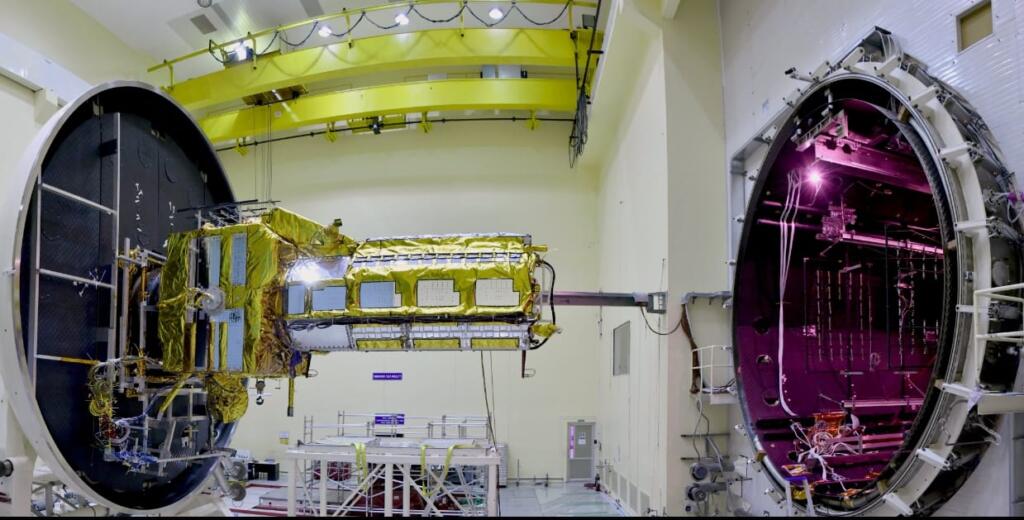
In a landmark development for global Earth observation and space cooperation, the Indian Space Research Organisation (ISRO) and the National Aeronautics and Space Administration (NASA) are set to launch the NASA-ISRO Synthetic Aperture Radar (NISAR) satellite today at 5:40 PM IST from the Satish Dhawan Space Centre, Sriharikota.
The satellite, weighing 2,393 kg, will be carried into low Earth orbit aboard ISRO’s Geosynchronous Satellite Launch Vehicle F16 (GSLV-F16). NISAR represents the world’s first Earth-imaging satellite to utilize dual-frequency synthetic aperture radar, a significant technological leap designed to enable continuous, high-resolution monitoring of the Earth’s surface in all weather conditions, day and night.
The NISAR mission is one of the most advanced scientific collaborations between the United States and India. Jointly developed by NASA and ISRO, the satellite is a product of nearly a decade of cooperation, bringing together complementary expertise in radar technology, satellite engineering, and launch capabilities.
Dual-Frequency Radar: Seeing the Invisible
With an estimated mission cost of $1.5 billion, NISAR stands among the most expensive Earth observation satellites ever built.
What makes NISAR unprecedented is its ability to operate in two radar frequencies:
L-band (24 cm wavelength)
Built by NASA, this longer wavelength radar can penetrate through vegetation, ice, and soil. It is highly effective for monitoring large-scale processes such as tectonic shifts, glacier and ice sheet dynamics, and forest biomass.
S-band (10 cm wavelength)
Developed by ISRO, this radar is optimized for measuring surface-level deformations, making it ideal for tracking land subsidence, urban infrastructure shifts, and agricultural activity.
Together, these radars enable NISAR to detect surface changes as small as one centimeter, delivering ultra-precise measurements across varied terrains, from dense forests and farmlands to urban landscapes and polar regions.
Significance and Applications
NISAR is designed to orbit the Earth at an altitude of 743 kilometers, completing 14 orbits per day, and will scan the entire Earth’s surface every 12 days. The mission is expected to operate for at least three years, though extensions are likely based on performance.
The satellite will support a wide range of applications:
Disaster Management
NISAR will significantly enhance early warning systems and disaster response by monitoring:
Earthquakes, tsunamis, and volcanic activity via ground deformation detection
Floods and landslides in vulnerable terrain
Storm tracking and post-disaster damage assessment
Climate and Environmental Research
NISAR’s radar will aid in understanding the impacts of climate change by:
Measuring ice mass balance and glacier retreat
Monitoring deforestation, forest degradation, and carbon sequestration
Tracking wetland loss and coastal erosion
Agriculture and Resource Monitoring
The satellite will assist governments and agencies with:
Crop mapping, growth tracking, and yield estimation
Monitoring soil moisture and drought conditions
Assessing water resource distribution and land use changes
Notably, all data collected by NISAR will be freely and openly available to scientists, governments, institutions, and the public worldwide typically within 1–2 days of acquisition, and within hours during emergencies.
Technical Setbacks and the Path to Launch
While the mission was originally scheduled for March–April 2024, it faced a critical delay due to a technical anomaly. During final integration and pre-launch thermal testing, NASA engineers identified that the 12-meter radar reflector, when folded inside the rocket’s payload fairing, could experience overheating from solar radiation during launch and early orbital phases.
The reflector was subsequently returned to NASA’s Jet Propulsion Laboratory (JPL) in California for analysis and corrective measures. A highly reflective thermal coating was applied to mitigate heat absorption, and the antenna underwent extensive environmental testing to ensure safe deployment in space.
Further delay occurred due to orbital constraints between October 2024 and February 2025. During this period, the satellite would experience frequent transitions between sunlight and shadow, posing thermal stability risks. Launch planners therefore opted to defer the mission to July 30, 2025, ensuring ideal orbital lighting conditions.
Legacy Missions That Paved the Way for NISAR
The NISAR mission is the culmination of decades of Earth observation advancements by both ISRO and NASA, drawing heavily on their extensive heritage in radar imaging, remote sensing, and international collaboration.
ISRO’s Indian Remote Sensing (IRS) satellite series, beginning with IRS-1A in 1988, laid the foundation for high-quality, civilian Earth observation, with subsequent satellites like IRS-1C, IRS-1D, and the Cartosat series delivering critical data for agriculture, forestry, land use, and disaster management.
Complementing this, the ResourceSat missions focused on agricultural and natural resource monitoring, while the RISAT series introduced radar imaging capabilities under all weather and lighting conditions particularly with C-band (RISAT-1) and X-band (RISAT-2) SAR systems, setting the stage for ISRO’s contribution of the S-band radar to NISAR.
The two agencies also collaborated on earlier missions like Megha-Tropiques and SARAL, establishing frameworks for shared goals and operations. The concept for NISAR itself emerged from NASA’s 2007 Decadal Survey, which highlighted the value of radar for observing crustal deformation, glaciers, and ecosystems; interests aligned with ISRO’s focus on monitoring landslides, glaciers, and agriculture.
These cumulative efforts not only supplied the technical knowledge and instrumentation required but also forged the institutional synergy that would make NISAR the world’s first dual-frequency SAR Earth observation mission, a groundbreaking leap in global environmental science.
A Symbolic Moment for Indian Space Science
Ahead of the high-stakes launch, ISRO Chairman S. Somanath Narayanan and senior scientists visited the Sri Chengalamma Temple in Sullurpet, located in the Tirupati district, to seek divine blessings for the mission’s success.
Addressing media, Narayanan stated, ‘With the NISAR launch, India will once again fly the flag of victory.’ He emphasized the strategic and scientific importance of the mission, noting that NISAR strengthens India’s global role in cutting-edge climate and disaster science.
Looking Forward
NISAR is poised to become one of the most capable Earth observation missions in operation, offering insights that are not just scientific but deeply humanitarian. From protecting communities against natural disasters to informing climate negotiations with precise environmental data, the satellite will play a key role in understanding and managing the dynamic changes on our planet.
As the GSLV-F16 prepares for ignition, the world awaits a mission that is not just about launching a satellite but about launching a new era of international space cooperation, climate resilience, and technological advancement.