
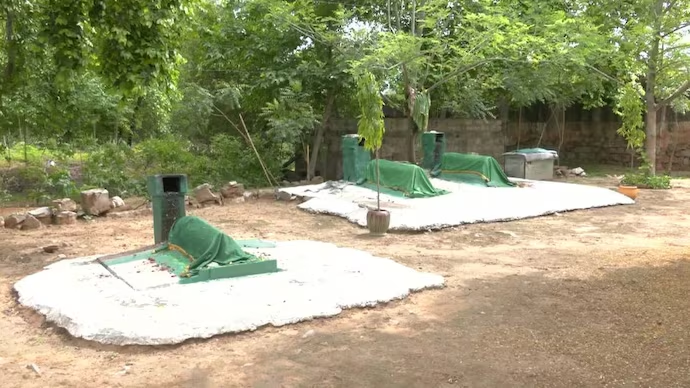
Three Islamic Mazars were recently discovered within the college premises at Maharani College, in Jaipur. The revelation of these unauthorised structures has ignited controversy, with serious allegations of an attempt to encroach upon institutional land. Many see this as a growing trend where religious structures are quietly built in sensitive or public areas, only to later be declared as waqf properties. This incident has alarmed Hindu groups and heritage activists who fear a larger conspiracy to grab government and educational institution lands under the guise of religious sanctity.
Shrines Spark Fury, Heritage Group Alleges Conspiracy
Bharat Sharma, head of the Dharohar Bachao Sanrakshan Samiti, was among the first to raise the alarm. In a video that has gone viral on social media, Sharma is seen inside the campus appealing to the college administration to act swiftly and remove the shrines. He strongly alleged that the construction was a part of a premeditated conspiracy aimed at illegally occupying the land through misuse of the Waqf Act. “Today they build small shrines. Tomorrow they claim it’s waqf land. This is how land jihad works,” he said, warning of mass protests if the administration failed to act.
According to reports, the shrines were found near the college pump house and water tank, inside a high-walled compound, hidden from plain view. What has raised more suspicion is that even many students were unaware of their presence, sparking questions on when and how they were built.
College Principal Gives Vague Response
The college principal Payal Lodha was reached out for a clarification by activists. Her response, however, left more questions than answers. “I joined as principal only last December. These shrines appear to be a few years old. This is an educational institution and our focus is on academics,” Lodha said. She refrained from confirming whether the shrines were illegal or an attempt to grab land, nor did she clarify if the administration plans to remove them.
The lack of a firm stance from college authorities has further angered activists and concerned citizens, who believe that delaying action would only strengthen illegal claims to the land. Several right-wing groups have now called for a thorough investigation into the origin of the shrines and whether they were registered under the Waqf Board without institutional consent.
Potential Waqf Encroachment Raises Alarm
The core of the concern lies in what comes next. Once such shrines are left undisturbed, there is a pattern often observed in India where Muslim organisations move to declare the area as waqf property. Under existing laws, such declarations can make it nearly impossible for the original landholders to reclaim the space. Hindu organisations warn that this is a systematic land grab technique that needs urgent legal reform.
Activists say such moves begin subtly with small religious structures erected without permission. After some time, waqf boards are roped in, who then lay claim to the land citing religious use. This has resulted in multiple legal battles across the country, often stretching over decades. In educational institutions and public properties, this tactic not only poses a threat to land ownership but also disrupts the secular, academic atmosphere.
Previous Incidents Reflect a Dangerous Pattern
This is not the first time such an incident has surfaced. In 2022, illegal dargahs were found constructed on railway land in Uttar Pradesh. In Mumbai, several shrines were discovered in public parks and footpaths, later claimed as waqf property. A similar issue erupted in Delhi when a 150-year-old temple was demolished during a road widening project, but nearby unauthorised dargahs were left untouched.
In many of these cases, local administrations either delayed action due to vote bank pressure or were entangled in legal red tape once the Waqf Board got involved. The result is a slow but consistent encroachment of public land across India, often ignored by mainstream discourse.
Time for Firm Administrative Action
The discovery of Islamic shrines inside Maharani College is not just a local issue; it is a reflection of a nationwide problem that has long been brushed under the carpet. Hindu groups and nationalists are right in demanding immediate investigation and action. Educational institutions should remain centres of learning, not silent battlefields for demographic and religious assertions. Allowing unauthorised religious structures to stand unchecked sets a dangerous precedent. It is time for the administration to assert its authority, remove illegal encroachments, and ensure that no religious entity – waqf or otherwise – can exploit public land under the pretext of faith.