
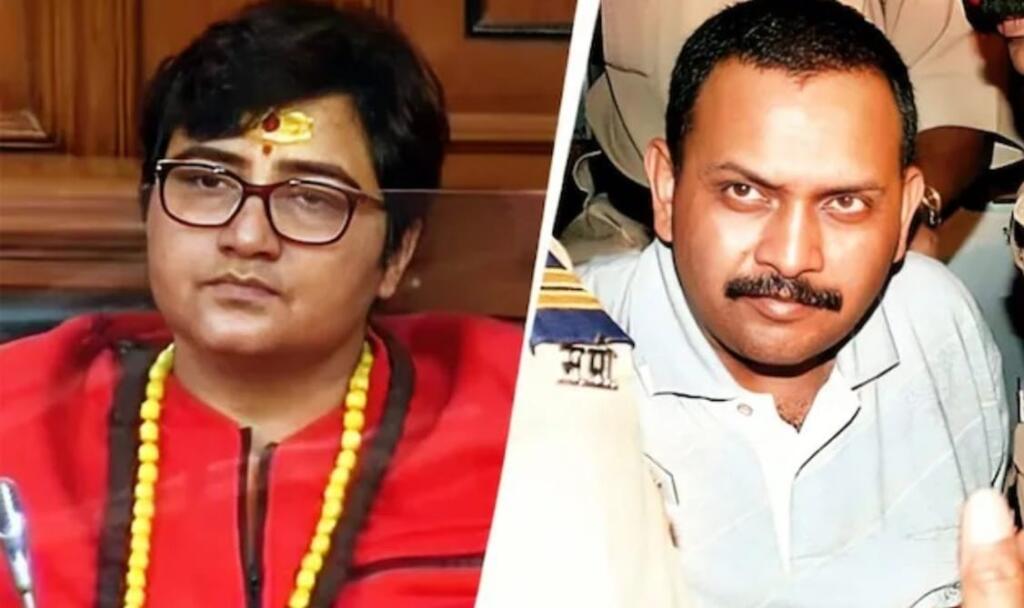
Seventeen years after a bomb exploded in the crowded bylanes of Malegaon during the holy month of Ramzan, killing six and injuring over 100, a special court in Mumbai has acquitted all seven accused in the 2008 Malegaon blast case. The court said there was no direct evidence to connect any of the accused to the crime, bringing a dramatic end to a case that once redefined how India debated terrorism and political bias in investigations.
The acquitted include high-profile names such as Sadhvi Pragya Singh Thakur, a sitting BJP MP, and Lt Colonel Prasad Shrikant Purohit, a serving Army officer at the time of his arrest. The verdict has reignited discussions about the narrative of ‘saffron terror’ and raised serious questions about the investigation led initially by the Maharashtra Anti-Terrorism Squad (ATS), later taken over by the National Investigation Agency (NIA).
Here is a closer look at the seven individuals who were accused of orchestrating the blast but have now been declared innocent by the judiciary.
1. Sadhvi Pragya Singh Thakur
A prominent face of the Bharatiya Janata Party and currently a Member of Parliament from Bhopal, Sadhvi Pragya was the first person to be arrested in the case. The Maharashtra ATS had alleged that the motorcycle used in the Malegaon blast belonged to her. The NIA, however, later stated that while the vehicle was indeed once registered in her name, it had long been in the possession of an absconding accused, Ramchandra Kalsangra, and there was no evidence that Pragya Thakur was aware of its use in the crime.
The court noted that the vehicle’s chassis number was never conclusively recovered, and no fingerprints from the scene could be traced back to her. She was granted bail in 2017 on medical grounds. The court now confirms there is no material proof linking her to the explosion, and no role in the planning or execution could be established.
2. Lt Col Prasad Shrikant Purohit
An officer in military intelligence at the time, Purohit was accused of playing a central role in the conspiracy. The ATS claimed that he was involved in acquiring RDX. Purohit, in his defence, consistently stated he was operating undercover to gather intelligence on radical groups and had kept his senior officers informed.
The court categorically stated that no RDX was found at his residence. Furthermore, the evidence presented failed to prove he ever assembled or transported the bomb. The judge also found the confession extracted under MCOCA provisions inadmissible, since MCOCA was later withdrawn from the case by the NIA itself.
The Army officer revealed that he was subjected to inhumane treatment, worse than that given to enemy prisoners of war. He alleged that officers like Hemant Karkare, Param Bir Singh, and Col Shrivastav relentlessly pressured him to falsely confess to the Malegaon blast. They also tried to coerce him into naming senior RSS and VHP leaders, including then MP Yogi Adityanath.
3. Major (Retd) Ramesh Upadhyay
A retired Army officer, Upadhyay was alleged to have helped facilitate meetings among the accused as part of the group ‘Abhinav Bharat’, which was suspected to have planned the blast. Investigators claimed that he supported logistics for the plot. However, the court said the prosecution failed to establish any such meetings took place in the manner described.
No witness or document placed Upadhyay at any planning session directly connected to the bombing. He was in custody for several years before being granted bail.
4. Ajay Rahirkar
According to the charges, he allegedly facilitated funding that went toward sourcing the explosive material and organising meetings. But the court found no transaction trail, no recorded communication, and no witness testimony that could prove this claim.
His name, like others, had initially been justified through confessions extracted under MCOCA but those confessions were later deemed legally inadmissible when the court ruled that MCOCA was wrongly applied.
5. Sudhakar Dwivedi (alias Dayanand Pandey)
A self-proclaimed spiritual guru, Dwivedi was dubbed the ‘ideological brain’ behind the conspiracy. The ATS alleged that he was the philosophical motivator of Abhinav Bharat and played a role in conceptualising the retaliatory attack.
The court, however, found this theory speculative. Key witnesses turned hostile, and no concrete digital or physical evidence was found that linked him to any actionable role in the bombing. The judge remarked that ‘material witnesses did not support the prosecution’s case,’ particularly in reference to Dwivedi’s alleged influence.
6. Sudhakar Chaturvedi
Another accused alleged to have been close to Purohit, Chaturvedi was charged with aiding in the storage of explosives and participating in planning meetings. However, the court said no forensic or independent corroborative evidence supported this claim. His alleged presence in certain locations was not backed by mobile location data, surveillance, or witness testimony.
7. Sameer Kulkarni
Linked to Abhinav Bharat, Kulkarni was accused of attending key conspiracy meetings. He was among those who spent several years in custody before getting bail. Once again, the case against him rested largely on confessions that were rendered legally irrelevant once MCOCA was dropped. In court, no independent proof of his participation in any plot or communication related to the blast was produced.
What Did the Court Say?
Special NIA Court Judge A.K. Lahoti delivered a firm and detailed verdict, stating that ‘mere suspicion cannot take the place of legal proof’ and that the case lacked the evidence needed for conviction. He observed that there was no direct link between any of the accused and the blast, nor any reliable chain of events built from the prosecution’s claims.
‘The incident was grave, but the court cannot convict on moral grounds,’ the judge said. He also held that the UAPA sections were invoked without proper procedural sanction and slammed the ATS for relying on legally inadmissible confessions made under pressure and questionable legal frameworks.
Further, the court gave a clean chit to the organisation ‘Abhinav Bharat’, which had been at the centre of the prosecution’s narrative, saying it found no evidence that the group was formed to or used to carry out terrorist activities.
Political and Investigative Fallout
The Malegaon blast case had far-reaching consequences in Indian politics. For years, it was cited as a textbook example of ‘Hindu terror’ or ‘saffron terror’. Senior leaders of the Congress party at the time including then Home Minister P. Chidambaram and party president Sonia Gandhi were accused by the BJP of selectively targeting Hindu groups.
Following the acquittal, BJP leaders are already calling the verdict a ‘total collapse’ of the Congress’s ‘malicious narrative,’ demanding accountability from those who, they allege, falsely dragged Sanatan Dharma and the Army into the terror debate.
Meanwhile, questions remain over the credibility of the initial probe by the Maharashtra ATS. With key aspects of the investigation now dismissed by the court, including ownership of the blast vehicle, conspiracy meetings, and role of Abhinav Bharat; the case has become a cautionary tale about mixing politics with policing.
The Malegaon blast case was more than just a criminal investigation; it was a battleground for ideological, political, and religious narratives. The court’s verdict that not one of the seven accused could be linked to the 2008 explosion is not only an acquittal for the individuals, but also an indictment of how the case was handled.