
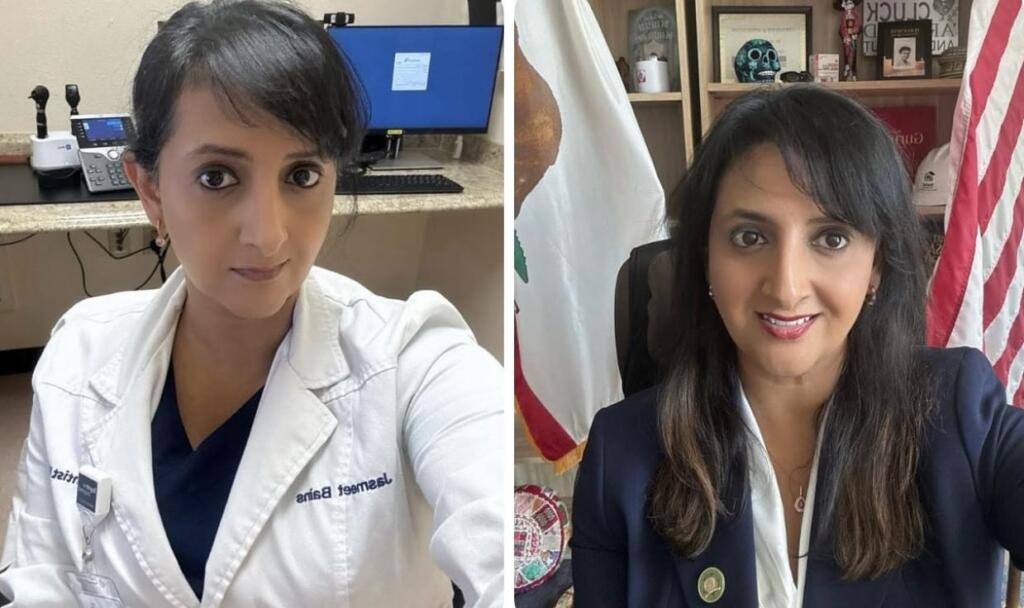
California Assemblywoman Dr. Jasmeet Bains, a physician-turned-politician has launched her campaign for the U.S. House of Representatives from California’s 22nd Congressional District. But her candidacy is drawing sharp criticism and concern from segments of the Indian-American community over her ties to Khalistani ideology and anti-India positions.
Bains finds herself at the center of a storm of online allegations and diaspora outrage centered not just on her recent Congressional bid, but on her past legislative actions that critics claim echo anti- India narratives.
Khalistan Allegations
Over the past several weeks, social media has lit up with posts accusing Bains of being a ‘Khalistani sympathiser’- a charge tied primarily to her co-authorship of controversial California legislation and a 2023 resolution. The legislation, Assembly Bill 3027, now known as Senate Bill 509, seeks to address ‘transnational repression’- foreign governments surveilling or intimidating diaspora communities in the U.S. The bill has been cheered by pro-Khalistani groups and criticized by many Indian-Americans who fear it could cast ordinary Hindus and Indian-origin individuals as foreign agents.
In addition, Bains sponsored a resolution recognizing the 1984 anti-Sikh riots in India as a ‘genocide’, a move that some Hindu-American organizations called politically divisive and historically contentious. Critics argue that the resolution weaponizes past tragedies to build support among separatist factions and paints the entire Indian state as complicit, further deepening distrust.
Bill Tied to Global Tensions
The scrutiny surrounding SB 509 intensified in 2023 after the U.S. Department of Justice indicted an Indian national for plotting to assassinate Khalistani figure Gurpatwant Singh Pannun in New York. Around the same time, Canadian Prime Minister Justin Trudeau accused Indian agents of involvement in the killing of another separatist, Hardeep Singh Nijjar, in British Columbia.
Against that backdrop, the timing of the bill’s introduction backed by Bains and fellow lawmakers Anna Caballero and Esmeralda Soria has sparked alarm among Indian-American organizations who feared the bill was designed to institutionalize suspicions against Indian-origin voices in the U.S. While Sikh civil rights groups praised the bill for ‘protecting marginalized communities,’ other diaspora members see it as a dangerous legislative door to surveillance and profiling.
A Divided Diaspora
Bains’ rising profile has revealed deep and growing fractures within the Indian diaspora in the United States. Hindu groups argue that her actions risk inflaming religious tensions and reviving extremist Khalistani rhetoric under the guise of human rights.
Organizations such as the Coalition of Hindus of North America (CoHNA) and the Hindu American Foundation (HAF) have warned of a disturbing rise in anti-Hindu sentiment in the political landscape, though neither group has directly named Bains in official statements.
Some diaspora members have gone so far as to label her ‘the next Ilhan Omar,’ referring to the controversial Congresswoman accused of fostering sectarian division in U.S. politics. Terms like ‘anti-Hindu,’ ‘anti-India,’ and ‘Khalistani pawn’ have flooded message boards and campaign threads.
Born and raised in California’s Central Valley, Bains is a first-generation Indian-American and practicing family doctor. She won her Assembly seat in 2022. The growing allegations and international controversies do raise a doubt about her credibility as a community leader.
What’s Next?
Bains has not publicly responded to the growing accusations of Khalistani alignment, nor has she clarified her position on Indian unity or separatist movements. As her campaign gains momentum, the spotlight on her past actions, affiliations, and policy decisions will only intensify.
For Indian-American voters, especially in California’s politically active Central Valley, the question looms: Is Jasmeet Bains a political figure entangled in separatist rhetoric and diaspora divisions?
The answer could shape not just her race for Congress, but the future of Indian-American politics in the United States.