
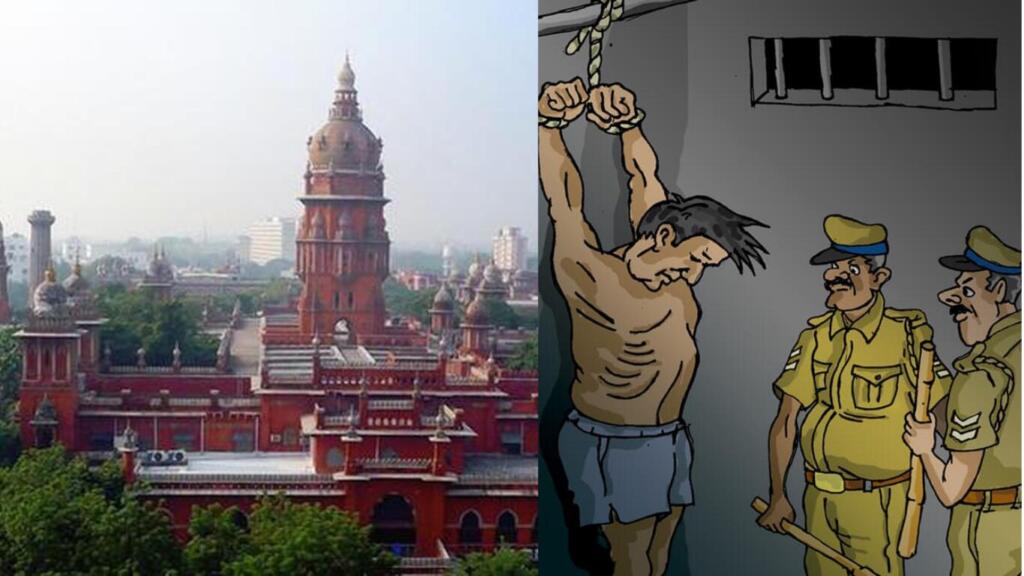
A judicial probe supervised by the Madras High Court has confirmed that 27-year-old Ajith Kumar, a temple guard in Tamil Nadu’s Sivagangai district, died due to custodial violence. The confirmation has reignited outrage across the state, especially as public anger turns toward the ruling DMK government for its failure to curb police brutality and protect basic human rights. Ajith was arrested in connection with an alleged jewellery theft case and died within 24 hours of being taken into custody. His death, initially dismissed by the police as a medical episode, has now been exposed as a brutal custodial killing. The judicial inquiry lays bare the DMK government’s inability to maintain rule of law and enforce accountability within its police force.
Arrest, Assault, and a Fabricated Story
Ajith Kumar was picked up by the police on June 27 for questioning in connection with a minor theft case. Shockingly, instead of being taken to a police station, he was brought to a cowshed for interrogation a highly irregular and illegal act. The next day, he was declared dead. Police initially claimed Ajith suffered an epileptic seizure while trying to flee custody. However, this version quickly fell apart when a disturbing video surfaced showing Ajith being savagely beaten with sticks by uniformed personnel.
The post-mortem report later confirmed what many had feared this was no natural death. Medical examiners documented 44 distinct injuries, including deep bruises, internal bleeding, and blunt force trauma to major organs like the brain, heart, and liver. The autopsy clearly pointed to prolonged and repeated physical assault. Such brutality raises serious questions about the police culture under the DMK regime and whether such abuse has tacit political approval through systemic negligence.
High Court Steps In Amid DMK Silence
As outrage spread across Tamil Nadu, the Madras High Court ordered a judicial inquiry into the death. The court’s involvement came after mounting public pressure and the failure of the state government to take meaningful action. Under intense scrutiny, five police officers were arrested, but the larger question remains who enabled this kind of lawless policing?
The High Court’s judicial probe did not mince words. It concluded unequivocally that Ajith Kumar was the victim of custodial violence. The Central Bureau of Investigation (CBI), now handling the case, is reportedly evaluating whether to add more names to the list of accused based on the probe findings. The court’s intervention stands in stark contrast to the DMK’s delayed and half-hearted responses. Chief Minister MK Stalin and his administration have yet to offer any meaningful assurance or compensation to Ajith’s family.
Systemic Failure Under the DMK Watch
The DMK government, which had once promised reform, transparency, and humane policing, has failed miserably. This isn’t the first instance of custodial torture in Tamil Nadu under DMK rule. Critics argue that Ajith Kumar’s death is not an isolated incident but part of a broader pattern of unchecked police violence enabled by political indifference.
The scale of Ajith’s injuries including subscalp contusions and petechial haemorrhaging in internal organs suggests torture over a sustained period. Experts believe this could not have happened without a network of complicity, possibly involving higher-ups in the department. Yet, despite the gravity of the case, the DMK government has avoided strong public condemnation of the officers involved, fueling suspicion of a cover-up.
The silence from key DMK ministers has further angered the public. In many districts, protests have erupted, demanding justice for Ajith and greater accountability from the ruling party. Civil rights groups and opposition leaders have accused the DMK of shielding a violent and corrupt police culture that treats citizens, especially those from marginalized communities, as disposable.
CBI Probe Underway Amid Public Outrage
Now under the purview of the Central Bureau of Investigation, the case is gaining national attention. Officials say they are reviewing the judicial report to determine if additional officers should be charged. The judicial probe’s detailed forensic assessment has been central to this process.
With 44 external and internal injuries, the probe left no doubt about the nature of Ajith Kumar’s death. The report found signs of blunt force trauma not compatible with a single incident but consistent with extended abuse using hard objects such as rods or batons.
CBI sources suggest more arrests may follow. Meanwhile, the DMK regime is being questioned over how such an atrocity could happen in a state that claims to uphold social justice. It remains to be seen whether this incident will become a turning point in addressing custodial torture — or just another forgotten headline.
DMK’s Hollow Promises Exposed
Ajith Kumar’s custodial death has exposed a deep rot within Tamil Nadu’s law enforcement, worsened by the DMK government’s apathetic response. The judicial confirmation of a brutal custodial murder puts the ruling party in the dock for its failure to deliver on promises of police reform. When accountability is missing from the top, such tragedies are not just possible they are inevitable. As the CBI expands its probe and civil society calls for justice grow louder, the DMK must answer: how many more Ajith Kumars must die before systemic change is enforced?