
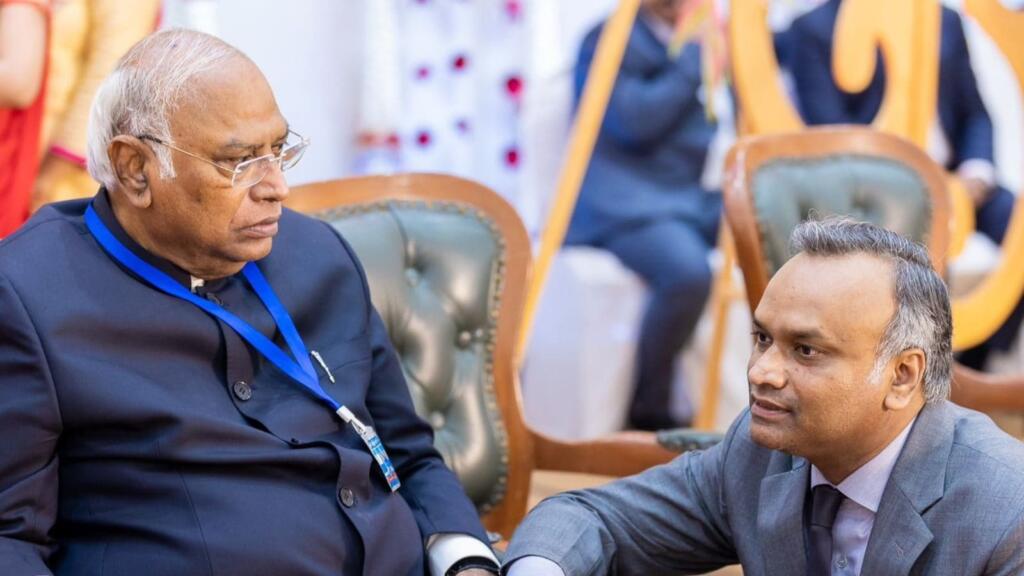
Karnataka Minister Priyank Kharge, son of Congress national president Mallikarjun Kharge, has reignited political controversy by calling for a ban on the Rashtriya Swayamsevak Sangh (RSS), alleging that the organization poses a threat to the Constitution. While such remarks aren’t new in political circles, the timing of his statement is raising questions.
The Congress party’s latest call to ban the RSS may do more political damage to the grand old party. The call is being seen as an attack on a nationalist, cultural organisation with deep roots in Indian society.
The RSS is viewed by millions as a symbol of Hindu identity and cultural pride. By openly advocating for its ban, the Congress risks reinforcing the perception that it is hostile to Hindu interests, a label the party has been trying to shake off for years.
The Congress’s past and present associations with parties like the Indian Union Muslim League (IUML) have further fueled criticism. The IUML, which has often been accused of identity-based politics, is frequently portrayed by right-wing groups as being at odds with Hindu cultural values. Congress’s continued electoral alliances with such parties only deepen the narrative that it is appeasing minorities at the cost of Hindu sentiment.
A Strategic Distraction?
The Congress in Karnataka is currently dealing with internal friction, especially between Chief Minister Siddaramaiah and Deputy Chief Minister D.K. Shivakumar, both of whom have strong support bases and ambitions for the top post.
Against this backdrop, Priyank Kharge’s comments are being viewed by some as a deliberate attempt to shift public attention away from the ongoing leadership rift. As the son of the party’s national chief, it’s possible his remarks are aimed at easing the pressure on his father, who is under scrutiny for not being able to resolve the Karnataka power tussle effectively.
By reviving the issue of banning the RSS—a consistent political adversary of the Congress—Priyank may be trying to reframe the narrative to focus on ideological issues rather than internal party struggles.
How Many Times Has RSS Been Banned by Congress?
Historically, the RSS has been banned three times, and each time under Congress governments:
1948 – After Mahatma Gandhi’s assassination, the RSS was banned amid accusations that its ideology had influenced the assassin, Nathuram Godse. The ban was lifted in 1949 after the RSS agreed to adopt a constitution and limit its political involvement.
1975 – During the Emergency, declared by then Prime Minister Indira Gandhi, the RSS was banned again along with several other political and civil organizations that were critical of the government.
1992 – Following the demolition of the Babri Masjid in Ayodhya, the Congress government under P.V. Narasimha Rao banned the RSS, accusing it of contributing to communal tensions. The ban was later revoked.
These bans have been criticized as politically driven and, in some cases, seen as attempts to curb dissent rather than maintain law and order.
Performance vs. Politics
Priyank Kharge’s recent call to ban the RSS could be more about managing political optics than addressing real policy concerns. With the Congress facing infighting and leadership disputes in Karnataka, targeting the RSS may help divert attention and rally support among secular voters.
Critics argue that the call to outlaw the RSS, an organization with a vast network and deep grassroots presence, is both politically motivated and strategically flawed. At a time when the party is struggling to manage infighting in Karnataka and maintain stability in states like Rajasthan and Himachal Pradesh, targeting ideological rivals appears to be a diversionary tactic rather than a solution-driven strategy.
Several Congress-ruled states are grappling with administrative challenges, delayed implementation of welfare schemes, and internal power struggles. Observers note that instead of addressing these pressing issues, the Congress leadership appears to be focusing on reviving ideological debates, possibly to distract from governance shortcomings. The call to ban the RSS in this context seems more about political optics than public interest. If Congress hopes to remain relevant it must focus less on ideological battles and more on effective leadership, policy delivery, and unity within its own ranks.