
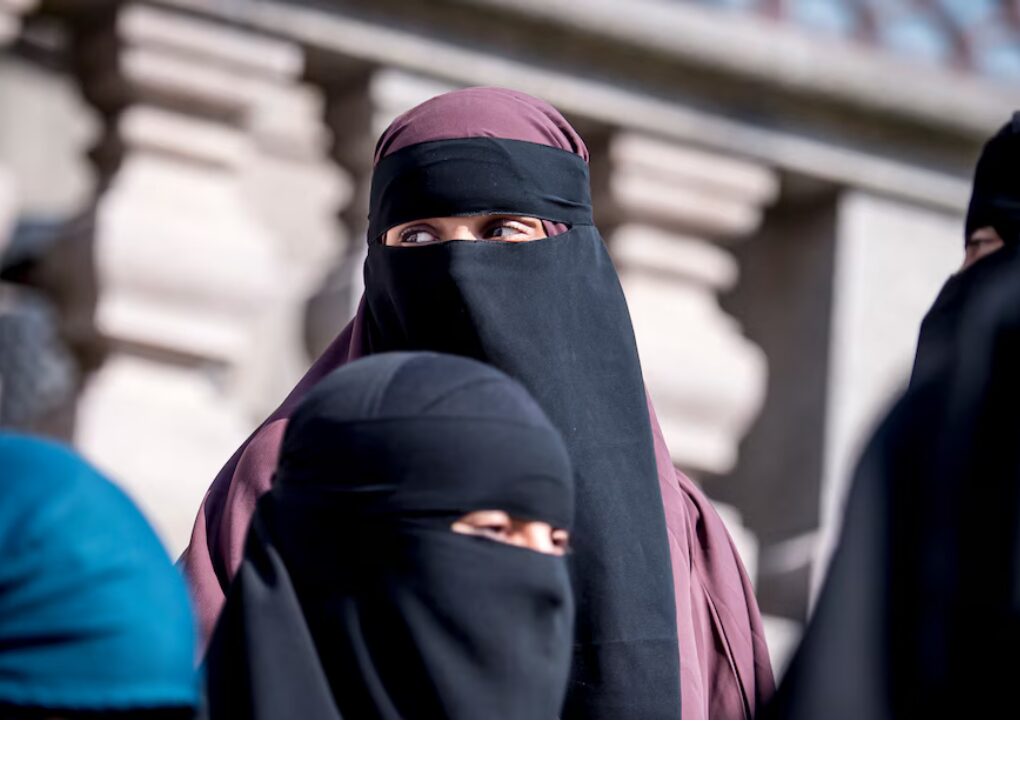
In a country as diverse and democratic as India, the freedom to practice one’s religion is a constitutional guarantee. But let’s be clear: this freedom is not, and should not be, a license to undermine national security, public safety, or social accountability. The niqab- a full-face veil worn by some Muslim women has become more than a symbol of modesty. Increasingly, it is being misused as a tool for concealment, deception, and in some cases, criminal activity. The time has come for India to legislate a nationwide ban on the niqab in public spaces.
This is not about policing religious identity. It’s about restoring clarity and accountability in public life. It’s about ensuring that no piece of cloth; no matter how religiously symbolic is allowed to shield lawbreakers or obstruct public safety.
Misused as a Cloak for Crime
Let’s start with the facts. The niqab has been repeatedly abused as a disguise in serious criminal cases:
In Patna (August 2024), Mohammad Asif, accused of kidnapping and raping an 11-year-old girl escaped court by disguising himself in a burqa. He was eventually caught, but not before exposing how easily face-covering garments can be used to undermine our judicial system.
Back in Kashmir (2015), a militant dressed in a burqa shot and killed a police officer in broad daylight in Pampore. Witnesses couldn’t identify the attacker, proving how full-face veils can be exploited for deadly purposes.
And it doesn’t stop there. In cities like Mumbai, Pune, and Delhi, multiple reports have emerged of individuals wearing burqas or niqabs to rob banks, loot jewelry stores, and slip through crowded markets undetected- effectively using the garment as a cloak for crime.
These are not rare cases. They point to a systemic vulnerability- one that any responsible state should address swiftly and firmly.
A Clear and Present Risk to Public Safety
Visibility is fundamental to public safety. A niqab obscures not only the face but also identity, facial expressions, and intent- three critical cues in law enforcement, surveillance, and interpersonal interaction. At a time when India is increasingly reliant on facial recognition technology in airports, metro stations, and public surveillance grids, permitting full-face coverings is an open invitation to exploitation.
In Delhi, a recent near-miss traffic accident involving a niqab-clad driver highlighted another concern: impaired visibility. The fabric not only shielded the face from identification but clearly posed a visual hazard behind the wheel. How long before this results in fatal consequences?
No Place for Ambiguity in Law
India already regulates face coverings in limited settings. The Karnataka High Court in 2022 ruled that wearing a hijab was not an essential religious practice and could be restricted in educational institutions that mandate uniforms. The Kerala-based Muslim Educational Society (MES) has also prohibited niqabs in its institutions.
Why then is the niqab still permissible in courts, metro stations, airports, and public protests?
If helmets are disallowed inside banks or public buildings, if even medical masks must be removed for identity verification; how is it that a religious garment, used and misused with impunity, gets a free pass?
This Is Not Islamophobia, It’s Policy Clarity
Let’s preempt the predictable outcry: this is not an attack on Islam. In fact, many Islamic scholars and Muslim-majority countries including Turkey, Tunisia, and even parts of Egypt have regulated or banned face coverings in public life, recognizing that such practices are cultural, not core religious obligations. Kazakhstan too has joined the league by banning naqab in public places.
In India, we must stop cowering behind a distorted idea of secularism that demands silence in the face of legitimate concerns. Secularism means neutrality, not paralysis. It means protecting the rights of all citizens including the right to feel secure in a crowd where everyone is visibly accountable.
What India Must Do Now
A national ban on the niqab in public spaces is not just reasonable, it is overdue. The legislation should be:
Gender-Neutral: Apply to all face coverings, including masks, helmets, or any fabric that obscures the face, unless for medical or weather-related reasons.
Limited in Scope: Exclude places of worship or private property, but cover schools, courts, public transport, banks, and government buildings.
Sensitive but Firm: Offer clear guidelines, transitional awareness campaigns, and respectful enforcement but no exemptions based on personal interpretation of religious mandates.
A Choice Between Freedom and Fear
This is about protecting freedoms- the freedom to walk in public without fear, the freedom of law enforcement to do their job, and the freedom of victims to seek justice without their attackers hiding behind veils. True democracy doesn’t indulge loopholes in the name of tolerance; it closes them in the name of justice.
Let’s be clear: a niqab ban is not discrimination, it is discernment. It is a policy rooted in reason, not bigotry. And India, with its deep respect for diversity and law, must lead the way in choosing safety over symbolism.