
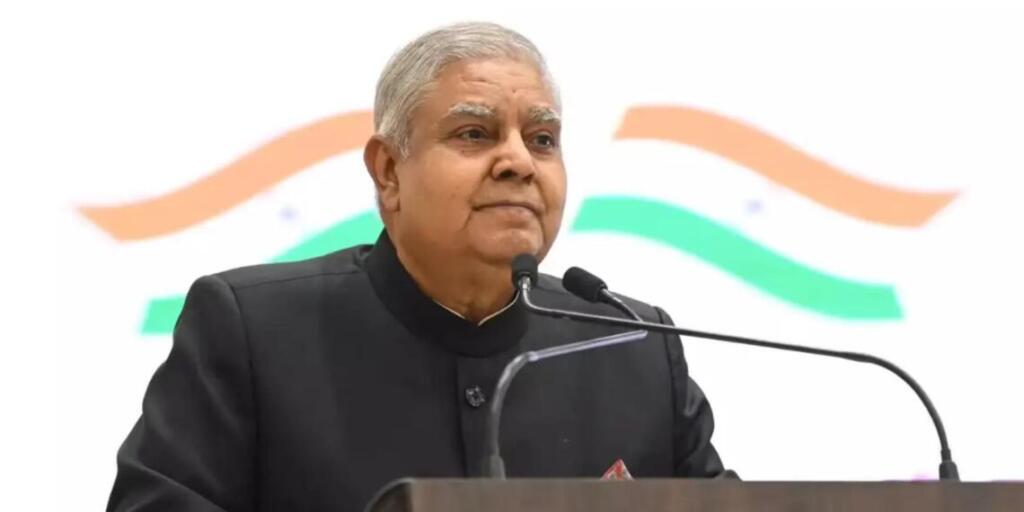
In a move that caught the entire political establishment off guard, Vice-President Jagdeep Dhankhar tendered his resignation yesterday (July 21), triggering a flurry of speculation and strategic maneuvering within the BJP and Parliament. His sudden decision, coinciding with the very first day of the Monsoon Session, has created a vacuum in the Upper House of Parliament. Unlike previous Vice-Presidential resignations, Dhankhar’s move didn’t come ahead of a presidential bid, raising pressing questions about the reasons behind this dramatic step. Now, as BJP MPs have been asked to remain stationed in Delhi, a new political chapter may be unfolding in real time.
A Surprise Move That Shook Parliament
Jagdeep Dhankhar’s resignation as Vice-President of India came without prior political indications. While he had been presiding as the ex-officio Chairman of the Rajya Sabha with noticeable authority and alignment with the Modi government’s policies, his exit now raises eyebrows. According to highly placed sources, the groundwork for this development was laid just hours earlier. Parliamentary Affairs Minister Kiren Rijiju reportedly held discreet meetings with BJP Rajya Sabha MPs in small groups on July 21 at Defence Minister Rajnath Singh’s residence. There, MPs were confidentially informed of the Vice-President’s decision and were made to sign on blank papers a move that reflects swift behind-the-scenes preparation for what is likely to be an intense political exercise in the coming days.
BJP Locks In for the Next Battle
Following Dhankhar’s resignation, the BJP has moved quickly into election mode. All BJP MPs have been asked to stay put in Delhi for the next 14 days, underlining the urgency of the party’s plans. The leadership is keen to complete the Vice-Presidential election before political uncertainties take root or Opposition parties attempt to leverage the vacuum in the Rajya Sabha. While the name of the new candidate is still under wraps, insiders suggest the party is evaluating several senior figures, including governors and former chief ministers who have maintained a strong nationalist and constitutional image.
The BJP’s strategy indicates a clear intent: maintain stability in Parliament and ensure ideological continuity at the top. Dhankhar’s exit has opened a power node, and the selection of his successor will likely be a politically symbolic choice leading into the next general elections.
The Constitutional Process: How India Elects Its Vice-President
The Vice-President of India is elected under Article 66 of the Indian Constitution. The election is conducted through a secret ballot by an electoral college comprising members of both Houses of Parliament—Lok Sabha and Rajya Sabha, including nominated members. The election is held by the Election Commission of India using a system of proportional representation by means of a single transferable vote.
Unlike the President’s election, where state legislatures also participate, the Vice-Presidential election remains confined to Parliament. Once elected, the Vice-President holds office for a term of five years. However, there is no bar on resignation before the term ends, as seen in the rare case of Jagdeep Dhankhar. The other two earlier resignations—V.V. Giri and Bhairon Singh Shekhawat—were made when the then VPs contested the presidential polls. Dhankhar’s case stands apart and begs deeper inquiry since he has made no such intention clear.
Who Will Be the BJP’s Choice?
Speculation is rife about who the BJP will field as its Vice-Presidential nominee. Will it be a party veteran, a retired bureaucrat, or a symbolic choice representing either southern or northeastern India? The party has used such constitutional positions in the past to deliver both administrative efficiency and political messaging. With the Rajya Sabha’s proceedings now temporarily without a presiding officer, BJP’s urgency stems from its intent to keep parliamentary business streamlined, especially key bills related to reforms and national security.
Names doing the rounds include individuals with RSS backgrounds, known nationalists, and leaders who have stood firmly for dharmic values and constitutional propriety. The party’s aim is clear: bring in a figure who strengthens the ideological line it has drawn under the Modi-Shah era and one who ensures the Upper House doesn’t become a battleground for obstruction.
A Political Puzzle with Strategic Undertones
Jagdeep Dhankhar’s resignation may have come as a shock, but it appears far from unplanned. As the BJP recalibrates quickly for the upcoming Vice-Presidential election, the political landscape is shifting once again in Delhi. With high-level meetings already underway and tight control being exercised over its parliamentary unit, the ruling party is unlikely to leave anything to chance.
What remains to be seen is the real reason behind Dhankhar’s sudden departure. Was it internal dissent, a shift in political strategy, or groundwork for an even higher office? Whatever the cause, one thing is clear—Delhi’s political corridors are buzzing, and India is once again witnessing democracy’s dynamic churn.
Nadda Breaks Silence: Clarifies No Disrespect Meant to Vice-President Dhankhar
BJP National President J.P. Nadda, in an on-record interaction with reporters, categorically refuted speculation that Vice-President Jagdeep Dhankhar resigned due to any personal slight or protocol breach by senior BJP leaders. Dismissing claims that his and Kiren Rijiju’s absence from the key Business Advisory Committee (BAC) meeting triggered Dhankhar’s decision, Nadda clarified the situation with precision.
“Kiren Rijiju and I could not attend the 4:30 PM meeting convened by the Hon’ble Vice-President as we were preoccupied with other important parliamentary duties. However, prior intimation about our absence had already been shared with the Vice-President’s office,” Nadda said.
He also addressed the viral video clip where he was heard saying “what I am saying will be on record.” Nadda clarified that this remark was aimed squarely at opposition MPs who were repeatedly disrupting the proceedings, and not at the Vice-President, dispelling any misinterpretation of disrespect.