
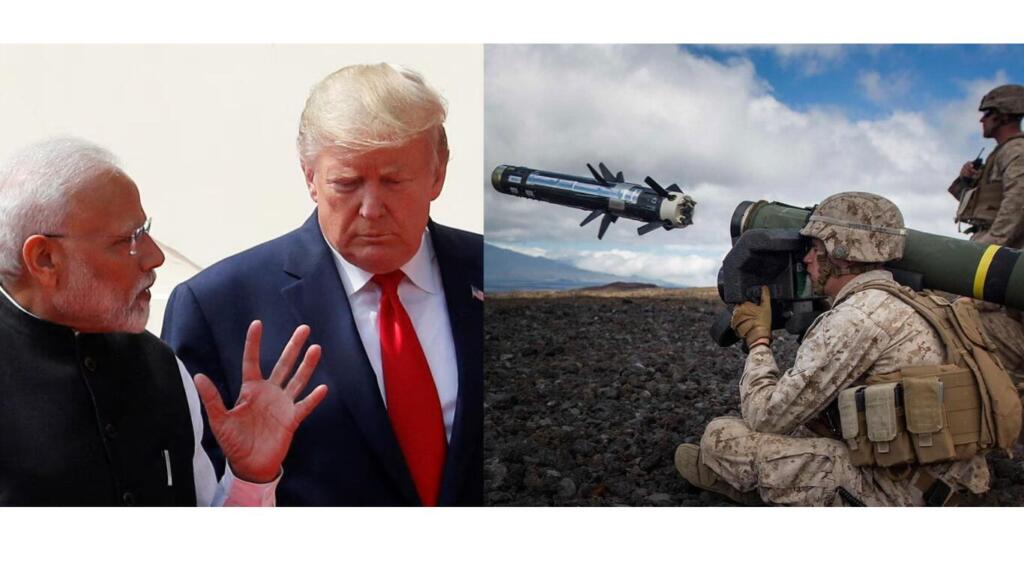
India has officially submitted a Letter of Request (LoR) to the United States for the co-production of the Javelin anti-tank guided missile (ATGM) system, signaling a major leap forward in the nation’s defense preparedness and industrial capability. This move comes as part of the Modi government’s renewed focus on indigenization under the ‘Make in India’ initiative and amid growing regional threats from Pakistan and China. With the Javelin being one of the most advanced third-generation shoulder-fired ATGMs, this development is poised to significantly bolster India’s anti-tank warfare capacity and reduce reliance on external suppliers during emergencies.
India Pushes for Co-Production of Javelin Missiles
In a strategic move to fortify India’s defense self-reliance, a top defense official confirmed that a formal proposal has been submitted to the U.S. authorities for the joint production of the Javelin missile system. “The talks are in advanced stages,” the source added. This proposal aligns with India’s Make in India agenda, seeking not only to acquire cutting-edge missile systems but to ensure transfer of technology and domestic manufacturing capability.
The Javelin missile, jointly developed by U.S. defense giants Raytheon and Lockheed Martin, is known for its fire-and-forget capability, portability, and high precision against armored targets. India’s defense forces are especially keen on acquiring lightweight, shoulder-fired systems that allow for rapid deployment in mountainous terrain, such as Ladakh and Arunachal Pradesh, where confrontations with Chinese PLA troops are intensifying.
Modi-Trump Push for Strategic Defense Ties
The proposal comes just months after Prime Minister Narendra Modi’s working visit to the United States in February 2025, which laid the groundwork for expanded defense cooperation. That visit, marked by his meeting with U.S. President Donald Trump, produced several key agreements aimed at enhancing interoperability between the two militaries. A highlight of those discussions was the expected co-production of both the Javelin ATGMs and the Stryker Infantry Combat Vehicles.
A new 10-year Framework for the U.S.-India Major Defense Partnership was announced, covering a wide spectrum—from anti-tank missiles and drones to fifth-generation fighter jets and maritime systems. The recent phone conversation between Defence Minister Rajnath Singh and U.S. Defence Secretary Pete Hegseth reaffirmed the mutual urgency to deliver on pending arms deals, including the Javelin missile system.
The Pentagon, in its July 2 statement, emphasized the United States’ view of India as its “key defense partner in South Asia” and reiterated its support for co-development and co-production models that foster technology sharing and supply chain integration.
Bolstering Border Security Against China and Pakistan
India’s interest in the Javelin system is deeply rooted in its strategic imperatives. With increasing security concerns along both the Line of Actual Control (LAC) with China and the Line of Control (LoC) with Pakistan, the ability to quickly deploy highly effective anti-tank weapons is vital. The Javelin system, capable of destroying heavily armored tanks, bunkers, and even low-flying helicopters, could be a game-changer in future conflicts.
The Indian Army has already expressed its preference for systems that reduce troop burden while maximizing firepower, especially in forward bases that are logistically hard to access. This becomes even more critical as India looks to restructure its battlefield posture, relying more on agile and technologically superior weapon platforms.
Further, with China investing heavily in hypersonic systems and unmanned combat vehicles, India’s acquisition and localized production of such advanced anti-armor capabilities will be crucial in maintaining credible deterrence.
Beyond Javelins: A Broader Indo-US Defense Vision
The Javelin deal is just one piece of a larger puzzle. India is also set to acquire six more P-8I maritime reconnaissance aircraft, while talks are ongoing for expanding cooperation in undersea warfare, space-based systems, and autonomous platforms. Collaborations between U.S. firms like Anduril Industries and Indian counterparts such as the Mahindra Group for unmanned aerial systems are already underway.
Notably, India and the U.S. are expected to sign a Reciprocal Defence Procurement (RDP) agreement soon. This deal will align acquisition mechanisms, allow for smoother maintenance and overhaul logistics, and enable joint participation in global defense value chains.
The two countries have also agreed to review their arms transfer regulations, a move that could further ease technology sharing and co-production, which has often been held up by export restrictions and bureaucratic delays in the past.
As part of the broader strategic partnership, India has expressed interest in fifth-generation fighter platforms. Although discussions on the F-35 remain tentative due to cost, interoperability issues, and strict U.S. monitoring requirements, other platforms and co-development proposals are expected to move forward rapidly under the new framework.
Strategic Autonomy Through Co-Development
India’s push for co-producing Javelin missiles reflects a pragmatic shift in its defense strategy—moving from being a buyer to becoming a strategic partner in high-end defense manufacturing. By localizing the production of advanced missile systems, India can not only boost operational readiness but also create a resilient domestic ecosystem that sustains future needs without foreign bottlenecks.
As regional tensions escalate and the need for rapid, effective defense responses grows, joint ventures like the Javelin missile co-production deal represent India’s intent to achieve true strategic autonomy. It also cements the U.S.-India defense partnership as a vital pillar of South Asian security in the coming decades