
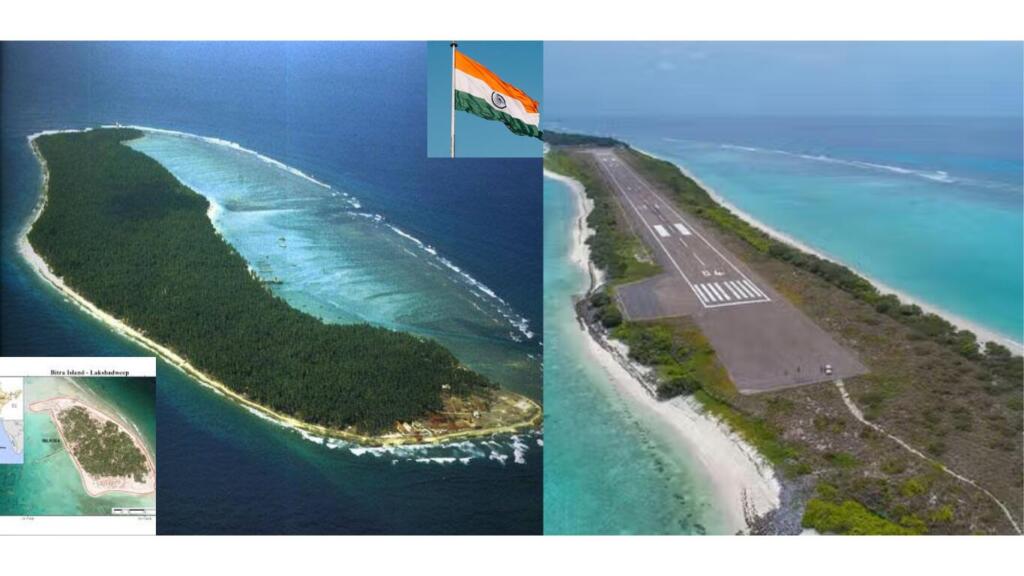
In a major step aimed at strengthening India’s maritime security and establishing strategic dominance in the Arabian Sea, the Central Government has initiated the process to take over Bitra Island, a part of the Lakshadweep archipelago, for defence use. Situated in a geopolitically sensitive zone, Bitra holds immense significance for India’s national security framework. The island, currently inhabited by around 105 families, is being earmarked for military and strategic operations. The administration has issued a notification for a Social Impact Assessment (SIA), marking the beginning of a legal and structured acquisition process that adheres to the Right to Fair Compensation and Transparency in Land Acquisition, Rehabilitation and Resettlement Act, 2013.
The move is a part of India’s broader vision to build an impenetrable maritime perimeter and assert its strategic presence near vital sea lanes, especially amid growing challenges in the Indian Ocean Region (IOR) from adversarial nations and non-state actors. In times where naval power has become central to regional stability, India is prioritizing indigenous infrastructure upgrades on key islands.
Building a Robust Naval Presence in Lakshadweep
This isn’t the first strategic move in Lakshadweep. Just last year, the Ministry of Defence commissioned INS Jatayu, a full-fledged naval base on Minicoy Island, further reinforcing India’s maritime surveillance and deterrence capability. The commissioning of such bases aligns with India’s long-term defence doctrine which seeks to dominate the surrounding seas and protect key shipping lanes that carry nearly 70% of India’s imports and exports.
INS Jatayu, which evolved from a naval detachment, will soon boast enhanced airfield infrastructure, improved residential facilities, and expanded logistical support for India’s defence personnel. The Bitra acquisition fits seamlessly into this strategic expansion plan, and the island could become a vital node in India’s naval grid across the western coast.
With Pakistan’s Gwadar port increasingly under Chinese influence and the PLA Navy frequently entering the Indian Ocean, India’s decision to build stronger bases in Lakshadweep is both timely and necessary. The defence forces will have quicker response capabilities, broader maritime reach, and better surveillance of international waters from this forward post.
Social Impact Assessment Follows Legal Norms
The Revenue Department of Lakshadweep has officially initiated the Social Impact Assessment process to ensure that the transfer of Bitra Island is done in a transparent and consultative manner. The SIA will take into account the concerns of the local population and Gram Sabha while aligning with national interests. According to the notification, the island’s strategic location and national security relevance necessitate its handover to defence and strategic agencies.
It is important to note that this move isn’t arbitrary or rushed. The SIA, mandated by law, ensures that all voices are heard and compensation, where applicable, is just. The Department of Revenue has been listed as the project developer and public consultations are being planned to include all stakeholders. Far from being a forced acquisition, this reflects a democratic process in service of national security.
While local Member of Parliament Hamdullah Syeed has expressed political concerns and voiced his support for the island’s residents, it is vital to understand that national security cannot be compromised. India’s geographical location demands foresight and readiness in defence planning — and Bitra’s acquisition reflects that prudence.
A Move Rooted in National Interest and Maritime Vision
The proposed acquisition of Bitra Island by the Central Government is a bold yet necessary step to safeguard India’s national security in a region witnessing heightened geopolitical activity. In a time when India is rising as a regional and global power, securing maritime boundaries has become non-negotiable.
The government’s decision must be seen not as an imposition, but as an investment in the nation’s future defence architecture. As India faces multiple security threats from state-sponsored terrorism to hostile naval intrusions the need for forward military installations in strategic zones like Lakshadweep is paramount.
India isn’t militarizing the islands arbitrarily it is safeguarding its sovereignty, securing sea lanes, and preparing for any eventuality. The move to take over Bitra Island is not just strategic it is visionary. It reflects a government that is assertive, nationalistic, and committed to defence self-reliance, hallmarks of the Modi-led administration.
In a region where only the prepared survive, India is stepping ahead boldly, decisively, and unapologetically.