
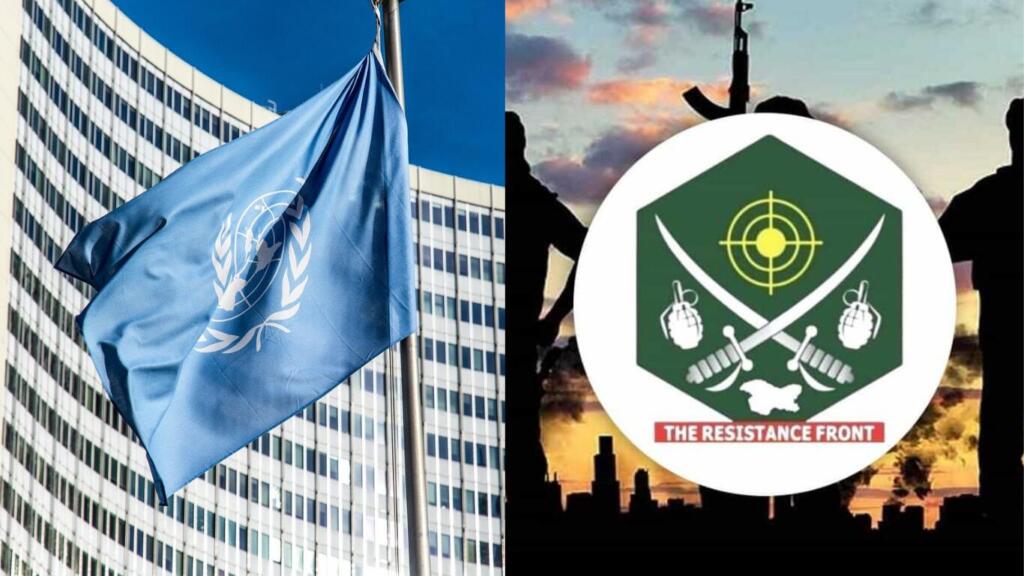
India has moved a step closer to achieving a significant counterterrorism milestone getting The Resistance Front (TRF) designated by the United Nations Security Council (UNSC). In a pivotal development, the UNSC’s Monitoring Committee has officially named TRF in its latest report, marking the most definitive international acknowledgment of the terror group’s links to Lashkar-e-Taiba (LeT). This is seen as a critical precursor to the Sanctions Committee’s potential action against the group.
The report, which reviewed recent terror incidents in South Asia, referenced TRF’s role in the Pahalgam terror attack and highlighted its likely coordination with Pakistan-based LeT. Notably, a member state has confirmed the operational link between TRF and LeT, further validating India’s long-standing position on Pakistan’s use of proxy groups to foment unrest in Jammu and Kashmir.
UNSC Names and Shames TRF
The Monitoring Team’s report is particularly significant because all references included in its findings are cleared by consensus among UNSC members, making them difficult to manipulate or contest. In this context, TRF’s naming is a diplomatic triumph for India and a blow to Pakistan, which had recently claimed to have succeeded in removing TRF’s mention from a previous UNSC press statement.
The report does more than name TRF—it draws attention to the group’s propaganda efforts, including releasing photographs of the Pahalgam attack site to incite unrest. The Monitoring Committee also warned that terror groups could exploit ongoing regional tensions, urging the international community to ramp up vigilance and counterterrorism strategies.
This development reflects the global community’s growing awareness of Pakistan’s strategy of using modern-sounding terror proxies such as TRF and “People Against Fascist Front” to obscure the involvement of banned outfits like LeT and Jaish-e-Mohammed (JeM). This is the first time since 2019 that LeT or any of its affiliates have been referenced in an official UN report—underscoring the seriousness of the matter and Pakistan’s deepening international isolation on this issue.
Pakistan’s Narrative Collapses
Pakistan’s long-running narrative of plausible deniability has now taken a major hit. In the past, Islamabad tried to mask its terror infrastructure by launching groups with secular-sounding names to give their actions an indigenous appearance. TRF, which emerged after the abrogation of Article 370, was among Pakistan’s latest attempts to reinvent LeT under a new banner.
Earlier this year, Pakistan’s Foreign Minister boasted in the National Assembly that his country had successfully lobbied to exclude TRF’s name from UNSC documents. However, the Monitoring Team’s report has flatly contradicted this assertion, restoring the reference to TRF and validating India’s claims.
Indian diplomatic sources highlighted the significance of this reversal, stating, “Pakistan’s strategy of plausible deniability—using secular and modern names like ‘The Resistance Front’ and ‘People Against Fascist Front’—now stands punctured.”
U.S. Adds TRF to Global Terror List
India’s campaign against TRF also received a major boost from the United States. On July 17, the U.S. Department of State designated TRF as a Foreign Terrorist Organization (FTO) and placed it on the list of Specially Designated Global Terrorists (SDGT). The U.S. explicitly cited TRF’s operational links with Lashkar-e-Taiba in its designation.
This international alignment was highlighted in Parliament by External Affairs Minister Dr. S. Jaishankar. “When the UNSC discussed the Pahalgam attack in April, Pakistan defended TRF. The Pakistani Foreign Minister even called it a diplomatic win that TRF wasn’t mentioned. Today, thanks to our diplomacy, TRF has not only been named by the UN but also designated by the U.S.,” he said in the Lok Sabha on July 28.
Dr. Jaishankar also referred to the extradition of Tahawwur Rana—a U.S. national wanted for his role in the 2008 Mumbai attacks—as another example of India’s robust diplomatic efforts. “People asked where our diplomacy was. Rana is now in Indian custody because of that diplomacy,” he asserted.
UN Warns of Rising Terror Threat in the Region
While naming TRF and linking it to LeT was a critical step, the report also provided a broader assessment of terror threats in the region. It identified ISIL-Khorasan (ISIL-K) as the most dangerous group in Central and South Asia, with around 2,000 fighters. Alarmingly, ISIL-K has reportedly established suicide training programs for minors, indoctrinating children as young as 14.
Tehrik-i-Taliban Pakistan (TTP), with about 6,000 fighters, is also on the radar. Several UN member states indicated that the TTP continues to receive support from factions within Afghanistan and has maintained tactical cooperation with ISIL-K. The convergence of these networks poses a significant risk for regional and international security.
India’s Credibility Strengthened, Pakistan’s Denials Exposed
The inclusion of The Resistance Front in the UN Monitoring Committee report and its designation by the United States marks a watershed moment in India’s global counterterrorism campaign. For years, India has highlighted how Pakistan has operated a terror ecosystem under the veil of new names and narratives. Now, international institutions are echoing that view.
This isn’t just a diplomatic success; it’s a strategic one that brings India closer to global consensus on tackling state-sponsored terrorism. With Pakistan’s narrative crumbling under international scrutiny, India’s consistent efforts to expose terror proxies are now gaining the validation and momentum needed to bring lasting change in global counterterror policy.
As the UNSC Sanctions Committee takes up TRF’s case next, India stands on firmer ground than ever before—armed with evidence, international support, and a strengthened voice on the world stage.