
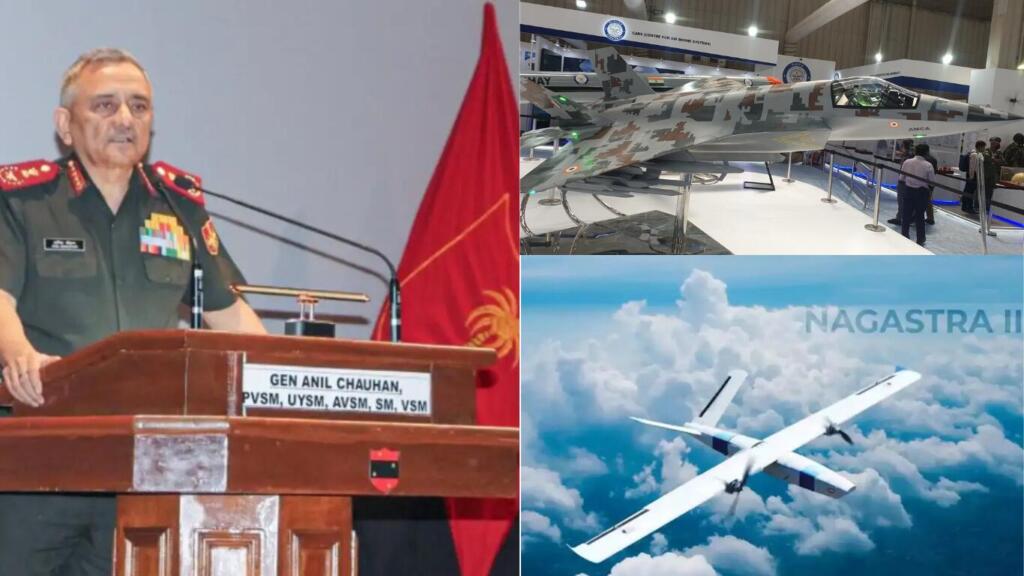
In a resounding message to the nation and the armed forces, India’s Chief of Defence Staff (CDS), General Anil Chauhan, declared that outdated weapon systems cannot win modern wars. Referencing the successful “Operation Sindoor” India’s precision response to the Pahalgam terror attack — General Chauhan hailed the effectiveness of indigenous drone and counter-drone technologies that thwarted Pakistan’s drone attacks without a single loss. His words are more than just a caution; they mark a definitive shift in India’s defense posture — a future-ready, technologically-empowered doctrine built on indigenous strength. From strategic bombers to AI-powered unmanned systems, India is racing to shed decades of dependency on foreign arms. Today, Indian-made weapons like the Tejas, Akash, Nagastra, and SkyStriker aren’t just supporting our forces — they are defining the new standard in 21st-century warfare.
Operation Sindoor: Victory Through Technology and Tactics
On May 10th, during Operation Sindoor, Pakistan launched a drone offensive using loitering munitions and surveillance UAVs. However, Indian forces displayed unmatched readiness. Using a hybrid mix of kinetic weapons and electronic warfare systems, Indian troops neutralised the incoming threats with clinical precision. Some drones were even captured intact, showcasing not just India’s capability but also its technological edge.
General Chauhan highlighted how the operation signified the transition from conventional defense to smart warfare. Indigenous systems like the Akash surface-to-air missile batteries, DRDO-developed radar suites, and the NAGASTRA series of indigenous kamikaze drones played a decisive role. “These new weapons are smaller, faster, more efficient and cost-effective,” the CDS explained, emphasizing how warfare has evolved from brute strength to intelligent mobility and automation. Systems like the SkyStriker, developed under the ‘Make in India’ initiative, further amplified the Army’s ability to conduct tactical strikes with minimal exposure.
From Tejas to AMCA: The Sky is No Longer the Limit
India’s indigenisation wave in aerospace began with the LCA Tejas project — and has now accelerated with the AMCA (Advanced Medium Combat Aircraft) and the upcoming ULRA (Ultra Long-Range Aircraft) stealth bomber. Tejas, now operational in the Indian Air Force with several squadrons, has proven itself in air superiority roles and precision attack missions.
The AMCA, expected to take flight in the early 2030s, is India’s answer to the fifth-generation stealth fighters fielded by global powers. Designed with stealth, supercruise, and AI-powered avionics, AMCA will significantly strengthen India’s aerial dominance.
Meanwhile, the ULRA bomber project is a game-changer. With an intended range of 12,000 km — surpassing even America’s B-21 Raider — this indigenous stealth bomber will allow India to conduct surgical or nuclear strikes anywhere in the world, without mid-air refueling. It draws inspiration from Russia’s TU-160 and will likely carry BrahMos-NG missiles, short-range nuclear payloads, and laser-guided munitions. This bomber will elevate India’s deterrence posture, making the nation a true global air power.
Boost to Ground Forces: Javelin Co-Production and Beyond
India’s ground warfare capabilities are also undergoing a rapid transformation. In a significant strategic move, India has pushed for co-production of the American Javelin Anti-Tank Guided Missile. This will bolster the Indian Army’s firepower against enemy armor, especially in high-altitude battlefields like Ladakh or Arunachal Pradesh.
Additionally, the Indian Army continues to induct Pinaka rocket launchers, Prachand attack helicopters, and swarm drone systems to stay ahead of adversaries. The indigenous Combat Management Systems (CMS) are also being integrated across land and naval platforms. These AI-enabled systems will ensure faster threat detection, response, and neutralisation in both hot war and grey zone conflict scenarios.
Furthermore, DRDO has made notable progress with the Nag anti-tank missile, Smart Anti-Airfield Weapon (SAAW), and the Rudram series of anti-radiation missiles. These developments underline a clear message: the Indian military is no longer reliant on imports for critical strike capabilities.
Indigenous Drones Lead the Charge in Tactical Warfare
Drones are no longer support tools; they are now central to war strategy. The Army, Navy, and Air Force are rapidly deploying Indian-made UAVs like Archer-NG, TAPAS-BH, and quadcopter swarms. The use of indigenous loitering munitions during Operation Sindoor marked a turning point in Indian drone warfare, allowing troops to neutralise enemy targets without exposing themselves.
Counter-drone systems, such as those deployed during Operation Sindoor, combine jamming, spoofing, and hard-kill solutions, offering a multi-layered defense shield against UAV threats. CDS Chauhan stressed that drones represent a revolutionary change in warfare and India must not only keep pace but lead in this domain.
Workshops like the one recently hosted by Headquarters Integrated Defence Staff, in partnership with the Centre for Joint Warfare Studies, are now pushing for complete indigenisation of drone and counter-drone systems. The goal is clear — self-reliance in niche, high-impact technologies.
A Future-Ready India on the Rise
India’s transformation from an importer of legacy weapons to a global developer of cutting-edge systems marks a historic shift in its defense doctrine. Operation Sindoor demonstrated not just our readiness, but our indigenous capability to outthink and outgun any adversary.
With projects like Tejas, AMCA, ULRA, Javelin co-production, Akash, Nagastra, SkyStriker, and a new generation of UAVs, India is no longer preparing for yesterday’s wars. It is preparing to dominate tomorrow’s battlefield. The message from CDS Anil Chauhan is not just a call to innovate — it is a call to lead.