
In an age driven by clicks and shares, the line between humour and harm has never been thinner. And recently, British African YouTuber Cenzo stumbled headfirst into that fragile space not by telling a joke, but by stepping into a sacred realm and violating what millions of Hindus consider holy.
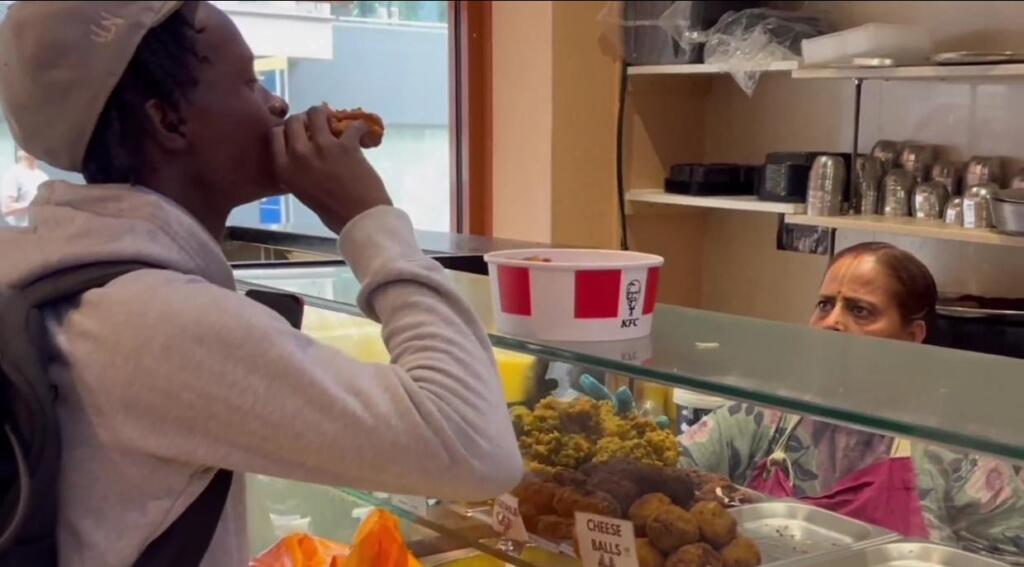
A video that rapidly went viral on social media showed Cenzo walking into Govinda’s, a London-based vegetarian restaurant run by the International Society for Krishna Consciousness (ISKCON) Temple, carrying a KFC chicken box. The footage showed him confirming with the staff that the place was vegan. Upon receiving confirmation, he proceeded to open the box, eat the chicken inside the premises, and even offered it to patrons, all for a video.
The response was immediate and intense. While some viewers shrugged it off as a ‘prank,’ ISKCON devotees and practicing Hindus saw it as nothing short of sacrilege.
Govinda’s: An Extension of the Temple
To understand the depth of the outrage, it’s essential to understand what Govinda’s represents. It’s not just another vegetarian eatery; it’s a spiritual extension of an ISKCON temple. Every dish served here follows religious dietary codes. Food is not merely cooked, but it is offered to Lord Krishna before being served, becoming prasadam, or sanctified food.
This isn’t a casual commitment to plant-based eating. ISKCON strictly forbids the consumption of meat, fish, eggs and even onion and garlic, believing that such foods increase ignorance and passion, detracting from a spiritual life. For many, to bring meat into such a space is not just an act of disrespect, it’s an act of spiritual desecration.
And that’s why this wasn’t just a harmless moment caught on camera; it was a moment of deep hurt and violation.
Can Ignorance Be an Excuse?
In the days following the incident, Cenzo issued a public apology on X (formerly Twitter). He claimed that he had no idea Govinda’s was affiliated with a temple and that had he known, he would never have pulled such a stunt. He called the act ‘ill-timed and irresponsible’ and expressed a desire to personally apologise to the temple and its devotees.
To his credit, he also mentioned that the backlash prompted him to do research into ISKCON’s philosophy. He came to understand its emphasis on non-violence, vegetarianism, and spiritual purity, and acknowledged that his actions deeply offended the community.
But the question remains: Is ignorance an acceptable justification in 2025? Shouldn’t those who create content for millions take the time to understand the context of the places they film in, especially when those places are religious or sacred?
When Content Creation Turns into Cultural Insensitivity
This incident shines a spotlight on an uncomfortable truth in the creator economy: many influencers have begun treating sacred spaces and cultural practices as mere backdrops for content. Pranks, challenges, or skits; whatever the label often prioritise virality over values.
Cenzo’s act was not bold or edgy. It wasn’t political satire. It wasn’t even clever critique. It was cultural ignorance masquerading as content. There’s a difference between comedy that punches up and actions that simply punch down often at those who rarely have a voice to push back.
By eating meat in a sacred, vegetarian-only space and offering it to others, Cenzo inadvertently mocked beliefs he didn’t understand. And that’s precisely the problem.
Owning the Harm
Yes, Cenzo apologised, and that’s a good beginning. But true accountability involves more than just issuing statements. It requires effort, education, and concrete action. Visiting the temple, speaking with devotees, publicly acknowledging the mistake in a way that educates his audience- these are the steps that elevate an apology into a lesson for others.
For creators especially, this incident should serve as a moment of reflection: Does your content uplift or offend? Does it challenge with purpose, or provoke without understanding?
In a world where influence is power, such choices matter.
This isn’t just about Govinda’s. It’s not just about Cenzo. It’s about the kind of digital culture we are creating; one where shock sells, and sacredness is sidelined for views.
Sacred spaces are not sets. Belief systems are not clickbait. And in a multicultural society, respect is not a nice-to-have, it’s a necessity.
As digital citizens, as creators, and as consumers, we need to ask better of ourselves. Because when humour becomes harm, and the sacred becomes content, we haven’t just crossed a line, we’ve erased it.