
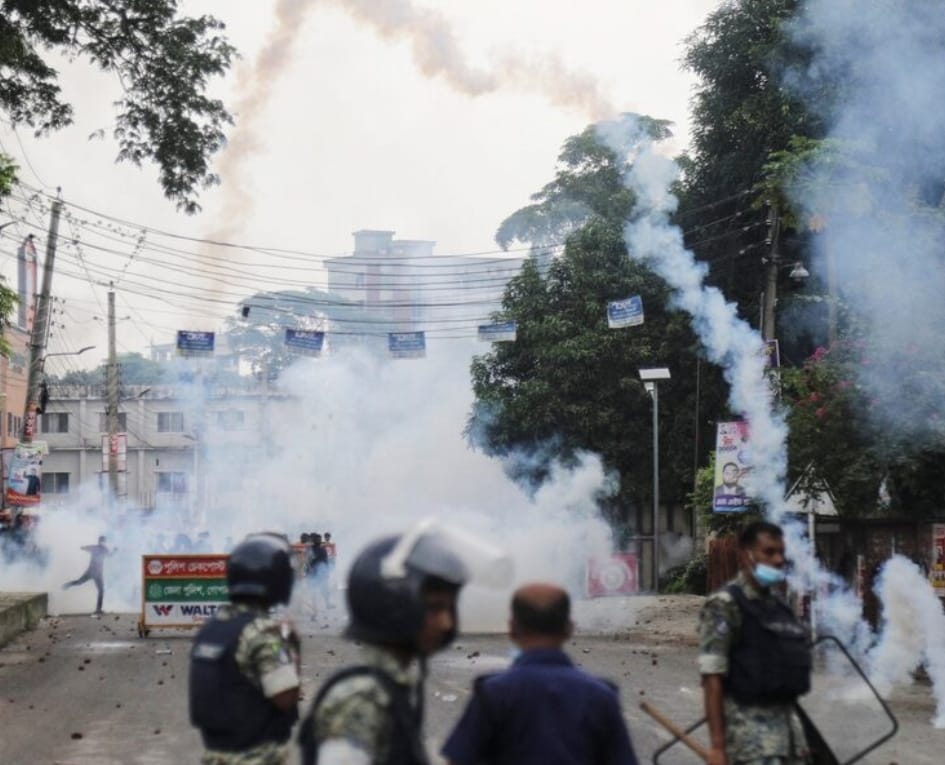
The heart of Gopalganj, once a symbol of power and legacy under former Prime Minister Sheikh Hasina, was reduced to chaos and bloodshed on Tuesday evening, as Bangladesh Army forces opened fire on a rally organized by the student-led National Citizen Party (NCP).
By nightfall, four young lives had been cut short, dozens were injured, and the streets echoed with the cries of the wounded, the thunder of gunfire, and the stifling silence of a city placed under military curfew.
A Rally Turns into a Battlefield
What began as a peaceful gathering to mark the one-year anniversary of the NCP’s anti-establishment movement turned into a scene of devastation. The rally had drawn thousands of students, young professionals, and local citizens who converged in Gopalganj to demonstrate solidarity and demand systemic reform.
Chanting slogans and waving banners, many carried the national flag. Their voices, once symbols of youthful defiance were soon drowned by chaos when, according to witnesses and media reports, pro-Awami League cadres armed with sticks, bricks, and rods launched an unprovoked assault on the crowd.
Tension snapped. Protestors retaliated. Rocks were thrown. Police vehicles were attacked. An administrative convoy was cornered. Then, gunfire was shot.
Security Forces Response
In response to the spiraling violence, Bangladesh’s security forces including army units and paramilitary troops opened fire, allegedly without warning. Tear gas and sound grenades filled the air, followed by a barrage of live rounds aimed at the dispersing crowd.
The scene turned frantic. Protestors scattered in all directions. Some sought refuge inside shops and alleyways. Others were caught in the open. Blood pooled on the pavement. Banners burned. A stage built by students was shattered by bullets.
Yet even amid the horror, NCP’s leadership, including convener Nahid Islam, stood firm. From a broken podium, Nahid shouted defiantly: ‘If justice is not given, we will take it ourselves.’
The Lives Lost: Innocent and Unarmed
By late evening, the death toll had risen to four. At Gopalganj General Hospital, the names were confirmed:
Deepto Saha (25):
A Hindu student leader and engineering aspirant, known in his community for tutoring local kids and leading blood donation drives. Shot in the chest.
Ramzan Qazi (18):
A soft-spoken first-year college student who loved cricket and photography. He was killed instantly by a gunshot to the head.
Sohel Molla (41):
A father of three and local grocery shop owner, caught in the crossfire while returning home from work.
Fourth victim:
Identity pending. Described by witnesses as a teenager.
Doctors said all four died before treatment could begin.
Curfew Declared, Military Deployed
In the wake of the tragedy, the interim government led by Muhammad Yunus declared a 22-hour emergency curfew across Gopalganj, starting at 8 PM. Over 200 personnel from the Border Guard Bangladesh (BGB) were deployed to maintain order.
‘The youth had gathered peacefully to mark their movement. To silence them with bullets is an act of tyranny,’ wrote the Chief Adviser’s Office on X (formerly Twitter).
The Yunus administration laid direct blame on Awami League supporters and its student wing, accusing them of inciting the violence that led to the bloodbath.
A Nation Still Recovering
The violence in Gopalganj did not emerge from a vacuum. The country is still reeling from the political upheaval of 2024, when mass student protests forced Sheikh Hasina’s Awami League government to collapse. The trigger was the controversial reinstatement of a 30% job quota for descendants of freedom fighters, upheld by the High Court in June last year.
Weeks later, in August, protestors nearly stormed Hasina’s residence. In the face of mass fury, she fled to India, claiming divine protection and vowing to return. Since then, the political climate has remained fragile, and Gopalganj, her hometown and long-time stronghold has become symbolic turf for both her loyalists and detractors.
Blood Money, Bloodshed, and Bangladesh’s Reckoning
The victims of Tuesday’s attack were not militants or armed rioters; they were students, workers, and common citizens. Their deaths have triggered mourning across the country, with candlelight vigils planned in Dhaka, Chittagong, and Sylhet.
The Bangladesh Human Rights Forum (BHRF) called for an immediate judicial inquiry, condemning the military’s use of lethal force. ‘This is a grave violation of civil rights and international law,’ the organization said.
Social media is now flooded with haunting visuals- blood-soaked flags, injured youth being carried away, and soldiers standing over scorched roads, weapons still raised. Hashtags like #JusticeForDeepto and #GopalganjMassacre are trending.
A Nation Awaits Answers
Bangladesh stands at a crossroads once again. Will the deaths of Deepto, Ramzan, Sohel, and the unnamed fourth victim be swept away in the churn of political narrative? Or will their sacrifice rekindle the youth-led fight for democratic justice?
For now, the streets of Gopalganj remain under lockdown. Families grieve behind closed doors. Protestors regroup in whispers. And a nation, weary but awake waits for accountability.