
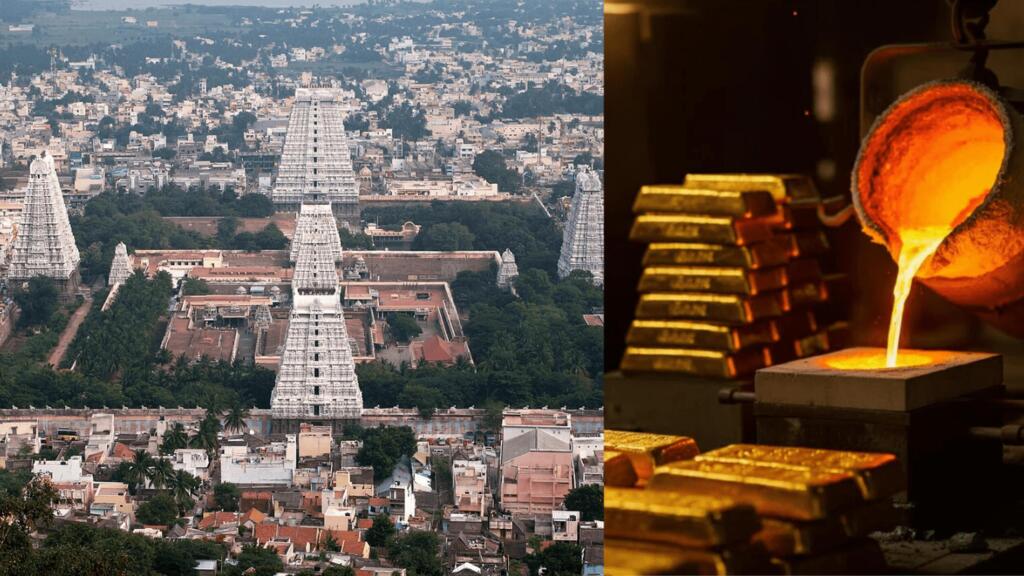
In a controversial move that has triggered outrage across Hindu communities, the Tamil Nadu Hindu Religious and Charitable Endowments (HR&CE) Department, under the DMK government, has melted over 1,074 kg of gold offered by devotees at 21 temples. These gold articles, deemed “unused” by state authorities, were converted into 24-carat gold bars and deposited in the State Bank of India under the Gold Monetisation Scheme. The initiative, according to HR&CE Minister P.K. Sekar Babu, is now yielding a staggering ₹17.81 crore in annual interest, claimed to be directed toward temple infrastructure.
While this might sound like prudent financial management on paper, the reality is far murkier. This scheme raises pressing questions: Who authorized the melting of sacred offerings? Where is the consent from the devotees? More importantly, is the money truly reaching temple improvement projects? Or is this a veiled appropriation of temple wealth under the guise of governance?
Sacred Gifts or Financial Assets? Devotees Alarmed by Temple Gold Scheme
Among the temples affected, the Arulmigu Mariamman Temple in Samayapuram, Tiruchirappalli, contributed the highest share at over 424 kg of gold. Three regional committees, chaired by retired judges, have been formed to supposedly oversee the scheme. Meanwhile, silver artifacts too are now under scrutiny, with the state greenlighting their conversion into pure silver bars by private, government-approved smelters. The smelting is being conducted within temple premises and supervised by zonal committees.
However, this mass melting of gold and silver, offered as sacred gifts to deities by devout Hindus, has drawn severe backlash. Traditionalists, right-wing commentators, and thousands of devotees argue that these items are not mere financial holdings but are sacred symbols of devotion and heritage. The notion that temple wealth is treated as liquidatable assets by the DMK government smacks of insensitivity and ideological bias.
Ignoring Court Orders, Devotee Consent, and Religious Sentiment
This is not a new issue. Back in 2021, over 50,000 people signed an online petition opposing the DMK government’s initiative to melt temple jewelry. The petition clearly cited that the Madras High Court had instructed the HR&CE to conduct an external audit through the CAG and create a centralized digital registry of temple assets. However, in an astonishing disregard for judicial authority, these orders were bypassed.
Petitioner Karthik Gopinath, who runs the YouTube channel Ilaya Bharatham, questioned why the state was hastily melting down offerings before completing the court-mandated audit. The petition warned that this would amount to contempt of court, a concern yet to be addressed by the government. With cases still pending in court, the HR&CE’s ongoing operations appear to flout both legal and ethical standards.
Selective Secularism: Why Only Hindu Temples?
One of the most disturbing aspects of this scheme is the exclusive targeting of Hindu temples. Why are churches, mosques, and other religious institutions left untouched? Why is there no equivalent “monetisation” drive in other places of worship? This selective approach reveals the hypocrisy and systemic discrimination inherent in the HR&CE’s operation. It is not just about gold; it is about a larger ideological war on Hindu identity and institutions.
A VHP functionary, speaking to TFI, said “The DMK government is systematically looting temples. There are over 45,000 temples under state government control, and a huge amount of money is collected through donations by devotees. The DMK projects an image of temple development by performing Kumbhabishekham at 10–15 temples but everyone knows the truth. What about the thousands of other temples? Most of them continue to suffer due to poor infrastructure and lack of proper maintenance.”
The DMK’s record in this regard is not reassuring. From introducing the “all caste can become priests” policy to encroachments on temple lands and interfering with ritual practices, the pattern is unmistakable. The current monetisation scheme is merely a continuation of a long-standing trend of undermining Hindu traditions, all in the name of progress and secularism.
Who Really Benefits from Temple Gold Monetisation?
Despite claims of temple development and enhanced infrastructure, there is little transparency on where the interest income is being spent. The HR&CE continues to operate with opaque financial practices, shrouded in committees and policy notes. Devotees are left wondering whether the temple they donated to will ever see the fruits of their offerings.
The first tranche of temple gold monetisation under the DMK has already been melted and mortgaged. The government even plans to increase deposits to 1,000 kg by the end of 2025, aiming to collect ₹10 crore annually in interest.
Is this development or disguised looting? For a government that has shown little respect for Hindu sentiments and continues to erode the autonomy of temples, this scheme appears less like administrative reform and more like an organized extraction of Hindu devotional wealth. The silence on whether similar schemes will be imposed on other religious institutions only highlights the discriminatory, anti-Hindu undertones of this policy.
The time has come for Hindu devotees and concerned citizens to ask: Should the State be allowed to control, monetize, and profit off the sacred offerings made by the faithful? Or is it finally time to demand a complete end to state interference in religious institutions?
(This is the Part – II of a Series of articles on Tamil Nadu’s Controversial Hindu Religious and Charitable Endowments control over Hindu Temples)