
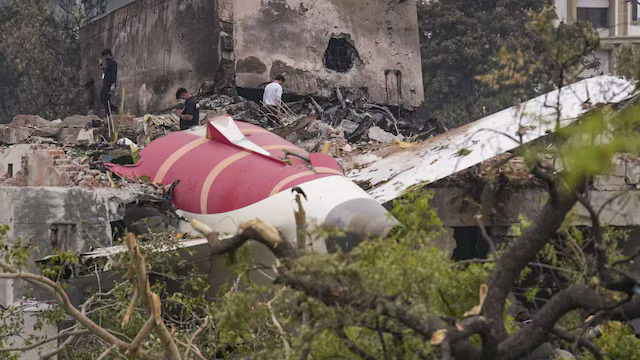
In a surprising turn of developments, the preliminary investigation into the tragic Air India, AI-171 Dreamliner crash in Ahmedabad has placed the spotlight squarely on cockpit actions, suggesting that human error rather than a technical malfunction was the likely cause. The early findings have sparked renewed scrutiny into the responsibilities of airline operators and the importance of rigorous cockpit protocol. Notably absent from the report is any recommendation for Boeing or the aircraft’s engine manufacturers, a move that usually follows if any defect is detected in the machine or design. Instead, attention has now turned to possible procedural lapses in the cockpit.
No Blame on Boeing or GE Engines: A Clean Chit So Far
The investigation report provides early relief for Boeing and General Electric, the makers of the Dreamliner 787-8 and its GEnx-1B engines, respectively. The Directorate General of Civil Aviation (DGCA) has not found any mechanical flaw or technical defect in the aircraft. Unlike other crash probes where aircraft makers are often asked to implement corrective measures, no such directive has been issued so far.
“At this stage of investigation, there are no recommended actions to B787-8 and/or GE GEnx-1B engine operators and manufacturers,” the report explicitly states. The possibility of a bird hit a frequent suspect in such engine-related mishaps—has also been ruled out. “No significant bird activity is observed in the vicinity of the flight path,” the document notes.
Fuel Cutoff Switches and a Cockpit Mystery
The central revelation in the report is the abrupt fuel cutoff to both engines, which led to the fatal crash. According to the analysis of the flight data recorder, Engine 1 and Engine 2 were sequentially shut down—just one second apart—through the fuel cutoff switches. These switches are protected by safety guards designed to prevent accidental activation, which makes the sequence of events deeply concerning.
What adds further intrigue is a snippet from the cockpit voice recorder. One pilot can be heard asking the other, “Why did you cut off?” to which the second pilot responds, “I did not do so.” This exchange hints at either a major communication failure or, more ominously, sabotage or a systems anomaly yet to be understood. The fact that both pilots deny initiating the cutoff raises more questions than answers.
The flight was being commanded by Captain Sumeet Sabharwal, aged 56, with over 15,000 hours of flying experience. His co-pilot, Clive Kundar, 32, had over 3,200 hours under his belt. Both men tragically perished in the crash.
Failed Engine Relight and Missed Recovery Window
As per the data analysis, the pilots did attempt to restart the engines after the cutoff, but the low altitude and rapid descent left them with an impossibly narrow window for recovery. The report mentions, “The EGT (Exhaust Gas Temperature) was observed to be rising for both engines indicating relight attempts.” While Engine 1 showed some signs of recovery, Engine 2 failed to stabilize, despite repeated fuel re-introductions aimed at restarting core speed.
This left the aircraft with no real chance of regaining sufficient thrust to avoid the crash, especially so soon after takeoff when altitude and time were limited. This sequence of events essentially rendered the aircraft a powerless glider in a rapidly deteriorating flight scenario.
SAIB and the Fuel Switch Design Debate
One technical detail that could raise eyebrows, though not flagged as the cause of the crash, pertains to a 2018 advisory issued by the U.S. Federal Aviation Administration (FAA). The advisory, known as a Special Airworthiness Information Bulletin (SAIB), warned of the potential disengagement of the fuel control switch locking feature in various Boeing models, including the 737 and 787.
While the FAA did not consider this an unsafe condition requiring mandatory action, it recommended inspections. However, Air India reportedly did not carry out these checks, as the advisory was not legally binding. The crashed Dreamliner, registered as VT-ANB, had no recorded issues with its fuel control switch since 2023.
Still, investigators have not made a definitive link between this advisory and the Air India AI-171 incident. The report underlines that the safety rails on the fuel cutoff switches make accidental activation unlikely.
Human Error or Deeper Flaws? More Questions Than Answers
While the preliminary report leans toward cockpit error as the leading cause, the full picture will only emerge after a complete and detailed investigation—which could take nearly a year. The suggestion that the pilots themselves might have inadvertently or mysteriously triggered the fuel cutoff has shocked the aviation community.
However, this is not the first time that blame has ultimately landed on cockpit decisions. Both major Air India Express crashes in 2010 (Mangalore) and 2020 (Calicut) also found pilot error at fault, while the aircraft manufacturers walked away unscathed.
This pattern raises an important question—are pilots being made the fall guys too quickly? Are deeper systemic flaws within airline operations, pilot training, or aircraft ergonomics being overlooked in the rush to close investigations?
As families await closure, and the industry looks for lessons, the hope is that the final report will go beyond simply identifying the “last error” and instead look at the ecosystem that made such a tragedy possible. For now, Boeing may have escaped scrutiny, but the skies remain full of unanswered questions.