

















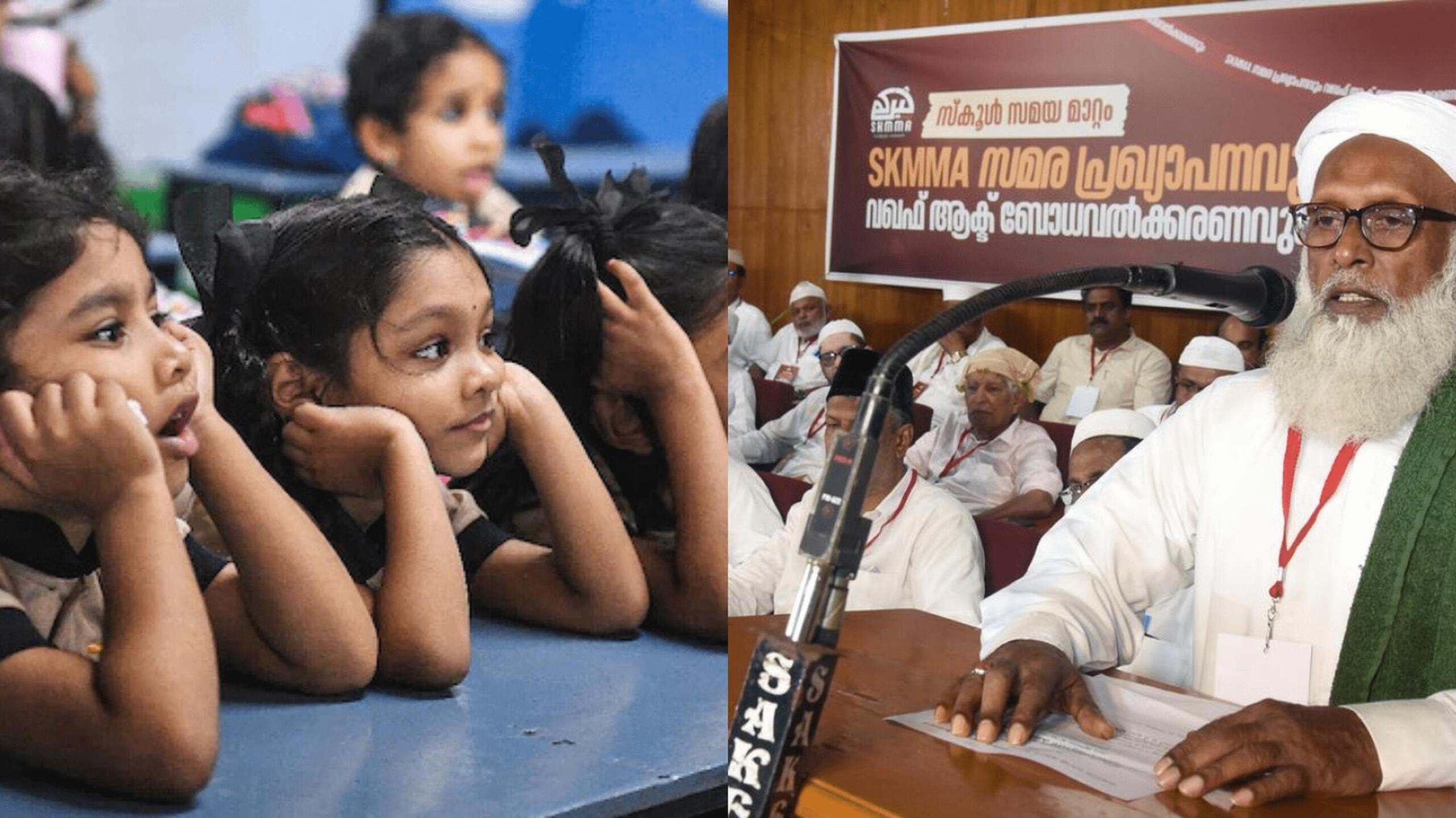
Just days ago, Kerala’s school campuses saw resistance from Islamic groups over the introduction of Zumba fitness sessions, claiming it was “un-Islamic.” Now, the same fundamentalist mindset has been activated again. This time, the trigger is a simple extension of school hours by 30 minutes. The latest protest from Samastha Kerala Jem-iyyathul Ulama and its affiliate Samastha Kerala Madrassa Management Association (SKMMA) isn’t about educational quality, student rights, or even teacher welfare. It’s about protecting their madrassa routines which they claim are more important than mainstream education reforms. Once again, progressive change is being held hostage by religious orthodoxy.
Fundamentalist Fury: Protests Erupt Over Extended School Hours
In a move aimed at meeting the mandates of the Right to Education Act and Kerala Education Rules, the Kerala government decided to increase daily school hours by 30 minutes for Classes 8 to 10. The revision applies across all government, aided, and unaided schools under the state syllabus. The additional time 15 minutes each in the morning and afternoon (excluding Fridays) is designed to help schools fulfill the required 220 working days and 1,100 instructional hours.
Instead of being welcomed as an effort to strengthen academics, the move has been met with fierce backlash from Muslim religious outfits. Samastha Kerala Jem-iyyathul Ulama, through its madrassa wing SKMMA, has announced district-level, regional-level, and statewide protests. Their central argument? That these additional minutes encroach on the time allocated for religious instruction at madrassas.
But critics argue that this isn’t about school hours at all. It’s about asserting religious dominance over state education policy.
Zumba Controversy: An Earlier Sign of the Same Mindset
This is not the first time fundamentalist Islamic groups in Kerala have resisted progressive educational initiatives. Earlier, the same Samastha bodies had opposed the introduction of Zumba classes in schools, claiming they were against Islamic culture and promoted “Western decadence.” Despite the health and mental well-being benefits that fitness activities bring to students, conservative forces turned the narrative into one of religious violation.
That same rigidity has returned, now weaponized against a minor scheduling change meant to enhance learning outcomes. Educational reform in Kerala is being continually throttled by a pattern of regressive, religiously motivated obstruction.
Education vs. Indoctrination: A Battle for Kerala’s Classrooms
The SKMMA claims that 1.2 million Muslim students attend madrassa sessions daily before school hours, and that the new schedule disrupts their routine. But the larger question remains: should religious education be prioritized over constitutional obligations to provide universal, quality education?
Moideen Faizy, general secretary of SKMMA, has gone so far as to accuse the government of acting on a High Court order without accommodating religious sentiments. Haris Beeran, MP from the Indian Union Muslim League, echoed this sentiment, stating that the extension of school hours was part of a broader plan to erode religious identity and inject neoliberal values.
However, such statements are viewed by many as alarmist, designed to trigger emotional reactions rather than engage in constructive debate. Critics argue that the resistance is part of a dangerous trend—one that seeks to elevate religious indoctrination over educational advancement.
Past Obstructionism: A Pattern of Regressive Resistance
Historically, these Islamic bodies have opposed a range of government reforms that they perceive as a threat to their religious ecosystem. From resisting the inclusion of gender and sex education in curriculum to objecting to modern dress codes and extracurricular activities, their track record reveals a consistent pattern of pushback against modernization.
When Zumba was introduced, these same groups painted it as a moral threat. When school hours are extended for academic betterment, they label it an attack on Islam. This deliberate conflation of religious sentiment with educational progress has been condemned by several academic bodies and parents’ associations across the state.
M.T. Abdulla Musliyar, general secretary of the Samastha Kerala Islam Religious Education Board, boldly declared that the government had “no business” interfering with religious education. This statement is a reflection of how deep the ideological divide runs between secular governance and religious gatekeeping.
Time to Choose Progress Over Parochialism
Kerala has long been considered a beacon of literacy and social progress in India. But that reputation risks being tarnished if regressive ideologies are allowed to dictate education policy. The State’s aim of ensuring 1,100 instructional hours and 220 school days is in line with national educational standards. No community, however numerically significant, should be allowed to hold that progress hostage.
If madrassas are important, then they must adapt, not obstruct. Kerala must assert that public education cannot be held to ransom by religious sentiment. Education is a tool for liberation, not indoctrination. And in that battle, the state must stand firm—with reason, with law, and with the future of its children.