
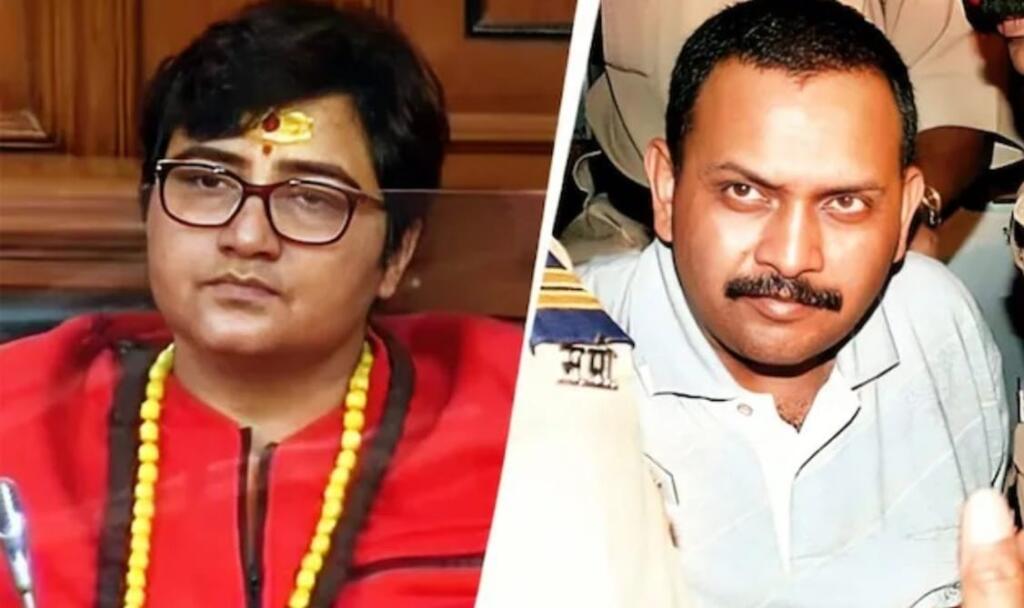
With today’s Malegaon blast verdict exonerating key accused like Col. Purohit and Sadhvi Pragya, the spotlight once again turns to the controversial ‘Hindu terror’ narrative that dominated headlines during the UPA era.
In a groundbreaking interview with The Frustrated Indian (TFI), RVS Mani, a former officer in the Ministry of Home Affairs (MHA), has made a series of allegations that shake the foundations of the much-publicized ‘Hindu terror’ narrative that emerged during the UPA regime.
According to Mani, who served in a critical position during the years when India witnessed multiple high-profile terror attacks, the idea of ‘Hindu terror’ was a deliberate political fabrication, orchestrated with the knowledge and involvement of top political figures and investigative agencies at the cost of national security.
Investigations in Malegaon Blast Case
Mani pointed out that the initial investigation into the Malegaon blast (2008) had identified operatives linked to the Ahle Hadees, a radical Islamist organization. Similarly, in the Hyderabad blast of 8 September 2006, names of Bangladeshi nationals such as Mohammed Bilal and Sharif Uddin were linked, though Mani says it remains unclear whether they had ties to Ahle Hadees.
Yet, the moment the Maharashtra ATS took over, the trajectory of the investigation dramatically shifted.
‘The moment ATS took over, everything changed. Suddenly, the focus shifted to ‘Hindu extremists’. That was the beginning of the narrative fabrication,’ Mani stated.
Hurried Arrest of Col. Purohit
One of the most controversial developments was the arrest of Lt. Col. Shrikant Purohit, a serving Military Intelligence officer, along with Sadhvi Pragya, Major Upadhyay, and Ramesh Kulkarni.
‘Col. Purohit was working on sensitive national security assignments. His arrest wasn’t just wrongly timed but it also jeopardized multiple active operations. Why the hurry?’ Mani asked.
He also revealed that Col. Honey Bakshi, who was with Purohit during key intelligence operations, had supported his innocence. Mani questioned the timing and urgency behind the arrests, hinting that they were part of a larger conspiracy that potentially involved the resurrection of Abhinav Bharat, an organization that had originally shut down in 1953 but was revived in 2005 under the NCP-Congress regime, purportedly for ‘societal welfare’ in Mumbai.
Mani questions who provided the funding and support.
‘Ask Shivraj Patil who funded this new Abhinav Bharat. Everything was set up for a larger game.’
Illegal Prosecution Sanctions Signed Under Political Pressure
Mani referred to court testimony given in March 2023 by former official Chitkala Joshi, who admitted under oath that she had signed prosecution sanctions under UAPA, the Official Secrets Act, and Section 489 (fake currency cases) without examining any merit.
‘She confessed that she signed those documents while Jayant Patil was Home Minister (Maharashtra). It was all politically driven. The merits were never questioned.’
These sanctions were issued before January 2009, while the investigation was still underway.
Furthermore, Mani pointed out a procedural failure: when the case was transferred from ATS to the NIA, new prosecution sanctions should have been obtained. However, neither the NIA requested them, nor did the court insist. The old sanctions were simply carried over, a breach of legal protocol.
The Role of Digvijay Singh and Hemant Karkare
Mani also described an incident where he was summoned to meet Digvijaya Singh and ATS Chief Hemant Karkare. He alleges that they directly asked him to gather information on ‘Hindu terror’.
‘They asked me to dig out Hindu terror incidents. I refused. I told them to approach my seniors. They didn’t like that.’
He asserts that while Shivraj Patil was officially the Home Minister, it was Digvijaya Singh who was de facto running the Home Ministry, pushing the Hindu terror narrative forward.
Inception of ‘Hindu Terror’ In Government Records
‘Till I was in charge of counterterrorism, there was no mention of Hindu terror in any government file,’ Mani emphasized.
According to him, it was only on July 17, 2010, that the term ‘Hindu terror’ was officially inserted into government records, and that too, without any supporting intelligence input.
This claim is supported by a 2016 RTI filed by a News Outlet, which revealed that there was no verified input behind the use of the term, further confirming that the narrative was artificially created.
Parliament vs Public Statements of UPA
RVS Mani noted the UPA government’s contradictory messaging; while ministers like P. Chidambaram, Shivraj Patil, and Sushil kumar Shinde openly blamed Pakistan and ISI for terror attacks inside Parliament, they simultaneously pushed the ‘Hindu terror’ narrative in public speeches and media appearances.
‘In Parliament they accepted Pakistan’s role. Outside, they kept talking about Hindu terror. It was all for votes.’
Coordinated Silence on Batla House
Mani linked the Batla House Encounter to a pattern of coordinated silence and selective empathy:
During the Batla House encounter, while Inspector Mohan Sharma was being assaulted by terrorists, Home Minister Shivraj Patil was receiving live updates in police Headquarters and yet he never publicly commented on the matter.
Mani recalled reports that Sonia Gandhi had cried for the terrorists killed in the encounter.
Gujarat Terrorists and Escape Plot: Digvijay Singh’s Involvement?
Mani further revealed an incident involving 14 terrorists from Gujarat, many of them linked to operatives from Azamgarh, whom Digvijay Singh allegedly tried to transfer to Delhi, which Mani suggests was an escape plan under the guise of legal procedure.
Mani did not hold back saying ‘From 2006 to 2011, all terrorist activities were a joint venture between Congress and ISIS. National security was sacrificed at the altar of vote bank politics.’
The interview with RVS Mani opens a deeply disturbing window into how political power can be misused to manipulate investigations and push a narrative that had no evidentiary support. Mani’s testimony, supported by court documents and RTI responses, raises a fundamental question: Was India deliberately misled, and were its people betrayed by those sworn to protect them?