












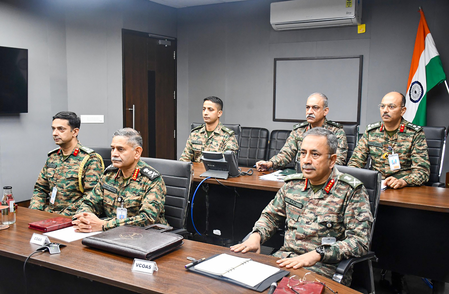
In a significant shift aimed at strengthening India’s position in the global narrative battlefield, the Armed Forces have initiated workshops for its officers where leaders from the media industry will sensitise and train uniformed officers in the art of establishing their command over perception building.
The initiative was planned in the aftermath of Operation Sindoor, where despite military success and clear strategic superiority, the nation found itself trailing in global perception and narrative control, sources said.
Operation Sindoor, conducted in May 2025, was a military response to the brutal terror attack in Pahalgam by Pakistan-backed terrorists. Indian forces struck nine high-value terror infrastructure targets spread across Pakistan and Pakistan-occupied Jammu & Kashmir. The operation showcased the military’s precision-strike capability using advanced weaponry such as SCALP cruise missiles, HAMMER bombs, and loitering drones. Yet, despite its operational success and strategic messaging, it was felt that we faced an uphill battle in controlling the narrative, as hostile propaganda and misinformation diluted the country’s achievements on the world stage.
Sources stated that it was this gap between battlefield victory and international perception that triggered a broader rethink in the highest echelons of government and military establishment. The first such workshop, where training was provided to the nation’s military leadership was held at Dharamshala, Himachal Pradesh.
It is learnt that at these workshops, officers from armed forces are now being trained to shoot professional-quality videos, develop clear explainers and convey accurate real-time updates. These narratives will not just be aimed towards the domestic audiences but also to counter disinformation abroad. Sources stated that the ultimate goal is to create a cadre of officers adept in modern information warfare, capable of both defending and projecting India’s narrative with clarity and credibility. Officers from various commands of the armed forces were part of this workshop.
It must be pointed out that the concern over a lacking narrative building has also been echoed in political circles over the past few weeks. Several Members of Parliament, who were part of official delegations visiting foreign capitals to clarify India’s position after Operation Sindoor, expressed frustration over the lack of compelling and timely messaging by the country. “There is clear respect for India’s military capability, but we lose ground when it comes to perception. Our adversaries are faster and sharper in pushing out their version of events,” a senior Member of Parliament told TFI. The same was also conveyed to Prime Minister Narendra Modi by several MPs after these delegations returned to the national capital.
Narrative Gaps Post-Operation Sindoor
Despite achieving operational objectives, India’s post-strike communication suffered from bad messaging, delayed briefings and outdated media posturing. Sources stated that this reactive stance by India led to foreign media outlets quickly picking up Pakistan’s claims of civilian casualties. Though most of Pakistani claims were later discredited, it was felt that India lacked timely and persuasive counter-narratives to shape public opinion internationally. This was another issue pointed out to PM Modi by MPs which were part of delegations that visited foreign capitals.
The absence of real-time video evidence sharing, authoritative spokespersons and well-packaged content allowed adversarial actors to gain the early initiative in shaping the global conversation. Sources stated that by holding such workshops across the nation the armed forces are now aiming to fill this critical gap in our communications strategy.
How Changes Will be Made
These training workshops will also aim to address the gaps on social media narrative building. It was felt that several social media platforms were flooded with speculative reports, many originating from unofficial Pakistani handles and aided by our adversaries like China. In fact, it was felt that these adversarial comments were making inroads into Indian dominated social media spaces as well.
India’s official response lacked immediacy and emotional resonance with the common people and global audience and it was pointed out by experts that India cannot afford to win militarily but lose the story, especially in an era where digital battles often outlast those fought with weapons.
These training workshops are now being considered as a strategic necessity toward fixing this vulnerability. It reflects a growing understanding that narrative-setting is not a peacetime luxury but a war-time necessity which is critical to maintain both domestic confidence and international legitimacy.
The Dharamshala workshop is the first in a planned series of such initiatives. Officials confirmed that more workshops are on the way across various commands and formations to create a pool of trained officers capable of handling narrative dissemination, both in times of conflict and peace. As perception building increasingly become tools of modern warfare, India’s armed forces appear determined not to cede this critical battleground.