
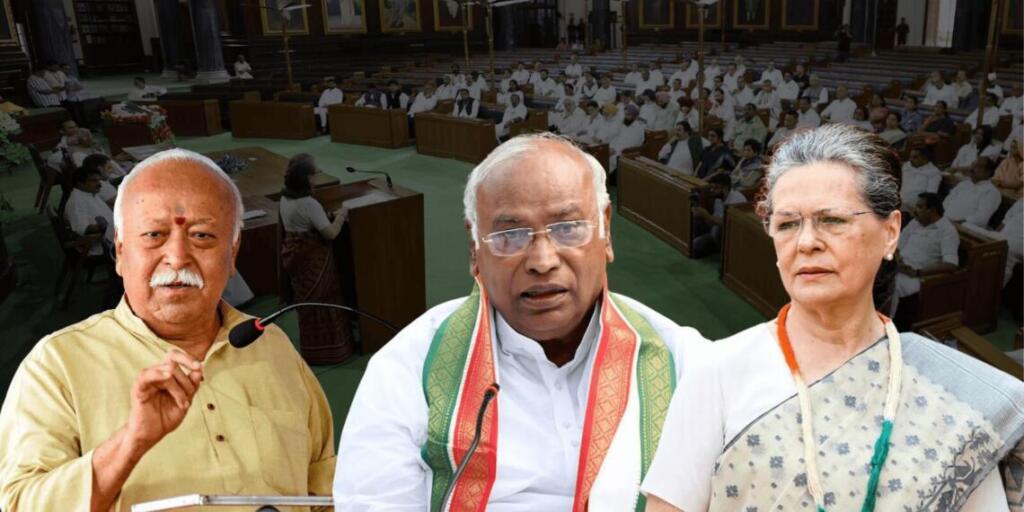
RSS chief Mohan Bhagwat’s recent statement suggesting retirement from public life at the age of 75 may have been aimed at the BJP’s internal succession planning, but it has stirred unexpected enthusiasm in the Congress camp. The reason? Prime Minister Narendra Modi will turn 75 in September 2025, and Congress leaders quickly interpreted Bhagwat’s remarks as an indirect call for Modi’s political retirement. The Congress not only endorsed the statement but also widely circulated it across its official communication channels. But this quick celebration has exposed an uncomfortable hypocrisy: what about the aging leadership within the Congress itself?
Congress’s Double Standards: Ignoring Sonia and Kharge’s Age
While the Congress was swift to weaponize Bhagwat’s comment against Modi, it conveniently overlooked the age of its own top brass. Sonia Gandhi, the party’s parliamentary party president, will turn 78 in December 2024. Mallikarjun Kharge, the current national president, is already over 80 years old. If Bhagwat’s remarks are to be taken as universal political wisdom, shouldn’t they apply across party lines?
The selective outrage reveals a deep contradiction in Congress’s narrative. For a party that champions generational change and accuses the BJP of gerontocracy, its own structure remains heavily reliant on elderly leaders. Congress may have attempted to present Rahul Gandhi as its youthful icon, but with Rahul now 54 and having dominated the party’s narrative for over a decade, the “young leader” image is losing credibility.
The Call for Generation Shift: Long-Standing But Unheeded
Young Congress leaders have for years murmured about the need for a generational shift, but most have not dared to vocalize it out of loyalty to the Gandhi family. Despite repeated electoral failures, Sonia Gandhi has remained at the helm of internal party affairs, and her symbolic leadership continues to dictate the Congress parliamentary strategy. Kharge’s appointment was supposed to mark a shift, but in reality, he functions more as a Gandhi family loyalist than an independent president.
Bhagwat’s comment has now provided an opportunity for open introspection within all parties. If the Congress chooses to truly walk the talk on political rejuvenation, then it must first look inward. The principle of retirement at 75 cannot be selectively applied only to adversaries. Sonia Gandhi has had a long and impactful political career, but if the yardstick applied to Modi is Bhagwat’s logic, then Gandhi, Kharge, and several others must gracefully step aside as well.
Has Rahul’s Era Already Become Stagnant?
Even with the supposed generational transition to Rahul Gandhi, the Congress has failed to rejuvenate its base or decentralize leadership. Rahul’s tenure has been marred by repeated election defeats, poor strategic decisions, and a lack of consistent messaging. The party’s dependency on him, coupled with the continued dominance of senior loyalists, has blocked the emergence of any new, charismatic second-rung leadership.
More critically, the generational change in Congress appears to be an illusion. There has been no structural or ideological renewal. Young leaders who could have infused fresh energy have either been sidelined, left the party, or been co-opted without real power. The result is a stale leadership circle where age has become a political number game rather than a transformative measure.
Time for Congress to Practice What It Preaches
It’s easy to take potshots at the BJP using Bhagwat’s statement, but the Congress must realize that such standards, when publicly endorsed, will naturally be turned inward. Congress needs to go beyond the tokenism of youth representation and embrace genuine structural reform. That means making way for younger leaders not only in media narratives but within the organizational power structure.
If Congress is to present itself as a credible alternative to the BJP, especially among young voters and aspirational India, it must embody the values it preaches. This includes breaking the generational monopoly of the Gandhi family and giving the reins to leaders with fresh ideas and a new outlook.
Will Congress Dare to Look in the Mirror?
Mohan Bhagwat’s call for political retirement at 75 was seen as a veiled dig at Prime Minister Modi, and Congress rushed to cheer. But in doing so, the party exposed its own reluctance to follow the same principle. With Sonia Gandhi nearing 78 and Kharge already past 80, the question isn’t just about BJP’s leadership timeline—it’s about whether Congress has the courage to introspect and act. As India’s political landscape evolves, voters are demanding sincerity and consistency, not just clever optics. If Congress truly believes in change, the mirror Bhagwat held up is one it can no longer ignore.