
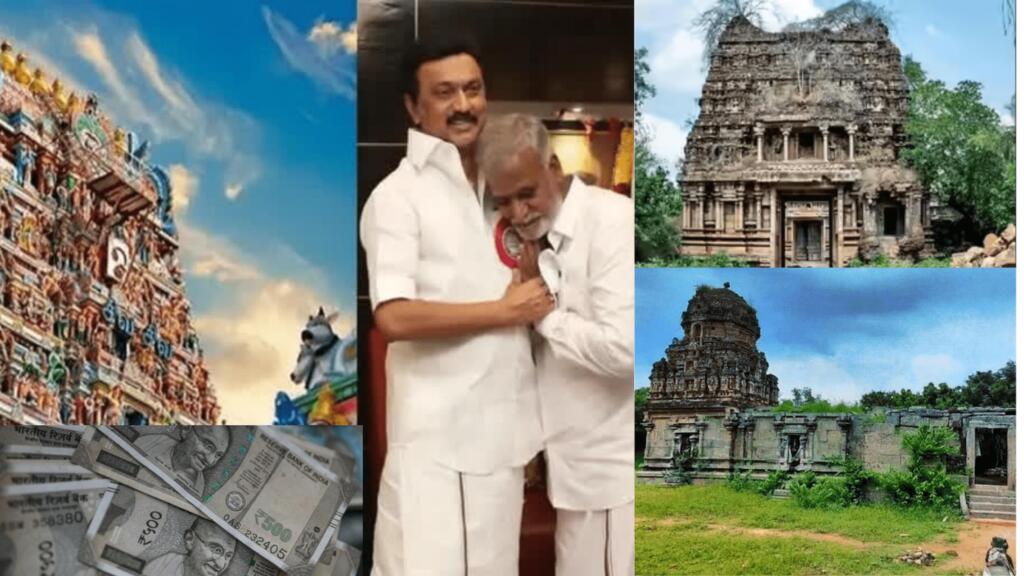
The Tamil Nadu government’s Hindu Religious and Charitable Endowments (HR&CE) Department currently controls over 45,000 Hindu temples, and is allegedly eyeing control of even more. Many critics argue this is nothing short of a systematic subversion of religious autonomy. Out of the estimated 100,000 temples in Tamil Nadu, almost half of the temples are already under state control, and the state’s actions suggest a relentless push to dominate every sacred Hindu institution.
This control isn’t merely administrative. According to multiple reports, this is a deeply political project orchestrated by the Dravidian model politics, with critics, including the AIADMK and religious leaders, calling it a direct assault on Hindu cultural heritage. The DMK-led government’s motivations have increasingly come under scrutiny, with questions raised about where temple funds are going and whether the state’s interference violates the Constitution.
Temple Funds Diverted: Schools and Colleges Built at Devotees’ Expense
In July 2025, AIADMK General Secretary Edappadi K. Palaniswami stirred a political storm during his public campaign in Coimbatore, alleging that the DMK government had diverted temple funds from the HR&CE Department to build colleges. Palaniswami asked, “Devotees donate to temples for their maintenance and development. Why can’t the government use its own budget to build colleges?”
He was clear that he did not oppose education, but asserted that education expenses must be borne by the state, not by funds meant for religious upkeep. He described the use of temple donations for college construction as a “planned conspiracy” against the temples, calling out the DMK’s discomfort with religious institutions.
Indeed, facade projects like Kumbhabhishekham (ritual consecrations) of 10-15 temples are highlighted publicly, while thousands of temples are crumbling without basic maintenance or daily pujas. Critics argue that the DMK projects an image of temple improvement while allowing large swaths of temples to decay—spiritually, structurally, and culturally.
Legal Wrangling and Constitutional Violations
The Indic Collective Trust has petitioned the Supreme Court to intervene in the HR&CE’s sweeping control, citing violations of Articles 25, 26, and 29 of the Indian Constitution—rights that guarantee religious freedom and protection of cultural identity.
In December 2022, the Supreme Court asked the Tamil Nadu government to respond to allegations that Executive Officers (EOs) were appointed indefinitely to temples without following proper legal procedures. As per the 2015 EO Appointment Rules, such appointments should not exceed five years and must have clear justifications. Yet, EOs have been appointed indefinitely—even in temples with extremely low revenue, suggesting an indiscriminate and possibly unlawful takeover.
Notably, no temple has ever been returned to its original trustees or community leaders in the past 70 years once it came under HR&CE control.
Misuse of Funds: A Facade of Development?
In January 2025, just days after a Madras High Court ruling mandated that temple surplus funds be used only as per the HR&CE Act, the department floated an ₹8.40 crore tender for decorative lighting at the sacred Sri Ranganathaswamy Temple. Critics called this project a “facade of deception” with zero religious utility, launched while hundreds of temples have no funds for daily rituals.
Worse, in temples like Sri Ranganathaswamy, activists allege that there’s no legal record of Executive Officer appointments, making HR&CE’s control itself illegal. Activists challenge the government to produce legal authorizations, which have yet to materialize.
Cultural Erosion and Neglect of Heritage
Temples are not just places of worship; they are cultural monuments and architectural marvels. Tamil Nadu, often called “Temple Nadu”, has thousands of temples that are centuries old. Yet, according to multiple activists, over 5,000 temples lie in ruins, victims of total administrative neglect by the HR&CE.
Reports of missing idols, stolen temple jewelry, and untraceable assets further amplify concerns that HR&CE functions more like a looting apparatus than a caretaking body. Not only has the government failed to protect temple properties, but it has also been accused of selling or leasing out temple lands without accountability.
Who Should Control Hindu Temples?
This ongoing saga raises a fundamental question: Who should control Hindu temples in a secular democracy? Churches and mosques are administered freely by their respective religious groups. Yet, only Hindu temples fall under government control, through HR&CE.
This anomaly contradicts the principle of equal treatment of all religions and the constitutional promise of religious freedom. Prominent spiritual leaders like Sadhguru Jaggi Vasudev have repeatedly called for a reassessment of the HR&CE Act, stating that it no longer serves its original intent and is now simply a tool for political control.
Citizens, religious heads, and activists have demanded that temples be handed back to the Hindu community, managed by dharmic trusts, religious heads, or cultural organizations—just like in the case of Christian and Islamic institutions.
A Call for Justice and Restitution
The DMK government’s aggressive control over temples via the HR&CE Department, while allegedly diverting funds for non-religious use, undermines the cultural, spiritual, and constitutional fabric of the state. With over 45,000 temples already under control and thousands decaying in neglect, the HR&CE’s mismanagement and opacity have come under harsh scrutiny.
If Tamil Nadu truly wants to honor its reputation as the “Land of Temples,” it must restore the sanctity of these institutions, ensure transparency, and most importantly, respect the rights of the Hindu community to manage its own places of worship. Temples are not ATMs for state projects or appeasement schemes. They are living heritage, and they deserve better.
The time has come to rethink the role of HR&CE, hold corrupt officials accountable, and initiate a comprehensive handover of temple management to rightful stakeholders—the devotees and dharmic custodians of these ancient traditions.
(This is Part – IV and final story of a Series of articles on Tamil Nadu’s Controversial Hindu Religious and Charitable Endowments control over Hindu Temples)