
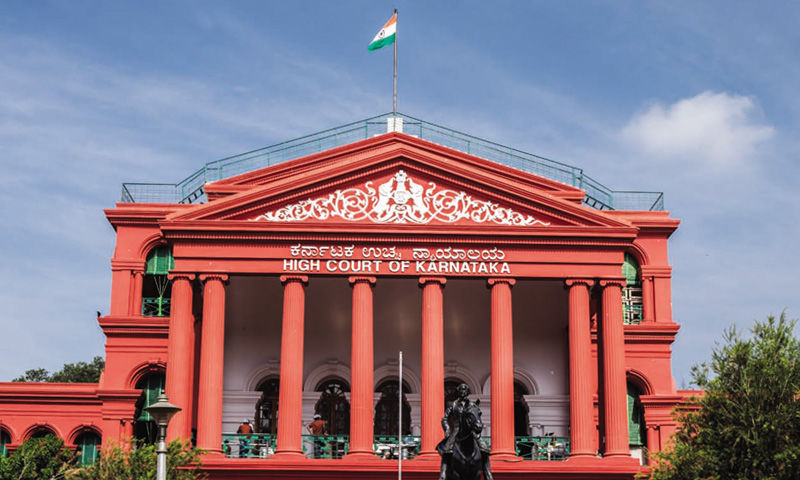
In a critical judgment reaffirming the right to religious expression, Dharwad Bench of the Karnataka High Court has quashed a criminal case against three Muslim men accused of promoting Islam and allegedly attempting to convert Hindus near a temple. The court held that merely distributing religious pamphlets or speaking about one’s faith in public spaces without evidence of coercion, inducement, or fraud does not constitute an offence under Karnataka’s anti-conversion laws.
The accused Mustafa, Alisab, and Suleman were booked under multiple sections of the Bharatiya Nyaya Sanhita (BNS), along with Section 5 of the Karnataka Protection of Right to Freedom of Religion Act, 2022, after a complaint was filed by a local resident in Jamkhandi. On May 4, 2025, the three were reportedly seen distributing Islamic pamphlets and engaging in religious discussions near the Ramatheerth Temple, a prominent local shrine.
Overreach of Anti-Conversion Law
The complainant, a local barber named Ramesh Mallappa Navi, alleged that the men were denouncing Hindu deities, declaring the supremacy of Allah, and making inflammatory statements suggesting a desire to convert others. He further claimed they offered jobs and other financial allurements to encourage conversion and threatened those who objected.
However, the Karnataka High Court dismissed the FIR as legally unsustainable. Justice Venkatesh Naik T ruled that Navi lacked the legal standing to file such a complaint, as the anti-conversion law limits such complaints to the individuals who are allegedly converted or their immediate family members. Since Navi was not directly impacted, his complaint did not meet the threshold defined under Section 4 of the Act.
Additionally, the Karnataka High Court found that even if all allegations were accepted as true, they did not amount to a prosecutable offence. ‘There is no allegation that the petitioners converted or attempted to convert any person to another religion,’ the court stated. It emphasised that discussing or promoting religious beliefs in the absence of coercion or fraud does not violate the law.
Religious Outreach Alone Not a Violation of Law
The Karnataka High Court’s ruling underscored the constitutional protection of religious freedom and free speech. It reiterated that mere expression of religious views even in a public space is not criminal, unless accompanied by concrete acts of unlawful inducement or deception.
Justice Naik asserted that the purpose of the anti-conversion law is to prevent exploitative or forceful conversions, not to prohibit peaceful religious discourse. ‘The absence of essential elements like fraud, coercion, or allurement renders the FIR untenable,’ he said.
With these observations, the bench quashed the FIR and all related proceedings pending before the Additional Civil Judge and JMFC Court, Jamkhandi, providing relief to the three petitioners.