
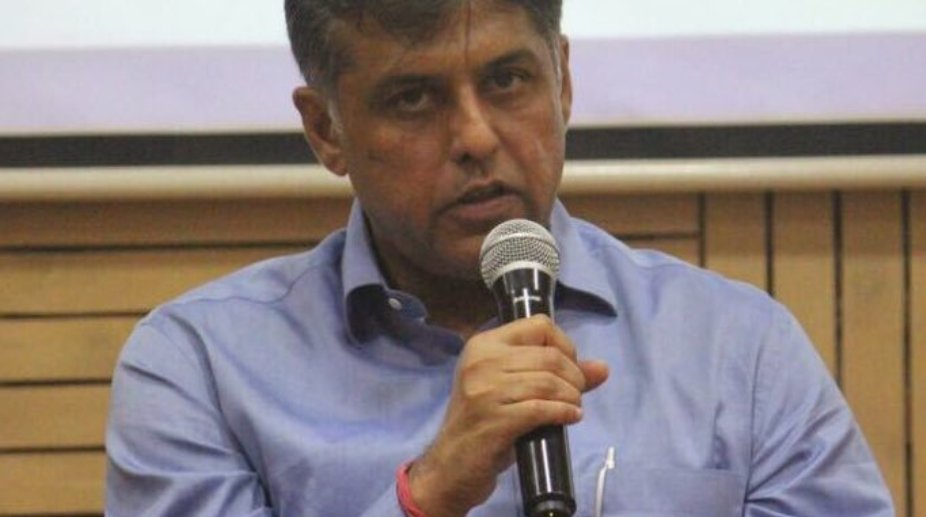
All is not well within the Congress party. A storm is brewing beneath the surface, and it’s no longer just whispers. As the high-stakes debate on Operation Sindoor unfolds in Parliament, senior Congress leaders Manish Tewari and Shashi Tharoor find themselves sidelined not by chance, but by design. Tewari’s cryptic but loaded social media post quoting a patriotic song has sent a clear message: the Congress is no longer a party that values seasoned voices who dare to acknowledge national interests, especially when they align even slightly with the government’s position. The leadership, it seems, has chosen politics over patriotism, factionalism over facts.
Patriotic Refrain, Political Snub
Tewari’s subtle yet unmistakable rebuke came via a post on X (formerly Twitter), where he shared a screenshot of the news highlighting his exclusion, captioned with lyrics from the patriotic classic Purab Aur Pachhim: “Hai preet jahaan ki reet sada, main geet wahaan ke gaata hoon, Bharat ka rehne waala hoon, Bharat ki baat sunata hoon. Jai Hind.”
है प्रीत जहां की रीत सदा
मैं गीत वहां के गाता हूं
भारत का रहने वाला हूं
भारत की बात सुनाता हूं
Hai preet jahaan ki reet sada
Main geet wahaan ke gaata hoon
Bharat ka rehne waala hoon
Bharat ki baat sunata hoon
– Jai Hind pic.twitter.com/tP5VjiH2aD
— Manish Tewari (@ManishTewari) July 29, 2025
The message was loud and clear — his allegiance lies with the nation, not with political maneuvering. In doing so, Tewari publicly underlined what insiders have long whispered: Congress today is far removed from national sentiment. The sidelining of leaders who refuse to blindly toe the anti-government line, especially on issues of national security, is now becoming the norm.
Senior Voices Silenced for Supporting National Interest
Manish Tewari and Shashi Tharoor, two of the most articulate and experienced parliamentarians in the Congress camp, were glaringly absent from the speaker list for the ongoing Operation Sindoor debate in the Lok Sabha. Both had recently represented India as part of all-party delegations abroad, articulating the nation’s stand against cross-border terrorism. Their credibility on national security matters is not only well-known but hard-earned.
However, when it came time for the Congress to present its case in Parliament, these voices were muzzled. Sources confirmed that while Tewari had proactively written to the leadership requesting to speak during the debate, he was denied the opportunity. Tharoor, meanwhile, reportedly declined an invitation to speak as he found it difficult to toe the party line — a line that took aim at the government’s actions despite their effectiveness in safeguarding India’s security.
Party Chooses Dynasts Over Domain Experts
In place of experts like Tewari and Tharoor, Congress is fielding a group of relatively unknown MPs such as Praniti Shinde, Saptagiri Ulaka, and Brijendra Ola — none of whom possess the credentials or gravitas required for such a critical debate. Alongside them are the usual dynastic faces like Rahul Gandhi, Deepender Hooda, Gaurav Gogoi, and Priyanka Gandhi Vadra, whose rhetoric rarely moves beyond theatrics.
This decision further reveals the rot within the Congress: when it comes to serious national conversations, the party prefers loyalty over logic and bloodlines over competence. This approach not only weakens the opposition’s credibility in Parliament but also distances the Congress from the pulse of the people, especially on matters as sensitive as national security.
Far from National Sentiment, Close to Political Gimmicks
Operation Sindoor was widely supported across the political spectrum and lauded by citizens as a bold response to terrorism emanating from across the border. The External Affairs Minister S. Jaishankar clearly articulated that the operation marked a “new normal” in India’s security doctrine.
But instead of aligning with the national sentiment and presenting a united front on a bipartisan issue, the Congress leadership chose to maintain a hyper-critical stance, even if it meant stifling its most capable voices. This is not opposition for the sake of democracy — it is opposition for the sake of opposition.
Congress’s reluctance to allow honest voices like Tewari and Tharoor to speak reflects a party trapped in its own ideological confusion. Rather than adapting to new geopolitical realities, it continues to cling to outdated political strategies that alienate both the public and its own leaders.
A Party at War With Itself
The sidelining of Manish Tewari and Shashi Tharoor is not just a strategic error; it’s symptomatic of a deeper malaise within the Congress. The party is increasingly appearing out of touch with national priorities and public mood. At a time when unity on issues like terrorism should transcend party lines, the Congress has chosen to silence its best minds in favour of internal politics and optics.
If this continues, the Congress risks not only irrelevance but complete internal disintegration. As Manish Tewari’s post suggests, patriotism and pragmatism now have little room within the Congress’s echo chamber — and that should concern not just the party, but the country.