
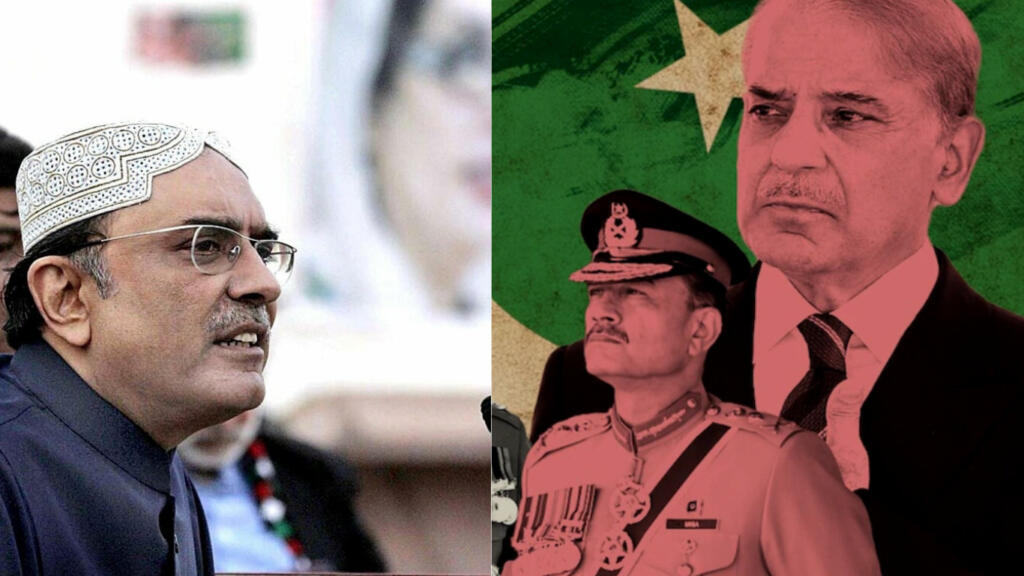
Pakistan is once again teetering on the edge of political chaos. As rumours swirl of a potential coup, the streets of Islamabad and Rawalpindi are heavy with anxiety. The fear is not baseless; credible reports from within Pakistan suggest that the country could be hurtling toward yet another military intervention, with President Asif Ali Zardari likely to be the first casualty.
The country, already reeling from economic collapse and international embarrassment, now faces a replay of its darkest political chapters. The timing couldn’t be more ominous, with July 5 marking 47 years since General Zia-ul-Haq’s infamous 1977 coup against Zulfikar Ali Bhutto. And this time, Bhutto’s own grandson, Bilawal, stands at the centre of the storm. Once again, it appears that the Pakistan Army may not be able to resist its favourite pastime: staging coups.
Zardari’s Chair Under Threat
According to multiple Pakistani media sources, Army Chief General Asim Munir is allegedly manoeuvring to dethrone President Zardari. Though no official confirmation has surfaced, whispers inside Islamabad suggest a calculated move to replace Zardari with Munir himself. Whether this shift happens through a backroom deal or a full-blown military takeover remains to be seen.
The spark came when Bilawal Bhutto Zardari openly criticised General Munir in an international interview, even going so far as to suggest Pakistan should hand over terrorists Hafiz Saeed and Masood Azhar to India. This direct hit on the military establishment sent shockwaves through Pakistan’s corridors of power and invoked a stinging backlash from terror sympathisers, including Talha Saeed, the son of Hafiz Saeed. Public discourse immediately turned toward Bilawal’s political future, and by extension, the safety of his father, the sitting president.
Interestingly, the ISPR, Pakistan Army’s media wing, has remained tight-lipped, a sign that something is brewing. Meanwhile, reports suggest Munir has been elevated to the ceremonial yet symbolic title of Field Marshal, signalling his tightening grip on Pakistan’s power levers. For Zardari, it may already be checkmate.
Shehbaz Sharif: Walking a Tightrope
If Zardari’s position is precarious, Prime Minister Shehbaz Sharif’s chair is no safer. The younger Sharif finds himself in a role eerily reminiscent of 1999 when the then-army chief Pervez Musharraf overthrew Nawaz Sharif’s elected government. At that time, Musharraf had offered Shehbaz a deal to replace his brother and lead with military support. Shehbaz refused, alerting Nawaz and keeping the family intact.
Now, history may be repeating itself. Asim Munir, with his rising power, is said to harbour ambitions not just for the presidency but also for total control of the political narrative. Unlike Musharraf, who posed as a liberal moderniser, Munir cloaks his ambitions in religious nationalism. From invoking Islamic imagery to declaring Kashmir Pakistan’s “jugular vein,” Munir’s rhetoric signals a more ideological, hardline stance.
Sharif, for all his attempts at balancing diplomacy and domestic governance, appears cornered. He stands next to a general who not only mirrors Musharraf’s rise but might well outdo him in ambition. If Munir’s plans for a Zardari exit succeed, Shehbaz could be next.
A History Repeating Itself
It’s almost poetic if not tragic how Pakistan’s political history keeps repeating itself. In 1977, General Zia-ul-Haq deposed Prime Minister Zulfikar Ali Bhutto in a bloody military coup. Zia’s promise of holding elections within 90 days turned into an 11-year military dictatorship. Bhutto was executed, and Pakistan was plunged into an era of Islamisation and martial law.
And now, 47 years later, Bhutto’s grandson Bilawal faces threats from the very institution that ended his grandfather’s life. The irony is deafening. It’s as though every army chief in Pakistan signs an unwritten pact upon taking office: stage at least one coup before retirement.
Operation Sindoor and the Kashmir Angle
The backdrop to this domestic turbulence is an increasingly tense situation with India. After the brutal Pahalgam terror attack that killed 26 Indians, India responded with Operation Sindoor—a sweeping air and intelligence operation targeting terror hubs deep inside Pakistan. The strikes revealed, through satellite images and intelligence intercepts, the deep entrenchment of groups like Lashkar-e-Taiba and Jaish-e-Mohammed within Pakistani territory.
In retaliation, Pakistan launched cross-border shelling, but the Indian Air Force followed up by neutralising key air defence systems across Lahore and beyond. These bold moves have escalated tensions, placing General Munir under pressure to respond.
In a speech, Munir doubled down on Pakistan’s Kashmir stance, invoking nationalist fervour. This may well be part of his plan to rally public support as he prepares for a power grab. History shows that Pakistani generals love to wear the cloak of “defender of the nation” before toppling the very government they claim to serve.
Pakistan’s Democracy in Free Fall
Pakistan’s fragile democracy is once again in the army’s crosshairs. With both President Zardari and Prime Minister Shehbaz Sharif looking increasingly vulnerable, the country appears headed for yet another military chapter. If the past is any guide, the consequences could be disastrous more international isolation, more economic instability, and more repression at home.
The world is watching, but if Pakistan’s army follows its own script, the outcome may already be written. The game of thrones in Islamabad is on, and the army, as always, holds all the cards.