
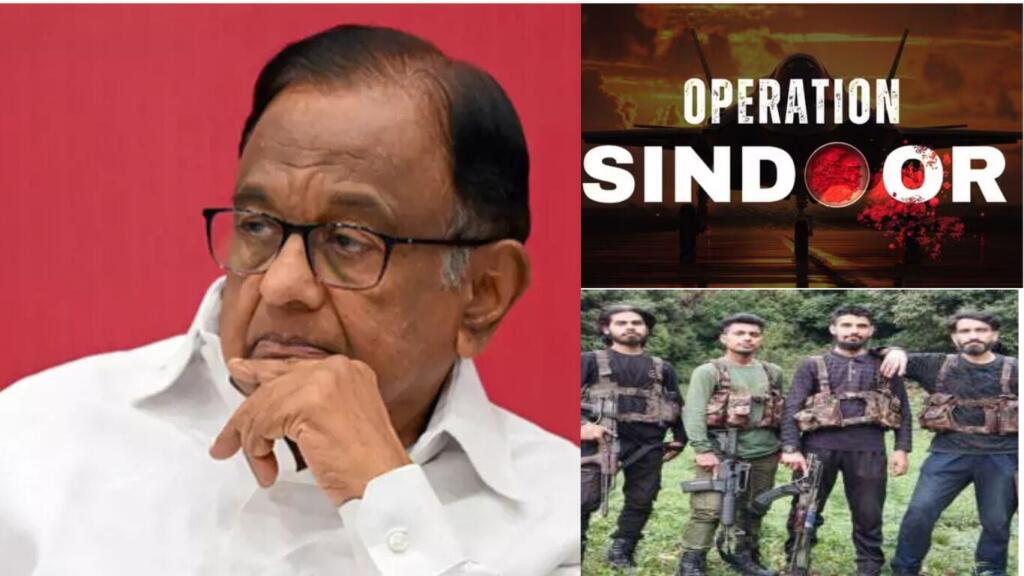
Senior Congress leader and former Union Home Minister P. Chidambaram publicly questioned whether the terrorists involved in the Pahalgam massacre were truly Pakistani. His remarks come just days ahead of the crucial parliamentary debate on Operation Sindoor, India’s counterstrike against the killers of 26 innocent pilgrims. Instead of standing with the armed forces and the victims, Chidambaram has once again chosen to question India’s response and cast doubt on Pakistan’s role a pattern that is becoming disturbingly familiar. The question the nation is asking now is “Why is the Congress in a hurry to give a clean chit to Pakistan”?
Chidambaram’s Dangerous Doubts: Echoes of ‘Saffron Terror’ Redux?
In a now widely circulated interview with The Quint, former Home Minister P. Chidambaram cast serious doubts over the Indian government’s claims that Pakistani nationals were behind the April 22 Pahalgam terror attack. “For all we know, they could be homegrown terrorists. Why do you assume they came from Pakistan? There’s no evidence of that,” he declared. These remarks were not just speculative they undermined India’s counterterrorism narrative and inadvertently echoed the talking points often pushed by Pakistan’s information machinery.
This is not the first time Chidambaram has cast such doubt. Under the UPA regime, the Congress floated the now-discredited “Saffron Terror” theory, which sought to shift the narrative away from Islamist terror to a fabricated threat within Hindu society. Now, once again, Chidambaram is questioning the Indian security establishment, the intelligence agencies, and the very foundation of Operation Sindoor.
A Pattern of Deflection: Congress and Its Long History of Undermining National Response
The BJP was swift and scathing in its response. Amit Malviya, in a strongly worded post, said, “Once again, the Congress rushes to give a clean chit to Pakistan this time after the Pahalgam terror attack. Why is it that every time our forces confront Pakistan-sponsored terrorism, Congress leaders sound more like Islamabad’s defence lawyers than India’s Opposition?”
The question is not rhetorical. From the 26/11 attacks, where Congress was accused of delaying response and refusing to name Pakistan directly, to doubting the authenticity of the surgical strikes and Balakot airstrikes, the pattern is clear: when it comes to national security, Congress has consistently found itself on the wrong side of the Indian sentiment. Even during the Galwan clash, senior Congress leaders amplified Chinese propaganda rather than backing the Indian Army.
Now, with Operation Sindoor India’s swift and strategic response to the Pahalgam attack under way, Chidambaram’s comments risk demoralising the forces and raising unnecessary doubts during a time of national mourning and military action.
Why Attack the Government Instead of the Enemy?
Chidambaram didn’t stop at doubting the identity of the attackers. He also accused the Modi government of hiding information, suppressing details of casualties, and failing to provide clarity on tactical decisions. He questioned why the Prime Minister or Defence Minister had not yet made a comprehensive statement, while ignoring the very real intelligence and security protocols that often require strategic silence.
He even accused the government of “re-strategising” midway through the operation and hiding “tactical mistakes,” despite the fact that such matters are always assessed internally by the armed forces and not meant for media spectacle. Furthermore, Chidambaram went on to allege that it was not India but Donald Trump who brokered a ceasefire — a statement completely detached from reality and echoing external narratives.
Instead of praising India’s swift response or honouring the 26 pilgrims who lost their lives in Pahalgam, the Congress veteran turned his ire entirely toward the Indian government. Why is it that for every Indian retaliation, the first question Congress asks is not about the enemy’s origin, but about the Indian government’s intent?
Opposition or Ally to the Enemy?
While healthy debate and scrutiny are cornerstones of democracy, there’s a thin line between constructive criticism and strategic sabotage. Chidambaram’s remarks have crossed that line. BJP spokesperson Shehzad Poonawalla put it bluntly: “26/11 to Surgical Strike to Pahalgam Congress ka haath, Pakistan ke saath.”
As the Parliament readies for a crucial debate on Operation Sindoor, Chidambaram’s statements are expected to be raised and scrutinised. The Indian public, especially the families of the 26 pilgrims brutally murdered in Pahalgam, deserve clarity and justice not speculative lectures about “homegrown terrorists” with zero factual backing.
Moreover, the Congress’s refusal to stand with India in moments of terror or war raises an uncomfortable truth — does the party now see opposing Modi as more important than supporting India?
National Security Can’t Be Partisan
The Chidambaram episode isn’t an isolated case it’s symptomatic of a larger rot within the Congress ecosystem, where every national security move is viewed through the lens of political competition, and not national interest. By constantly casting doubt on India’s fight against terrorism, Congress ends up strengthening the very forces that seek to weaken India whether in Islamabad or elsewhere.
In contrast, the Modi government’s consistent position has been one of zero tolerance against terror, swift action against Pakistan-sponsored attacks, and full support for the armed forces. Operation Sindoor, like the Balakot and Uri operations before it, is part of this doctrine.
It’s time for the Congress to make a choice: Does it wish to be remembered as a party that stood with India in its darkest hours, or one that always found excuses to speak against it? In matters of national security, ambiguity is betrayal. And no party that plays defence for Pakistan, intentionally or otherwise, will be forgiven by the people of India.