















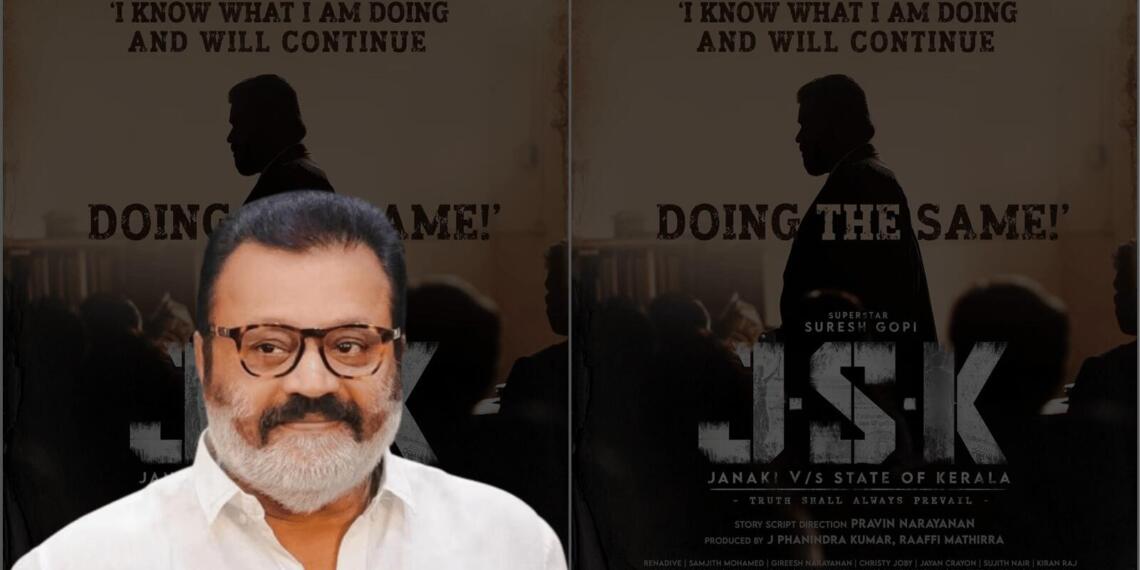
A Malayalam film starring Union Minister Suresh Gopi has sparked a legal and cultural controversy after the Central Board of Film Certification (CBFC) delayed its clearance, allegedly due to the character name ‘Janaki’ a name associated with the Hindu goddess Sita. The Kerala High Court has now intervened, expressing concern over the delay and criticising the CBFC’s objections. Justice N Nagaresh openly questioned why a rape survivor character fighting for justice cannot be named Janaki, calling the board’s rationale arbitrary and a violation of artistic freedom. The film has missed multiple release dates amid this dispute.
‘Janaki’ Name Triggers CBFC Objection, Court Steps In
The controversy centres around the Malayalam film “JSK: Janaki vs State of Kerala,” which portrays a rape survivor named Janaki seeking justice through the legal system. The film’s title and character name came under scrutiny from the CBFC, which reportedly objected to the use of ‘Janaki’ citing religious sensitivities.
Deputy Solicitor General of India OM Shalina told the Kerala High Court that the name Janaki, being another name for goddess Sita, could hurt religious sentiments. However, Justice N Nagaresh disagreed, stating, “She is the victim? If the rapist’s name was Ram, Krishna or Janaki, then it would have been understandable. Here she is the heroine, who is fighting for justice.”
The judge strongly asserted that it is not for the censor board to dictate the creative choices of filmmakers, including the names of characters. “What is wrong with the name Janaki? How is this an insult to religion? This is the freedom of the artist,” Justice Nagaresh asked pointedly.
Delay in Certification and Legal Plea by Filmmakers
Cosmos Entertainments, the production house behind the film, filed a petition in the Kerala High Court challenging the CBFC’s delay in issuing a certificate. The application for certification was made on June 12, but no official objections or clearances were communicated. The court was told that the teaser of the film was earlier certified without objection to the title.
The company argued that the delay not only infringes on their constitutional rights under Articles 19(1)(a) and 19(1)(g) freedom of expression and profession but also causes significant financial losses due to repeated postponements of the release. The film was originally slated for a June 20 release, later moved to June 27, and has now missed both dates.
Justice Nagaresh observed that CBFC’s objection appears to lack procedural backing, and noted that the advisory to approach the Film Certification Appellate Tribunal (FCAT) is redundant, as the tribunal was abolished in 2021. The court has scheduled the matter for further hearing on July 2 and sought a formal response from the CBFC.
Artists and Industry Stand Up Against Censorship
The controversy has triggered widespread protests from within the Malayalam film fraternity. Major industry organisations such as AMMA (Association of Malayalam Movie Actors), the Producers Association, and FEFKA (Film Employees Federation of Kerala) staged demonstrations outside the CBFC’s regional office at Chitranjali Studio, Thiruvananthapuram.
The protestors demanded that creative freedoms be protected and called for an end to arbitrary censorship. According to them, many films in the past, including one titled “Janaki Jaane” released in 2023, have used the same name without issue.
During the court hearing, the petitioner’s counsel highlighted that the character Janaki is a survivor, not an offender, and is portrayed as a symbol of strength. “If a rapist were named Rama, Krishna, or Janaki, then the court could understand the objection. But here, she is a heroine fighting for justice,” the judge reiterated.
CBFC’s Legal Stand and Questionable Guidelines
The CBFC, in internal communication, cited Guidelines 2(vi) and 2(xi) of the Cinematograph Act to justify its recommendation to remove the name Janaki from the film’s title and dialogues. These guidelines prohibit content that is contemptuous of religious groups or may incite hatred.
However, the court found this justification inadequate. “80 percent of names in India have religious connotations Ahmed, Anthony, Raman. Will the Board now decide what names filmmakers are allowed to use?” the court asked, pointing out that the board’s action appears “prima facie unsustainable.”
The court also hinted that if necessary, it would consider watching the film in open court before making a final judgment. For now, the production house has been asked to await CBFC’s formal clarification.
A Test Case for Artistic Freedom in India
The “Janaki vs State of Kerala” controversy has evolved into a larger debate on artistic freedom, religious sensitivities, and bureaucratic overreach. With the Kerala High Court standing firmly in favour of creative liberty, this case may set a precedent for future film certification disputes.
While the CBFC’s stated objective is to prevent offensive content, its actions in this case have raised questions about arbitrary censorship. The judiciary’s strong observations suggest that the film may eventually be cleared with its original title intact.
For now, the makers and audiences await July 2, when the court is expected to take a firmer stance, potentially paving the way for the film’s release.