
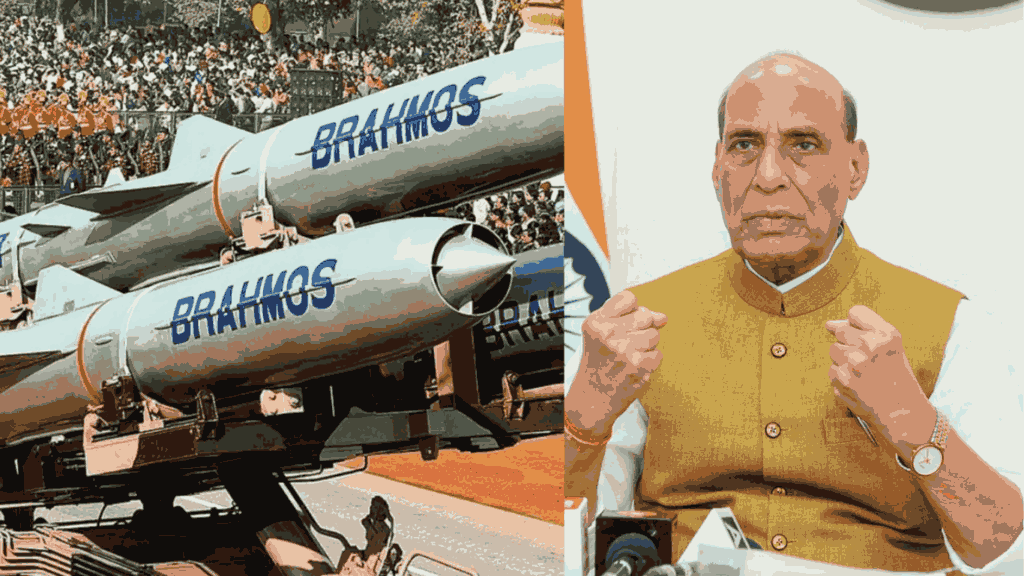
After Operation Sindoor, India’s defence capabilities have caught the world’s attention. Defence Minister Rajnath Singh revealed that 14–15 countries have expressed interest in purchasing the BrahMos missile following its exceptional performance in the operation against Pakistan. This global demand signals a major leap in India’s journey towards Aatmanirbhar Bharat (self-reliance), showcasing the prowess of indigenous military technology. The missile’s precision, speed, and effectiveness are now being recognised internationally. With the BrahMos production being inaugurated in Lucknow recently, it marks not only a strategic milestone but also a socio-economic boost for Uttar Pradesh. India is no longer just a buyer of defence technology it is becoming a global exporter.
BrahMos Shines in Operation Sindoor
Defence Minister Rajnath Singh, while speaking at a commemorative event in Lucknow, hailed the BrahMos missile’s “miraculous” role in Operation Sindoor, India’s retaliatory strike against Pakistan following the brutal Pahalgam terror attack in Kashmir. Singh noted that the missile’s precision and power during the operation not only achieved military success but also captured the attention of the global defence community.
“After Operation Sindoor, BrahMos has become a symbol of India’s strategic strength. Nearly 14 to 15 countries have shown keen interest in procuring the missile,” Singh said, emphasizing that the demand was a direct outcome of its stellar performance during the mission. The BrahMos missile, with its supersonic speed, pinpoint accuracy, and versatility across land, air, and sea platforms, played a decisive role in the mission’s success.
The Defence Minister was in Lucknow to honour former Uttar Pradesh Chief Minister Chandra Bhanu Gupta on his birth anniversary. At National PG College, Singh unveiled a statue of the veteran leader and released a commemorative postage stamp in his name.
Rising Global Demand for Indian Defence Tech
The global interest in BrahMos reflects a larger trend India’s emergence as a defence exporter. Under the Aatmanirbhar Bharat vision spearheaded by Prime Minister Narendra Modi, India has ramped up domestic defence production, moving away from dependence on foreign imports.
In the past five years, India has exported defence equipment to over 85 countries. The total value of defence exports touched nearly ₹21,000 crore (approx. $2.5 billion) in 2023–24 alone. Countries in Southeast Asia, Africa, and even Eastern Europe are exploring deals with Indian defence firms for drones, radars, artillery systems, and now, supersonic cruise missiles like BrahMos.
Singh said that India’s defence diplomacy is gaining ground, thanks to reliable performance, competitive pricing, and the geopolitical trust India commands. “India is not just protecting itself but is becoming a reliable defence partner to the world,” he declared.
BrahMos Production Begins in Lucknow
Highlighting a major development in defence manufacturing, Rajnath Singh also noted that the BrahMos missiles will now be produced in Lucknow. A few days ago, Singh, alongside Uttar Pradesh Chief Minister Yogi Adityanath, inaugurated a state-of-the-art BrahMos airspace integration and testing facility in the city.
This facility will not only contribute to India’s defence preparedness but also catalyse employment opportunities for the youth of Uttar Pradesh. “This initiative will strengthen Aatmanirbhar Bharat and provide job opportunities to locals,” Singh said. By setting up such high-tech defence production units outside traditional hubs like Bengaluru or Hyderabad, the government is decentralising industrial growth and empowering Tier-2 cities like Lucknow.
BrahMos, a joint venture between India’s DRDO and Russia’s NPO Mashinostroyenia, is a supersonic cruise missile known for its speed (Mach 2.8 to 3.0), low radar visibility, and lethal precision. It can be launched from land, air, sea, and even submarines. The name “BrahMos” is derived from two rivers: Brahmaputra (India) and Moskva (Russia), symbolising Indo-Russian defence collaboration.
India’s Defence Journey Enters a New Era
The post-Operation Sindoor demand surge for BrahMos marks a new era for India’s defence ecosystem. With global powers now seeking Indian missiles, and indigenous manufacturing plants opening in cities like Lucknow, India is clearly stepping into the role of a defence exporter with confidence. This transformation aligns with the larger vision of Aatmanirbhar Bharat, where self-reliance is not just about reducing imports but becoming a global provider of strategic technology.
India is now demonstrating that it can build, operate, and export world-class military solutions grounded in innovation, powered by national pride, and aimed at a secure, sovereign future.