















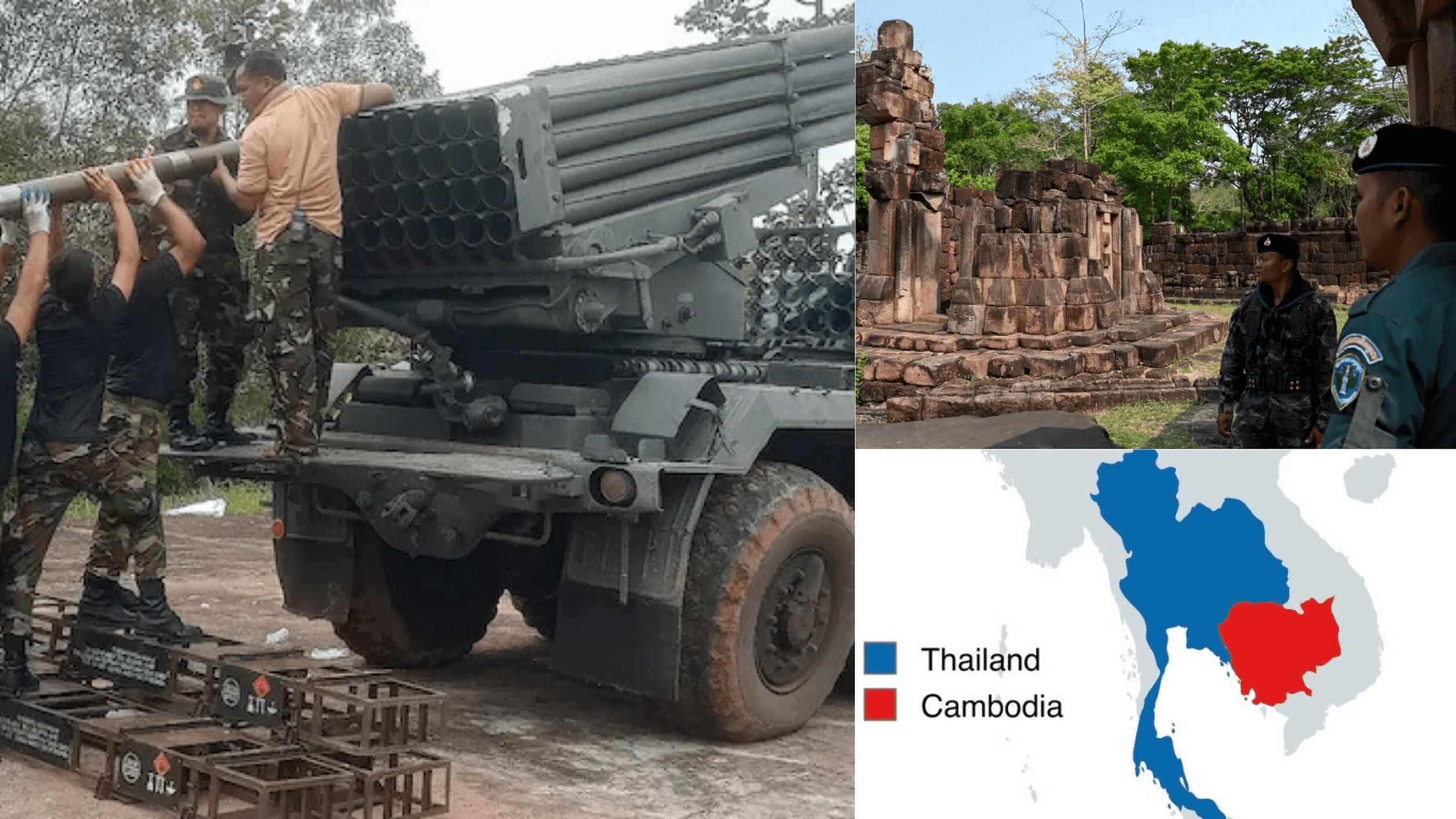
A decades-old territorial dispute between Thailand and Cambodia has once again erupted into deadly violence, with troops from both nations exchanging fire across multiple points along the contested border. The situation escalated sharply on Thursday, leaving at least nine people dead, according to Thai media reports. With clashes reported in at least six different zones, and airstrikes and artillery now part of the conflict, the region finds itself teetering on the edge of a broader confrontation. While this isn’t the first time tensions have erupted, the renewed violence underscores the fragility of peace between the two Southeast Asian neighbors, whose disputes date back more than a century.
Colonial Roots of a Bitter Dispute
The roots of the Thailand-Cambodia border tensions stretch back to the colonial era. Cambodia, then a French protectorate from 1863 to 1953, had its borders drawn by French cartographers. In 1907, a map was produced based on a bilateral agreement, establishing the natural watershed line as the boundary between the two nations. However, Thailand later objected to the map, particularly because it placed the Preah Vihear Temple—an 11th-century Hindu temple—within Cambodian territory.
This disagreement over the temple’s ownership became the flashpoint of future tensions. Despite the International Court of Justice (ICJ) ruling in 1962 that the temple belongs to Cambodia, Thailand has maintained that the surrounding territory remains contested. These cartographic and legal discrepancies have left both nations claiming overlapping areas along their 817-kilometre land border, sowing the seeds of recurrent clashes.
UNESCO Status Fuels Renewed Conflict
The situation grew worse in 2008 when Cambodia successfully applied to have the Preah Vihear Temple listed as a UNESCO World Heritage Site. The move angered Thailand, sparking renewed military standoffs and artillery fire in the area. Between 2008 and 2011, both sides saw several rounds of intense fighting, with 36,000 people forced to evacuate their homes during the height of the conflict.
In response to continued disputes, Cambodia returned to the ICJ in 2011 to seek clarification on the 1962 judgment. The court reaffirmed in 2013 that the temple belonged to Cambodia, but left the surrounding land issue unresolved. While both countries agreed to work through a Joint Boundary Commission set up in 2000, little tangible progress has been achieved in decades of negotiations.
May Skirmish Sparks Escalation
Tensions reignited in May 2025 after a Cambodian soldier was reportedly killed in a cross-border skirmish. This incident pushed bilateral relations to their lowest point in over ten years. The deteriorating atmosphere led to economic retaliation, with Cambodia banning the import of various Thai goods, including electricity, vegetables, and internet services.
By Thursday, the conflict had erupted into full-scale military exchanges. According to Thai defence officials, Cambodia launched artillery attacks that hit a civilian residence in Thailand’s Surin province, killing one and injuring three, including a five-year-old child. In retaliation, the Thai military launched airstrikes using six fighter jets from Ubon Ratchathani province, targeting Cambodian military positions near the border.
The violence unfolded near two temples situated along the disputed frontier dividing Thailand’s Surin province and Cambodia’s Oddar Meanchey. Both governments have blamed each other for initiating the conflict, further complicating efforts to de-escalate.
Diplomatic Channels Offer Little Hope
Although diplomatic talks have been ongoing, they have often ended in stalemates. The most recent meeting of the Joint Boundary Commission was scheduled for June 14 in Phnom Penh but yielded no breakthrough. The political leadership in both countries has made statements condemning the violence, yet there appears to be little momentum toward a peaceful resolution.
The Thai Prime Minister’s Office reported that they are preparing additional contingency plans should the violence escalate. Cambodia, meanwhile, has called on ASEAN to intervene diplomatically but has also bolstered its troop presence near the flashpoints.
Can ASEAN Prevent Another Regional Crisis?
The deadly skirmishes between Thailand and Cambodia are more than just a border dispute—they are the result of unresolved colonial legacies, nationalist sentiments, and failed diplomacy. With airstrikes, artillery, and civilian casualties now part of the equation, the situation is far more dangerous than previous flare-ups. ASEAN and other international bodies must step in urgently to facilitate dialogue and prevent further escalation. Without serious intervention, both nations risk slipping into a prolonged conflict that neither side—and the region—can afford.