
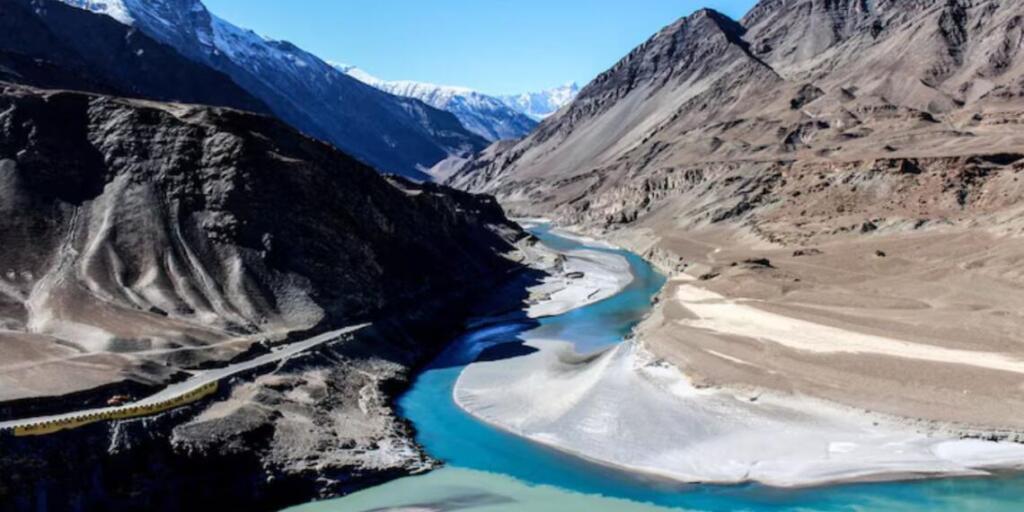
In a decisive move, the Narendra Modi-led BJP government is set to deploy senior Union ministers across the country to explain to the public how suspending the Indus Waters Treaty with Pakistan will serve India’s long-term interests. This outreach is a strategic effort to rally national sentiment around a tough policy that punishes Pakistan for its continued support of cross-border terrorism. Sources say ministers will especially focus on northern states such as Punjab, Haryana, Rajasthan, and Jammu & Kashmir, where water availability and irrigation potential are deeply tied to the Indus river system.
How the Suspension Will Help India: Water, Power and Security
With the treaty suspended, India can finally move ahead with long-stalled water infrastructure plans. The government is working on a major canal system that will connect the Chenab river with the Ravi, Beas, and Sutlej systems. A 160-kilometre-long canal and a nearly 13-kilometre tunnel are also being planned to divert Indus waters towards Indian states. This water will be used for irrigation in Punjab, Haryana, Himachal Pradesh, Rajasthan, and Jammu & Kashmir.
India plans to link all 13 major canal systems in these states to ensure uninterrupted water flow. The aim is to connect the Indus waters to Rajasthan’s Sri Ganganagar within three years. This will help convert arid and semi-arid regions into fertile agricultural zones. In addition to agriculture, the diverted waters will also boost India’s hydropower generation capacity. New and existing hydroelectric projects on the Chenab and Jhelum tributaries are now being fast-tracked, as India is no longer bound by the treaty’s restrictive clauses.
The strategic benefit? Reduced dependency on monsoons, food security for millions, and energy self-reliance all while dealing a non-military blow to a hostile neighbour.
India Reclaims Its Rivers: Water for Bharat, Not for Terror
The Indus Waters Treaty, signed in 1960, had for decades restricted India’s ability to utilize waters of the Indus, Jhelum, and Chenab rivers to their full potential. While the treaty granted India exclusive rights over the eastern rivers Ravi, Beas, and Sutlej it allowed Pakistan full control of the western rivers with only limited Indian usage. That arrangement continued even as Pakistan sponsored cross-border terrorism. But everything changed after the April 22 terrorist attack in Pahalgam, where 26 innocent civilians were killed.
As a direct fallout, India suspended the treaty, signalling that water and blood cannot flow together. Now, under the guidance of Union Water Resources Minister CR Patil, Agriculture Minister Shivraj Singh Chouhan, and Environment Minister Bhupender Yadav, the BJP will hit the ground to educate the public on how this bold decision turns the tide in India’s favour. The move will free up massive volumes of water for domestic agriculture and hydropower, especially in border states starved of irrigation support.
Modi Doctrine in Action: ‘Terror and Talks Can’t Go Together’
Prime Minister Narendra Modi’s doctrine is now being visibly implemented: terror and talks can’t go together and neither can terrorism and water-sharing. In fact, as far back as 2016, the PM had stated that “blood and water cannot flow together.” That sentiment echoed in Union Home Minister Amit Shah’s remarks last month, where he unequivocally ruled out any review of the Indus Waters Treaty. “There will be no talks on this. The water will now be used for our own people,” Shah declared.
Union Minister CR Patil, addressing the media, dismissed Pakistan’s repeated diplomatic letters requesting a review of the suspension. “The letters from Pakistan are just a formality. Our stand is firm no restoration,” he said. With Operation Sindoor having crippled Pakistan’s terror infrastructure, India is now targeting their economic and resource dependency, one step at a time.
A Treaty from the Past Brokered by the West
The Indus Waters Treaty was a product of Cold War-era diplomacy. Brokered by the World Bank, it was signed in 1960 by Indian Prime Minister Jawaharlal Nehru and Pakistani President Ayub Khan. It divided control of the six rivers between the two countries Pakistan getting the larger, western rivers and India the three eastern ones. Even during wars, India honoured the treaty, a goodwill gesture that earned international praise but domestic criticism.
Despite India’s compliance, Pakistan has frequently dragged India to international arbitration, claiming unfair water sharing, even when New Delhi built hydropower projects well within treaty parameters. That goodwill is now gone. India’s position is clear: when Pakistan uses terrorism as state policy, it cannot expect access to shared resources. The World Bank has so far remained neutral on the recent suspension, but officials say India is within its rights given Pakistan’s repeated breaches of bilateral trust.
A Bold Policy for a Stronger India
India’s decision to suspend the Indus Waters Treaty marks a turning point in its strategic doctrine. It’s not merely about rivers it’s about reclaiming sovereignty, punishing state-sponsored terrorism, and prioritizing national interests. For far too long, India honoured an agreement that Pakistan continuously exploited. That era is over.
The Modi government’s outreach campaign is not just a response to Pakistan’s protests it’s a signal to the Indian people that strong decisions are being taken, and that their long-term needs water, food, and power are finally being prioritized over diplomatic niceties. The BJP is not just informing the people; it is empowering them with facts, clarity, and a vision for a secure, self-reliant India.