















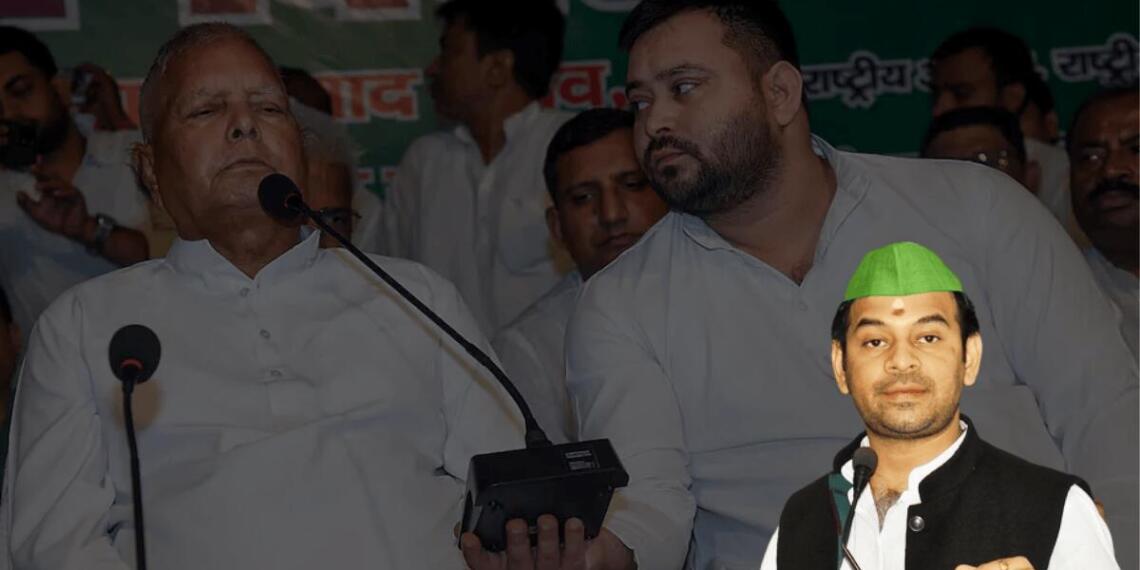
The Rashtriya Janata Dal, once a dominant force in Bihar politics, appears to be grappling with growing internal discord, both within the party and the family that controls it. What once looked like a seamless political succession plan is now showing deep cracks, with tensions mounting between party workers, community supporters, and members of the Lalu Prasad Yadav family.
In a public show of dissent, Lalu Prasad Yadav’s elder son Tej Pratap Yadav recently removed the RJD flag from his car, seen by many as a symbolic rejection of the party’s current direction. Meanwhile, Lalu’s MP daughter Misa Bharti has remained conspicuously absent from public functions for months. Sources within the party say that Tejashwi Yadav’s firm grip over the party’s leadership and legacy has sparked resentment within the family.
Party insiders admit that factionalism has reached a boiling point, and grassroots-level workers are growing increasingly disillusioned. Many warn that if this family dispute spills out into the open, it could spell serious trouble for the RJD. Even Lalu Prasad himself, according to sources close to the family, is deeply concerned about the brewing crisis. And all this continues even as elections to the 243-member Bihar Legislative Assembly are scheduled to take place later this year.
Suitable Heir or Political Misstep?
Lalu Prasad Yadav’s decision to declare Tejashwi Yadav as his political heir, while expecting other family members to fall in line and suppress their own ambitions, may prove to be his biggest political misjudgment. The expectation that elder son Tej Pratap, daughters and in-laws would remain loyal without personal stakes is now being questioned both within and outside the party, sources said.
However, the widening discontent among RJD’s traditional voter base—especially among the Yadav and Muslim communities is also emerging. The refrain now is: “Is there no capable leader in the RJD beyond Lalu’s family?” This sentiment is growing louder as examples of perceived marginalization surface.
One such case is of Ram Kripal Yadav, a once-prominent leader who was allegedly pushed out due to his rising popularity, seen as a threat to the family’s dominance. Similarly, the recent public snub of six-time MP Pappu Yadav by Tejashwi has triggered conversations in the Yadav community—questioning whether seasoned leaders are now reduced to mere bystanders in the “Lalu dynasty.”
Legacy of Dynastic Politics
Critics argue that the roots of this family-centric control were evident long ago, when Lalu, before heading to jail, appointed his inexperienced wife Rabri Devi as the Chief Minister of Bihar. The move was the start of what would become a long-standing tradition of dynastic rule, even amongst the so called icons of Samajwad.
The RJD has built its political base on Muslim-Yadav vote mobilisation, however, now both communities feel increasingly sidelined. One glaring example cited by critics is the party’s reluctance to elevate various Muslim leaders to senior positions.
A Party in Peril?
Today, many political analysts and disgruntled insiders describe the RJD as a private limited company run by the Lalu family, struggling to find its footing amid internal power struggles and eroding public trust. The situation has worsened post-election defeats, and many believe that the party is heading toward inevitable fragmentation unless significant changes are made.
The once unshakable RJD now stands at a crossroads—caught between family loyalty and democratic leadership, and between legacy and grassroots demands. Whether the party can overcome this internal turbulence or collapse under the weight of its own contradictions remains to be seen.





