
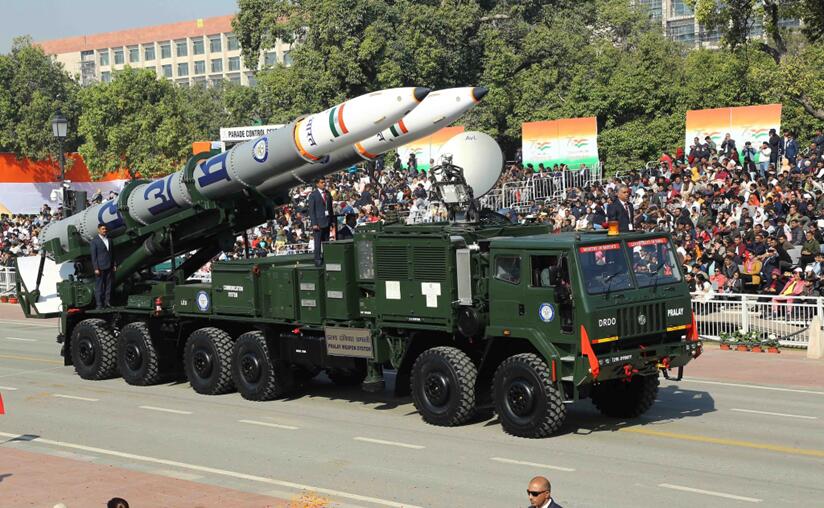
The two back-to-back flight tests demonstrated the Pralay missile’s performance across both its short and extended range profiles, indicating significant technological maturity and versatility. Capable of striking targets between 150 to 500 km and designed with radar-evading capabilities, the Pralay missile is rapidly emerging as a front-runner in India’s next-generation tactical arsenal. For Armenia—locked in an increasingly volatile military rivalry with Azerbaijan—India’s missile presents an ideal deterrent to balance regional threats, especially after Azerbaijan’s acquisition of Israeli-made LORA ballistic missiles.
Sources say that a visiting Armenian delegation may have quietly observed the Defence Research and Development Organisation’s (DRDO) recent twin flight tests of the Pralay short-range quasi-ballistic missile earlier this month. While no official confirmation has emerged, the coinciding timelines of the missile trials and the high-level Armenian visit have led to strong speculation that India may have deliberately showcased its advancing tactical missile capabilities to a key partner.
Pralay Missile: India’s Tactical Game-Changer
The DRDO-developed Pralay missile offers India and potential defence partners a powerful, mobile strike option. Built to be fired from road-mobile platforms, the missile employs a quasi-ballistic trajectory, high-speed terminal maneuvers, and a low radar signature, making interception by enemy defence systems extremely difficult.
With advanced inertial navigation and satellite-guidance systems, the Pralay is well-suited for striking high-value battlefield assets, including enemy command centres, radar installations, ammunition depots, and air defence systems. Its modular warhead capabilities—ranging from fragmentation to penetration munitions—make it a multipurpose platform across diverse conflict scenarios.
For Armenia, reeling from a significant military imbalance following Azerbaijan’s massive Israeli and Turkish-backed weapons procurements, Pralay represents not just an operational upgrade, but a strategic equalizer. The fact that the missile has so far only been cleared for domestic deployment by Indian armed forces further underlines the high-level trust India is likely placing in its defence relationship with Armenia.
Why Armenia Is Turning to India for Military Support
India has rapidly emerged as Armenia’s preferred defence partner amid shifting regional dynamics. Since 2020, Yerevan has signed multiple contracts with New Delhi, procuring systems like the Swathi weapon-locating radar, Pinaka multi-barrel rocket launchers, and anti-tank guided missiles. The defence partnership, reportedly valued at over $2 billion, includes the Akash-1S surface-to-air missile systems, with the second batch scheduled for delivery soon.
Armenia’s pivot to India is not merely transactional—it’s strategic. Disillusioned by Russia’s delayed arms deliveries and its preoccupation with the Ukraine war, Armenia is increasingly aligning itself with India, a like-minded democracy that offers advanced yet cost-effective military solutions without geopolitical strings attached. Moreover, India’s reliability and its proven track record in technology transfer make it an attractive partner for long-term defence cooperation.
India-Armenia Ties: A Strategic Counter to Turkey-Pakistan-Azerbaijan Axis
India’s deepening military ties with Armenia must be viewed in the context of a broader geopolitical rivalry emerging across Eurasia. Turkey and Azerbaijan have openly supported Pakistan, particularly during India’s Operation Sindoor—an airstrike mission launched in retaliation for a terrorist attack that killed 26 Indian tourists in Kashmir. Both Ankara and Baku publicly endorsed Islamabad while accusing India of “aggression,” further deepening the divide.
By supplying advanced weapons to Armenia, India is effectively countering the growing strategic triangle of Turkey-Azerbaijan-Pakistan, which has consistently challenged India’s interests in global forums and supported cross-border militancy against New Delhi. “India’s relations with Turkey and Azerbaijan are not great,” said Rajan Kochar, a senior adviser at the Indic Researchers Forum. “Therefore, any arms sales to Armenia are unlikely to affect our ties with them—especially when both nations have abetted Pakistan.”
Beyond military strategy, this partnership offers India a geopolitical foothold in the South Caucasus—a critical junction for Eurasian energy corridors and a gateway to European and Central Asian markets. It also allows India to project power and influence in a region where its strategic interests often intersect with those of Russia, China, and the Islamic bloc.
Armenia’s Shift from Russia and the Rise of Indian Defence Exports
For decades, Russia was Armenia’s primary arms supplier. However, deteriorating relations due to Armenia’s neutral stance on Russia’s Ukraine invasion, coupled with Moscow’s inability to fulfill defence contracts on time, has opened the door for India. As Armenia diversifies its military sources, India has swiftly filled the vacuum, positioning itself as a reliable and agile supplier.
The growing frequency of Indian weapon deliveries to Armenia—including reports of upcoming shipments of howitzers and Pinaka rockets—signals that India is moving toward becoming a major global arms exporter. If the Pralay missile deal is finalized, it would mark the first international sale of this cutting-edge system and a major milestone in India’s expanding defence export ambitions.
India’s Strategic Diplomacy Hits the Mark
India’s growing defence ties with Armenia are a calculated diplomatic and strategic victory. At a time when geopolitical alliances are rapidly evolving, India is positioning itself not just as a regional power but as a responsible global defence player. Through arms sales, strategic partnerships, and technological leadership, New Delhi is reinforcing its standing in regions that were once outside its traditional sphere of influence.
The showcasing of the Pralay missile to a key partner like Armenia is more than just a marketing move—it’s a statement of intent. As adversaries form their own blocs to isolate India diplomatically and militarily, New Delhi is responding not with rhetoric, but with results—defence innovation, partnership diplomacy, and strategic assertiveness.