
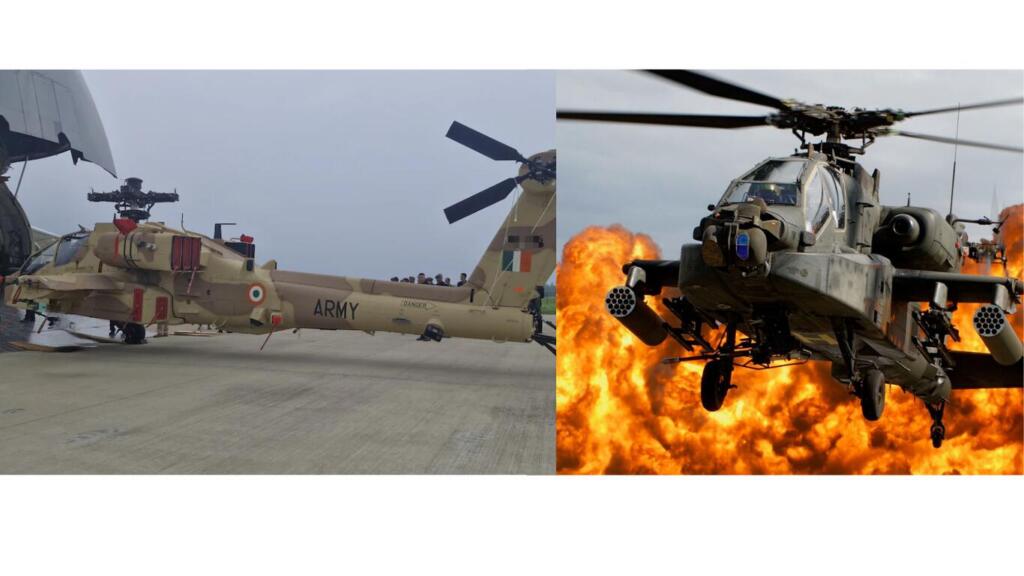
The Indian Army’s induction of Boeing’s AH-64E Apache helicopters near the Pakistan border marks a significant shift in India’s tactical and technological preparedness. These combat-ready helicopters are not just an addition to India’s arsenal—they are a transformative force. Equipped with cutting-edge radar systems, advanced firepower, and unmatched battlefield awareness, the Apache fleet will play a critical role in maintaining superiority along the western front, especially as tensions remain high in the aftermath of Operation Sindoor. The Indian Army today took delivery of the first three of six Apache helicopters, each destined for immediate deployment in forward areas.
The World’s Most Advanced Attack Helicopter Now in Indian Hands
Fifteen months after a dedicated squadron was raised in Jodhpur, the Indian Army’s Apache helicopters—built by Boeing and sporting desert camouflage—are now operational. These helicopters, featuring fuselages manufactured through a Tata-Boeing joint venture in Hyderabad, will work alongside India’s indigenous Dhruv Rudra and Prachand rotorcraft. However, the Apache brings an edge that redefines the battlefield.
The AH-64E Apache is widely considered the world’s most lethal attack helicopter. Its heavily armed configuration includes a 30 mm M230 chain gun, 70 mm Hydra rockets, and the AGM-114 Hellfire missile, capable of destroying enemy armour and bunkers from over six kilometres away. Additionally, it carries air-to-air Stinger missiles, enabling it to neutralize aerial threats such as enemy helicopters and UAVs. The Indian Army and Indian Air Force (IAF) variants are identical, making interoperability across forces seamless.
The Longbow Radar: Apache’s Most Feared Capability
What truly sets the Apache apart is its AN/APG-78 Longbow radar mounted above the main rotor. Roughly half of India’s Apache fleet—both for the Army and Air Force—is equipped with this mast-mounted, millimetre-wave radar. Capable of tracking up to 128 ground targets and prioritising 16 at once, this radar enables the Apache to remain hidden behind terrain while scanning and assigning targets. In essence, it can detect and strike without being exposed.
Combined with infrared sensors, night vision systems, and pilot helmet-mounted displays, this gives the Apache the unique ability to strike with precision even in pitch-dark or high-conflict environments. The psychological effect of such a platform being stationed near the Pakistan border cannot be overstated—it serves as a constant deterrent, limiting enemy movements and forcing Pakistan to rethink any misadventure.
Network-Centric Warfare and Real-Time Battlefield Awareness
One of the lesser-known but equally potent strengths of the Apache is its ability to operate in a networked combat environment. The Indian Army’s AH-64Es are equipped to receive live sensor feeds from unmanned aerial vehicles (UAVs), thereby extending the pilot’s situational awareness far beyond the immediate visual range. This feature enables Apache pilots to identify, track, and coordinate attacks on multiple targets in real-time, all while sharing critical targeting data with other battlefield units and commanders.
For the Indian Army, this marks a generational leap in helicopter warfare. It allows the Apaches to engage in precision strikes on terror launch pads, logistics hubs, and enemy radar systems, all while reducing risks to human life and aircraft assets.
India’s Western Front Gets a Firepower Boost
The induction of Apache helicopters is more than a symbolic step—it comes at a strategically vital moment. With threats lingering on the western border, and India’s internal counterterror operations intensifying, the Apache gives Indian commanders the ability to carry out swift, targeted missions deep inside hostile zones. Its survivability features, including armoured crew compartments, crash-resistant fuel systems, and hardened rotors, mean it can take a hit and still return home.
The Indian Army’s current order of six Apaches is only the beginning. There is strong indication that the order will increase to at least 18 in the coming months, bolstering India’s defensive and offensive rotorcraft capabilities even further.
Apache’s Arrival Marks a New Era in India’s Border Defence
With the AH-64E Apache now operational along the Pakistan border, the Indian Army has gained a decisive edge in combat readiness. Its unmatched firepower, superior sensors, and battlefield integration abilities position it as a core pillar of India’s evolving military doctrine. At a time when cross-border threats are real and persistent, the Apache’s presence not only boosts tactical strength but also reinforces India’s long-term strategic deterrence.
This is not just about matching capabilities with adversaries—it’s about setting the standard. And with Apache, India has raised the bar.