
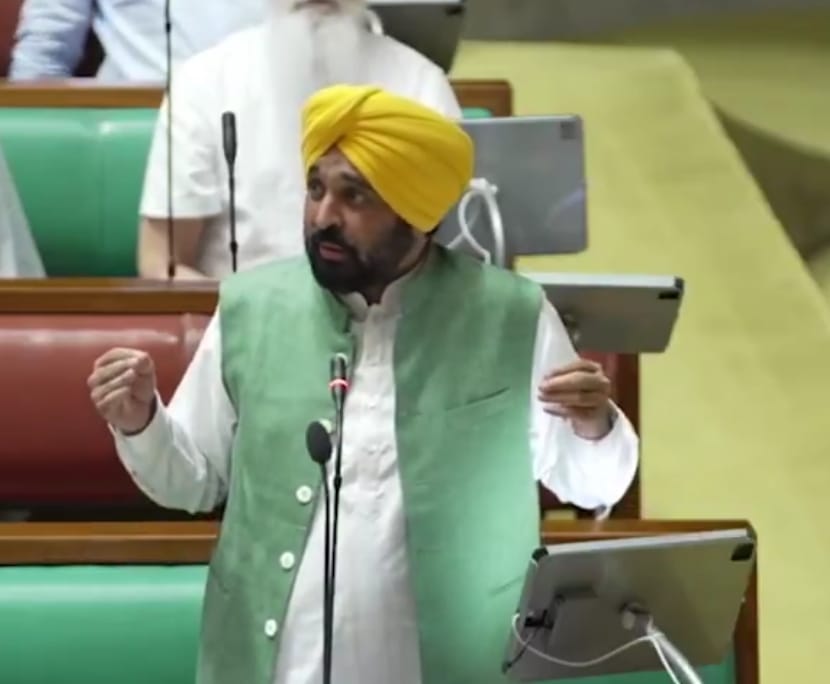
Over nine years after the desecration of the Guru Granth Sahib in Bargari shocked Punjab’s collective conscience, the state has finally introduced what it calls India’s first comprehensive anti-sacrilege law. The Punjab Prevention of Offences Against Holy Scripture(s) Bill, 2025, passed by the Punjab Cabinet, proposes life imprisonment for desecrating any religious scripture.
While Chief Minister Bhagwant Mann hailed the move as a ‘historic moment’ for preserving communal harmony, critics say the legislation is less about justice and more about political optics, majoritarian appeasement, and possibly even tools for suppressing minorities.
The law, many argue, is dangerously vague, legally redundant, and politically timed- not to bring healing, but to silence dissent, intimidate minority communities, and deflect from AAP’s own governance failures over the past three years.
A Decade of Delay, Then a Sudden Bill
AAP came to power in Punjab in 2022 promising decisive justice in sacrilege cases. Yet not a single major conviction has materialized. Investigations into past incidents, including Bargari, Behbal Kalan, and Kotkapura, have languished.
It was only after activist Gurjeet Singh Khalsa staged a nearly 280-day protest atop a mobile tower that the government finally introduced the bill, indicating that the legislation emerged from pressure, not policy, and certainly not from any principled urgency.
Sweeping Definitions, Steep Punishments
The Bill criminalizes the desecration of any part of a holy scripture of any faith. It proposes:
Life imprisonment for desecration
₹5–10 lakh fine for basic offences
20 years to life if sacrilege leads to communal violence or death
No parole, no furlough for convicts
Parents or guardians held liable for acts committed by minors
Special penalties for religious functionaries like granthis, maulvis, and priests
The offences are non-bailable, non-compoundable, and cognizable, with investigations permitted only by police officers of DSP rank or above.
At first glance, the law appears to be inclusive; mentioning the Guru Granth Sahib, Quran Sharif, Bible, Bhagavad Gita, and other holy books. But many civil rights advocates say the danger lies not in what is written, but in how the law might be enforced.
Vague Language, Targeted Impact?
Legal experts warn that the broad definitions of sacrilege, which include any ‘wilful insult’ to scriptures, are ripe for misuse. Who decides what qualifies as insult? Will quoting a verse out of context be criminalized? Could satire, critique, or theological debate be equated with blasphemy?
The risk, say minority groups, is that interpretation will not be neutral.
‘There is deep worry in Christian and Muslim communities that this law will be applied selectively,’ said a human rights lawyer in Ludhiana. ‘What we’ve seen in the past is that minority faith groups, pastors, and even Dalit preachers are often the ones charged when ‘hurt sentiments’ are invoked.’
In recent years, pastors have been arrested for distributing religious literature, and Muslim leaders have faced FIRs for social media posts. The fear is that this law could now become a state-sanctioned blasphemy code, not unlike those seen in Pakistan, weaponized not to protect religious freedom, but to curb it.
Suppressing Dissent Through ‘Sacrilege’
The concern is not merely religious, it’s also political. The ambiguity in the Bill’s language could give authorities tools to silence activists, scholars, and artists. A social media post, a university seminar, or even a protest slogan could be twisted into a case of sacrilege, say civil liberties groups.
‘What starts as protection of faith may easily become suppression of thought,’ said Jaspreet Kaur, a Supreme Court lawyer and former academic. ‘This government has already shown little tolerance for criticism. With this law, they now have the power to arrest you in the name of protecting religion.’
Some point out that Punjab already has legal provisions under the Bharatiya Nyaya Sanhita (BNS) Sections 298–300, which penalize deliberate religious provocation. ‘Instead of enforcing what already exists,’ said Kaur, ‘AAP has chosen a theatrical new law, loaded with moral panic and legal vagueness.’
A Step Toward Justice or Electoral Engineering?
AAP’s timing has also drawn political suspicion. The bill was rushed in a special Assembly session, with only a two-hour debate window. Opposition leader Partap Singh Bajwa questioned the intent: ‘This government had three years to act. Why now? Why in such a hurry? And why without consultation?’
Bajwa reminded the House that a similar bill was passed by the Congress in 2018 but was rejected by the Centre for being specific to one faith. AAP’s version has now been reframed but critics say it’s still crafted with one community in mind, using token references to other faiths for legal cover.
‘It’s a political insurance policy wrapped in the language of religious sanctity,’ said a former judge on condition of anonymity. ‘This is about placating the majority Sikh vote bank while projecting moral authority. It’s not about justice. It’s about 2027.’
Religious Sentiment or Religious Control?
In Sikhism, baedbi is not merely disrespect, it is desecration of the eternal Guru. The pain caused by the sacrilege of the Guru Granth Sahib cannot be overstated. But pain must not be manipulated into policy without safeguards.
Religious minorities, legal experts, and civil society groups are asking the same question: Will this law protect people of all faiths equally or become a tool for the state to enforce selective sanctity and suppress dissent?
What Lies Ahead
The Bill has been referred to a Select Committee by the Punjab Legislative Assembly. Meanwhile, CM Mann has promised swift passage once ‘technicalities’ are addressed. But the bigger concern remains: Does this law represent the closing of a painful chapter or the opening of a dangerous one?
As Punjab grapples with this uneasy mix of religious reverence and political reality, one thing is clear, justice for past sacrilege victims is still pending, and the fear of future misuse looms large.